

Article
C. Raja Mohan, Darshana M. Baruah
{
  "authors": [
    "C. Raja Mohan"
  ],
  "type": "legacyinthemedia",
  "centerAffiliationAll": "dc",
  "centers": [
    "Carnegie Endowment for International Peace",
    "Carnegie China",
    "Carnegie India"
  ],
  "collections": [],
  "englishNewsletterAll": "ctw",
  "nonEnglishNewsletterAll": "",
  "primaryCenter": "Carnegie India",
  "programAffiliation": "SAP",
  "programs": [
    "South Asia"
  ],
  "projects": [],
  "regions": [
    "South Asia",
    "India",
    "East Asia"
  ],
  "topics": [
    "Security",
    "Foreign Policy"
  ]
}
Source: Getty
As the world prepares to mark the anniversaries of the First and Second World War, the two great wars have acquired a peculiar political resonance in East Asia.
Source: Indian Express
The First World War began a century ago the Second World War drew to a close nearly 70 years ago. As the world prepares to mark these anniversaries, the two great wars have acquired a peculiar political resonance in East Asia.
In a region where China is flexing its impressive military muscle in multiple maritime territorial disputes with its neighbours and Japan is reclaiming its place in the Asian sun, the presumed lessons from the two wars are being evoked widely to describe the dangers of the current tensions in the region.In an interview to the ‘New York Times’ this week, the president of the Philippines, Benigno Aquino compared China to Nazi Germany and warned the world against appeasing China by accepting its aggressive territorial claims in the contested waters of East Asia.
As the Philippines lost control over some of the waters it claims to the Chinese navy over the last couple of years, neither Manila’s regional partners in the ASEAN nor the United States, its long-standing military ally, were ready to stand up and be counted.
No wonder, Aquino was recalling the Western acceptance of Germany’s territorial demands in the run up to the Second World War. “At what point do you say, ‘Enough is enough’? Well the world has to say it–remember that the Sudetenland was given in an attempt to appease Hitler”. China reacted angrily by denouncing Aquino’s remarks as senseless and calling the Filipino president as “ignorant of both history and reality”.
Beijing, of course, is not averse to using the Second World War to justify its territorial claims against Japan in the East China Sea. Amidst the mounting tensions with Tokyo over small islands called Senkakus in Japan and Diaoyu in China, Beijing has argued that accepting Japanese claims will be tantamount to overthrowing the peace arrangements that followed the Second World War.
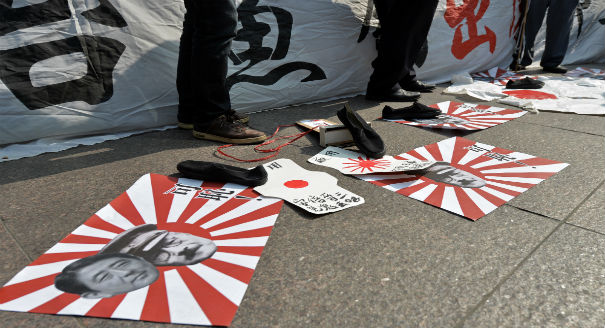
North Korea, meanwhile, has called the Japanese Prime Minister Shinzo Abe as Asia’s Hitler in a reference to Japan’s efforts to revitalise its military capabilities. Many in South Korea, which rarely agrees with the North, are as vehement in deploring Abe’s policies.
On his part, Abe has argued that the growing distrust between Japan and China today is similar to that between Britain and Germany in the First World War. Abe was drawing attention of the world business community at Davos last month to the prospects for an unwanted war between Japan and China as their militaries try to stare each other down in the East China Sea.
Scholars of international relations point to the dangers of simplistic evocation of historical analogies. Circumstances separated by time, space and geography are unlikely to produce similar outcomes. That, of course, has never stopped political leaders from trying to use history for immediate political ends.
India, which contributed a big part in shaping the outcomes of the two wars, seems blissfully unaware of the importance of the two anniversaries and is paying little attention to the arguments in East Asia. Turning a deaf ear to the nationalist passions in East Asia is not going to save India from the consequences of new Asian wars that now seem increasingly probable.
This article was originally published in the Indian Express.
Former Nonresident Senior Fellow, Carnegie India
A leading analyst of India’s foreign policy, Mohan is also an expert on South Asian security, great-power relations in Asia, and arms control.
Recent Work

C. Raja Mohan, Darshana M. Baruah


Alexander Gabuev, Paul Haenle, C. Raja Mohan, …
Carnegie does not take institutional positions on public policy issues; the views represented herein are those of the author(s) and do not necessarily reflect the views of Carnegie, its staff, or its trustees.

The new U.S.–Denmark–Greenland agreement will help Washington exert political, economic, and financial dominance under the guise of security. Yet, it acknowledged Copenhagen’s and Nuuk’s sovereignty on the island.

Marc Pierini

A summer of escalation in the Black Sea has hurt Ukraine economically and is exacerbating world food security. A truce is needed—as is a broader reframing of Europe’s Ukraine strategy.

Thomas de Waal

Are Germany’s economic, industrial, and political struggles becoming a liability for the EU’s ability to rise to the geopolitical moment?

Rym Momtaz, ed.

European Commission President Ursula von der Leyen is about to give her annual address on the state of the EU. Here’s what she won’t—but should—say.
Rym Momtaz

The aftermath of the Ceuta crisis shows Europe has drawn the wrong lessons. Rather than doubling down on failed migration policies, the EU needs to address the underlying roots of such episodes.

Richard Youngs