

Commentary
Alexey Malashenko
{
  "authors": [
    "Alexey Malashenko"
  ],
  "type": "commentary",
  "centerAffiliationAll": "",
  "centers": [
    "Carnegie Endowment for International Peace",
    "Carnegie Russia Eurasia Center"
  ],
  "collections": [],
  "englishNewsletterAll": "",
  "nonEnglishNewsletterAll": "",
  "primaryCenter": "Carnegie Russia Eurasia Center",
  "programAffiliation": "",
  "programs": [],
  "projects": [],
  "regions": [
    "Russia"
  ],
  "topics": [
    "Security"
  ]
}
Source: Getty
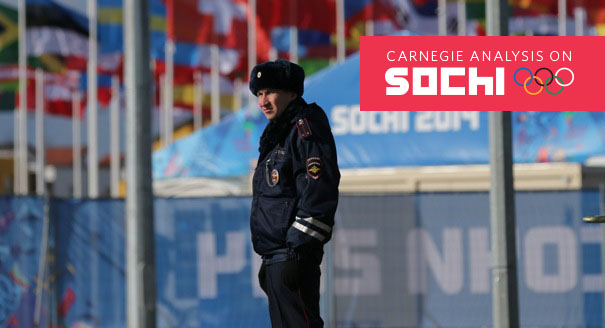
The terrorist threat to the Sochi Olympics may come from individuals who do not belong to organized and at least somewhat known terrorist groups.
Despite President Vladimir Putin’s assurances that the Olympics are guaranteed to be safe, tensions around Sochi remain high and even continue to rise. This is quite understandable, since it is the first time that a sporting event of such magnitude is taking place in close proximity to such an unstable region as the North Caucasus, in a country where terrorist attacks have unfortunately become regular occurrences.
The issue of keeping the Olympics safe attracts more attention than the actual sports component of the games. The Olympics are just about to start, but the games’ participants and spectators are still being asked “Aren’t you afraid to go there?” Russian security forces do everything in their power to prevent terrorist attacks. However, three recent attacks in Volgograd once again highlighted how vulnerable the Russian territory is to acts of terror.
Some reports that surfaced this January informed us of the killing of Doku Umarov, the head of the so-called Caucasus Emirate. Umarov was considered to be the Terrorist Number One, and his organization is believed to be the most powerful Islamic structure, which also operates in Russia’s Muslim regions outside of the North Caucasus, for instance, in Tatarstan. So far, the federal authorities did not confirm his death. In fact, eliminating Umarov was supposed to convince the Olympic tourists yet another time that they have no reason to be afraid to visit Sochi.
On the other hand, which European city can guarantee total safety? Oslo with its Breivik attack could not; neither could Boston after its tragic April marathon blown up by the Tsarnaev brothers.
But if Doku Umarov does not (or did not) pose the main threat to the Olympics, where does the threat come from?
I believe that it may come from lone-wolf terrorists, that is, individuals that do not belong to any structure and operate at their own risk fueled by religious fanaticism, dreams of self-actualization or thirst for revenge against the outside world. Thus, such fanatics are often driven by their personal grievances.
The threat may also come from the ethnic Russian converts to Islam, from those of Slavic descent. Neophytes have historically tried to prove themselves as the most ardent and sincere supporters of their newfound religion. In today’s complex religious and political situation, some of them are tempted to demonstrate their support through extremist activities and martyrdom.
Then, there are so-called “black widows”—former wives of the killed terrorists thirsting for revenge and trying to assert their right to be part of jihad.
The media have recently reported on “ghost” suicide bombers, who appear out of nowhere and are trained by unknown individuals in undisclosed locations. But I think the air of romanticism is out of place here. All this talk of the “ghost terrorists” reveals lack of understanding of the forces that security services, and the rest of us, have to deal with.
Finally, the threat comes from the Russian Islamic militants who fought alongside the Syrian opposition. Some of them returned home, and not only to the North Caucasus but also to the predominantly Muslim part of the Volga Region. Some came to heal old wounds, while others to channel the energy remaining from their Middle Eastern voyage into the terrorist attacks on the Russian territory.
All of the above individuals share one common characteristic: they do not belong to organized and at least somewhat known terrorist groups. These people—of course, if they dare—will mostly act alone. Compared to the “ordinary terrorists,” these individuals are harder to track, let alone destroy. Preventing them from carrying out their attacks is an extremely difficult undertaking, but let us hope that it will happen eventually.
Former Scholar in Residence, Religion, Society, and Security Program
Malashenko is a former chair of the Carnegie Moscow Center’s Religion, Society, and Security Program.
Recent Work
Alexey Malashenko
Alexey Malashenko

Europe’s reaction to the war in Iran has been disunited and meek, a far cry from its previously leading role in diplomacy with Tehran. To avoid being condemned to the sidelines while escalation continues, Brussels needs to stand up for international law.

Pierre Vimont
France has stopped clinging to notions of being a great power and is embracing the middle power moment. But Emmanuel Macron has his work cut out if he is to secure his country’s global standing before his term in office ends.

Rym Momtaz

Despite offering security benefits to candidates and the EU alike, the enlargement agenda appears stalled. Why is progress not being made, and is it time for Europe to rethink its approach?
Sylvie Goulard, Gerald Knaus
Leaning into a multispeed Europe that includes the UK is the way Europeans don’t get relegated to suffering what they must, while the mighty United States and China do what they want.
Rym Momtaz
Carnegie scholars examine the crucial elements of a document that’s radically different than its predecessors.

James M. Acton, Saskia Brechenmacher, Cecily Brewer, …