

Commentary
Dmitri Trenin
{
  "authors": [
    "Dmitri Trenin"
  ],
  "type": "commentary",
  "centerAffiliationAll": "",
  "centers": [
    "Carnegie Endowment for International Peace",
    "Carnegie Russia Eurasia Center"
  ],
  "collections": [],
  "englishNewsletterAll": "",
  "nonEnglishNewsletterAll": "",
  "primaryCenter": "Carnegie Russia Eurasia Center",
  "programAffiliation": "",
  "programs": [],
  "projects": [],
  "regions": [
    "North America",
    "United States",
    "Russia"
  ],
  "topics": [
    "Foreign Policy"
  ]
}
Source: Getty
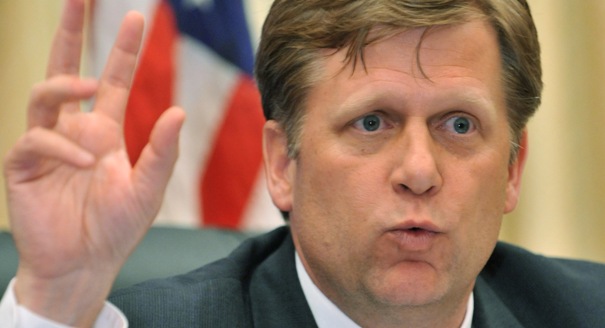
U.S. Ambassador to Moscow Michael McFaul is leaving Russia after just over two years on the job. His departure is symbolic of the many mismatches in U.S.-Russian relations which exist on both sides.
So, now it is official—Michael McFaul is leaving Spaso House, the residence of U.S. ambassadors in Moscow, after just over two years on the job. The architect of President Barack Obama's policy of "reset" with Russia has had a tough time as his representative in Moscow. Partly it was due to a sheer coincidence: on McFaul's first working day in the Russian capital, he met with a group of Russian liberal opposition figures. At the time of mass protests on Bolotnaya Square, this looked to some like the U.S. patron was inspecting and instructing his field commanders in a battle for political power in a foreign country. It did not help that McFaul was merely accompanying his superior, Deputy Secretary of State William Burns, who was following the recent U.S. ritual of meeting with civil activists as well as government officials on foreign trips. Unlike Burns, a career diplomat and a former ambassador to Moscow, McFaul was well known as a scholar and think tanker specializing in political transformations, including revolutions. No wonder Burns was barely mentioned in the Russian reaction, whereas McFaul got the full brunt of it.
Thus, Mike McFaul's ambassadorship was wrong-footed from the start, and it never fully recovered. McFaul was repeatedly harassed by "Nashi" activists and vilified in some media outlets. He fought back: he tweeted, enthusiastically. McFaul's Twitter account had more followers than those of many Russian public figures. He gave interviews, including on Russian television, and in Russian. He made full use of his contacts from the 1990s, when he spent a year as a resident scholar at the Carnegie Moscow Center. He also made new friends, or at least contacts, in high echelons of the Russian government. Open and disarmingly sincere, he was doing his best—in his trademark unconventional manner.
Ambassador McFaul was a very rare bird indeed among Moscow's diplomatic corps. He took the notion of transformational diplomacy seriously. He saw himself as a country-to-country representative rather than a state-to-state one. The state was just one element of it, alongside society. This did not endear McFaul to his hosts, or win applause from some colleagues who viewed the American professor-turned-diplomat with suspicion. McFaul's tenure in Moscow also coincided with increased impact of domestic politics on foreign policy and U.S.-Russian relations, not in the United States, but also in Russia, which was heretofore a preserve for publicity-shy professionals.
When Michael McFaul was nominated by President Obama to serve as U.S. ambassador to Russia, he seemed to be destined to be the most influential ambassador to this country since John Quincy Adams, who served at the court of St. Petersburg before becoming the sixth president of the United States. This time, things did not turn out as many had hoped. The islands of productive U.S.-Russian cooperation on Syria and Iran are surrounded by the sea of official mistrust and prevailing media negativism. The “reset” is history. It is only logical that its architect is now retiring.
This retirement is a personal decision. Michael McFaul never hid his eagerness to go back to Stanford: his years at the White House and Spaso were a diversion, not a career. Yet, his departure is also symbolic of the many mismatches in U.S.-Russian relations which exist on both sides. It may also be symbolic that for quite some time Spaso House may have to stay vacant: the line on Capitol Hill for U.S. Senate confirmation is long. The U.S. ambassador in Moscow, for the last two years the talk of the town, will from now on be more conspicuous by his absence.
Former Director, Carnegie Moscow Center
Trenin was director of the Carnegie Moscow Center from 2008 to early 2022.
Recent Work
Dmitri Trenin
Dmitri Trenin
Carnegie does not take institutional positions on public policy issues; the views represented herein are those of the author(s) and do not necessarily reflect the views of Carnegie, its staff, or its trustees.
The EU had to compromise to adopt a twenty-first sanctions package against Russia, exposing growing cracks in the union’s resolve. Is this latest, weaker round worth it to keep pressure on Moscow?

Rym Momtaz, ed.

Trump is distracted and Ukraine wants Europe to step up. The continent’s leaders must find their voice and assert it in talks with Russia.

Alissa de Carbonnel

Mounting economic strain and battlefield losses will not necessarily make the Kremlin less dangerous. They could instead push Moscow toward a more aggressive hybrid campaign designed to test NATO’s Eastern flank, exploit allied hesitation, and fracture European resolve.

Maksym Beznosiuk

Over the past ten years, NATO has held almost as many summits as it did during the entirety of the Cold War. Are they still useful, or is it time to stop holding annual meetings?
Rym Momtaz, ed.
Nearly a year and a half after Europeans leaned into sucking up to Trump, the strategy has produced some benefits when it comes to Ukraine.
Rym Momtaz