

Report
- +3
James M. Acton, Alexey Arbatov, Vladimir Dvorkin, …
{
  "authors": [
    "Petr Topychkanov"
  ],
  "type": "commentary",
  "centerAffiliationAll": "",
  "centers": [
    "Carnegie Endowment for International Peace",
    "Carnegie Russia Eurasia Center"
  ],
  "collections": [],
  "englishNewsletterAll": "",
  "nonEnglishNewsletterAll": "",
  "primaryCenter": "Carnegie Russia Eurasia Center",
  "programAffiliation": "",
  "programs": [],
  "projects": [
    "Eurasia in Transition"
  ],
  "regions": [
    "North America",
    "United States",
    "Middle East",
    "Iran",
    "Syria",
    "South Asia",
    "Afghanistan",
    "Pakistan",
    "East Asia",
    "China",
    "Russia"
  ],
  "topics": [
    "Security",
    "Military",
    "Foreign Policy"
  ]
}
Source: Getty
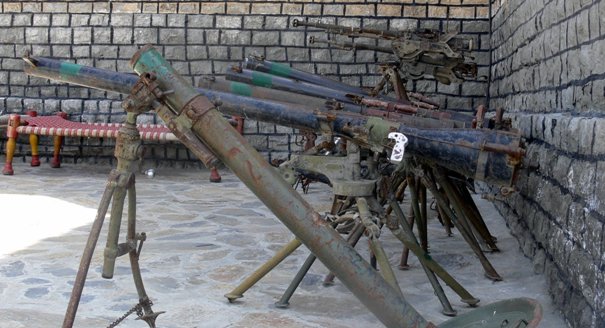
Today, many countries have to fight against terrorist organizations, which have roots in the Soviet war in Afghanistan. However, this lesson is still unlearned: in Syria, fighters under Islamic flags have gained support of several countries, but this support will recoil upon the supporters’ own heads.
25 years ago the last battle forces of the Soviet Union left Afghanistan. Yet it was not the end of the war. After February 15, 1989 there remained about 30 military advisors, including General Makhmut Gareev, who later wrote a book “My Last War” about his service in Afghanistan. In the ten years of the war, the USSR lost about 15,500 its soldiers and officers in Afghanistan, and about 1.5 million Afghans were killed. Nevertheless that war was not a war between the Soviet Union and Afghanistan. This was a war with multiple enemies.
According to Dr. Charles Cogan, Chief of the Near East—South Asia Division in the Operations Directorate of the CIA, 1979-1984, the United States had about one hundred CIA operatives directly involved in Afghan affairs. More than half of them were in “Pakistan and elsewhere.” Cogan argues that from 1979 till 1989 the United States spent about $2 billon only through “covert-action funding for the war.”
Pakistan’s role in that war was overt. Since the mid-1970s, Pakistan initiated support and military training for the Afghan opposition. In the time of the war Pakistan became the central element in the international efforts against the Soviet military presence in Afghanistan. Military training camps were set up on Pakistani territory, and the headquarters of opposition political parties were established in Peshawar. Starting in the early 1980s, Pakistan served as the main transit hub for arms, medicine, and food supplies to the mujahedeen. As for now there are not many known facts about military engagement of the Soviet and Pakistani forces, but these engagements happened on the territory of both Afghanistan and Pakistan.
China was one more active participant in that war. According to Dr. Yitzhak Shichor, Professor at the University of Haifa, it trained several thousand fighters in training camps near Kashgar and Khotan in China’s Xinnjiang province. Chinese supplies of machineguns, rockets launchers, surface-to-air missiles to these fighters could cost from $200 to $400 million. Russian military officers, who served in Afghanistan in 1970s-1980s, confirmed that many Afghan rebels were equipped with Chinese arms.
Iran played its game in Afghanistan as well. According to a declassified assessment of the U.S. Defense Intelligence Agency, in the 1980s Iran supplied rifles, land mines, antitank rockets, heavy machineguns, uniforms and boots to at least Hezb-e-Islami of Gulbuddin Hekmatyar. Since Iran supported even this Sunni party, its assistance to Shiite groups like Harkat-e-Islami was unquestionable.
Besides those mentioned, there were also other indirect participants of the war in Afghanistan, such as Saudi Arabia.
Further developments in Afghanistan demonstrated that all these nations made a bid for wrong groups. Some of the fighters waving Islamist flags in Afghanistan later turned into extremists and terrorists active elsewhere in the region and beyond. Now the United States, Pakistan, China, Iran, and other countries have to fight against terrorist and extremist organizations, which have roots in the war in Afghanistan. Moscow doesn’t gloat at this, since these organizations are a security threat for Russia as well.
So, a quarter-century after the end of the Soviet war in Afghanistan, some of its lessons are still unlearned. The Syrian situation is proving this. Fighters under Islamic flags have gained support of several countries. No doubt, this support will recoil upon the supporters’ own heads, when the fighters and their followers will return to these countries to continue their battle.
Former Fellow, Nonproliferation Program, Moscow Center
Topychkanov was a fellow in the Carnegie Moscow Center’s Nonproliferation Program.
Recent Work

James M. Acton, Alexey Arbatov, Vladimir Dvorkin, …
Petr Topychkanov
Carnegie does not take institutional positions on public policy issues; the views represented herein are those of the author(s) and do not necessarily reflect the views of Carnegie, its staff, or its trustees.

Radical-right parties are expected to do well in upcoming elections in four of the EU's biggest member states. If successful, they could prevent the union from addressing key challenges ahead.

Stefan Lehne

The aftermath of the Ceuta crisis shows Europe has drawn the wrong lessons. Rather than doubling down on failed migration policies, the EU needs to address the underlying roots of such episodes.

Richard Youngs

Canadian Prime Minister Mark Carney has twice inspired praise for standing up to U.S. President Donald Trump: at the 2026 World Economic Forum in Davos and on Canada-U.S. trade negotiations. Is Carney showing a third way better than the EU has in dealing with the Trump administration?

Rym Momtaz, ed.

The EU’s responses to two recent incidents expose the gulf between European perceptions and capabilities. Unless the union can bridge that gap, it will never become a real geostrategic power.
Rym Momtaz

European states control several Overseas Countries and Territories around the world that carry strategic, economic, and environmental weight. As great powers challenge the rules-based order, defending them is a geopolitical imperative for Europe.

Marc Pierini