

Article
Frederic Wehrey, Charles H. Johnson
{
  "authors": [
    "Frederic Wehrey"
  ],
  "type": "legacyinthemedia",
  "centerAffiliationAll": "dc",
  "centers": [
    "Carnegie Endowment for International Peace",
    "Malcolm H. Kerr Carnegie Middle East Center"
  ],
  "collections": [
    "Arab Awakening"
  ],
  "englishNewsletterAll": "menaTransitions",
  "nonEnglishNewsletterAll": "",
  "primaryCenter": "Carnegie Endowment for International Peace",
  "programAffiliation": "MEP",
  "programs": [
    "Middle East"
  ],
  "projects": [],
  "regions": [
    "Middle East",
    "Iran",
    "Bahrain",
    "Saudi Arabia",
    "Gulf"
  ],
  "topics": [
    "Political Reform",
    "Security",
    "Foreign Policy"
  ]
}
Source: Getty
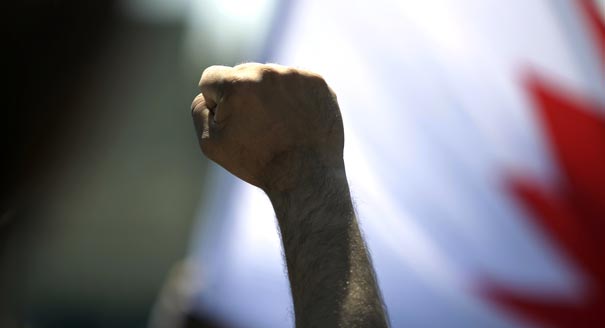
The political impasse of Bahrain is a festering wound in the Gulf. If left unaddressed, it will eventually threaten U.S. assets and people.
Source: National Interest
As President Obama meets with King Abdullah of Saudi Arabia in Riyadh on Friday he will undoubtedly offer reassurances of U.S. solidarity to the panicked kingdom. The two leaders will attempt to mend fences on the divisive regional issues of Egypt, Syria and, especially, Iran. There will public utterances of common ground and commitments to move the relationship forward. But there is another danger lurking just off the Saudi coast that Obama must raise.
The political impasse of Bahrain is a festering wound in the Gulf, the Achilles’ heel of a region that has tried to insulate itself from the forces of change buffeting the rest of the Middle East and from Iranian influence. If left unaddressed, it will eventually threaten U.S. assets and people—particularly the sprawling headquarters of the U.S. Navy’s Fifth Fleet. The urgency of fixing Bahrain, then, is not solely about human rights and aligning U.S. policy with U.S. values. It is about staving off an increasingly violent opposition and, potentially, malign Iranian interference.Obama must deliver a firm message to King Abdullah: compel Bahrain’s ruling Al Khalifa dynasty to make real, substantial progress on reform. Given the enormous funding that Riyadh pours into propping up the Al Khalifa, the Saudis hold unique and unrivaled leverage. The resumption of dialogue between the Bahraini Crown Prince and the Shia opposition bloc al-Wifaq could not have happened without Saudi approval. Pragmatic Saudi interior minister Muhammad bin Nayef has reportedly held frequent meetings with the Crown Prince, as has the leader of the United Arab Emirates, Muhammed bin Zayed. But beyond such contacts and tacit toleration, the degree of active Saudi support for genuine reform in Bahrain is unclear. Oppositionists fear that, as was the case in previous dialogue attempts, the goal now is simply to neutralize the opposition by bringing it back into the parliament without any substantial institutional changes. If the island is to achieve a just and durable peace, sustained Saudi pressure will be a prerequisite for meaningful reform.
The window for action is closing. A militant strand of the Shia opposition led by the February 14 Youth Coalition and the Ashtar Brigades is becoming bolder and more brazen in its attacks against regime security forces. It is not surprising that new, more sophisticated improvised explosive devices have become the currency of this radical strain, And perhaps most worrisome for the U.S., they are growing increasingly hostile to the presence of the Fifth Fleet, which they believe is colluding in the ongoing repression. Angry young men have marched on the Fifth Fleet housing area of Juffeir, burning U.S. flags. Swathes of the capital are now no-go zones for U.S. personnel.
Much has been made of an Iranian hand behind the growing violence. Although real evidence remains elusive, there are increasingly credible reports that Iran may be supplying and training the violent fringes of the Bahraini Shia opposition via proxies in southern Iraq. But more conservative elements in the Al Khalifa and some Saudi voices have charged that the entire Shia opposition is being funded and controlled by Iran. According this narrative, opposition politics on the island is simply an extension of a region-wide Iranian proxy campaign being waged in Syria, Iraq and Lebanon. Such linkage is not only vastly exaggerated but dangerous—it shuts of the possibility of reconciliation, fuels a pernicious sectarianism, and fans the flames of extremism on both sides. But if the current situation is left to fester, the Iranian bogeyman could become a self-fulfilling prophecy. Young Shia oppositionists, unemployed and living in ghetto-like conditions that contrasted sharply with the gleaming buildings of Sunni areas, told me that “when you are denied channels of participation you take assistance from whoever offers it”.
To stave off this scenario, the Saudis must engage the Al Khalifa to enact lasting reforms. The Bahrani regime must develop a roadmap for integrating Shia into the Bahraini security forces. It must release political prisoners who have been jailed for no other offense than calling for peaceful change. And perhaps most importantly they must empower the impotent Bahraini parliament to act as a real legislature that can hold the executive branch to account. The appointed Shura Council, which has long wielded veto power over the legislature, should be either wholly or partially elected. The island’s notorious gerrymandering must be abolished. In return for securing an inevitable majority in parliament, the main Shia bloc, al-Wifaq must hold off on maximalist demands that give ammunition to hardliners in the regime. And it must confront the extremist, violent trend within the opposition’s ranks.
Half measures and cosmetic fixes will no longer suffice for the troubled island. The former Secretary of Defense Gates realized as much when he revealed in his recently published memoirs that he had advised the King and Crown Prince to replace the long-serving and hardline Prime Minister with a more progressive figure. “Baby steps are not enough,” he warned in 2011. Today, as Bahrain sinks deeper into violence, those words appear prophetic—and they are an important message for Mr. Obama to deliver in his coming meeting with the Saudis.
This article was originally published in the National Interest.

Senior Fellow, Middle East Program
Frederic Wehrey is a senior fellow in the Middle East Program at the Carnegie Endowment for International Peace, where his research focuses on governance, conflict, and security in Libya, North Africa, and the Persian Gulf.
Recent Work
Frederic Wehrey, Charles H. Johnson
Frederic Wehrey, Charles H. Johnson
Carnegie does not take institutional positions on public policy issues; the views represented herein are those of the author(s) and do not necessarily reflect the views of Carnegie, its staff, or its trustees.

Canadian Prime Minister Mark Carney has twice inspired praise for standing up to U.S. President Donald Trump: at the 2026 World Economic Forum in Davos and on Canada-U.S. trade negotiations. Is Carney showing a third way better than the EU has in dealing with the Trump administration?

Rym Momtaz, ed.

The EU’s responses to two recent incidents expose the gulf between European perceptions and capabilities. Unless the union can bridge that gap, it will never become a real geostrategic power.
Rym Momtaz

European states control several Overseas Countries and Territories around the world that carry strategic, economic, and environmental weight. As great powers challenge the rules-based order, defending them is a geopolitical imperative for Europe.

Marc Pierini
As we close out another season of Strategic Europe, it is worth taking stock of the deep shifts underway.
Rym Momtaz
The EU had to compromise to adopt a twenty-first sanctions package against Russia, exposing growing cracks in the union’s resolve. Is this latest, weaker round worth it to keep pressure on Moscow?
Rym Momtaz, ed.