

Commentary
Evan A. Feigenbaum
{
  "authors": [
    "Evan A. Feigenbaum"
  ],
  "type": "legacyinthemedia",
  "centerAffiliationAll": "",
  "centers": [
    "Carnegie Endowment for International Peace",
    "Carnegie China"
  ],
  "collections": [
    "China’s Foreign Relations",
    "U.S.-China Relations"
  ],
  "englishNewsletterAll": "",
  "nonEnglishNewsletterAll": "",
  "primaryCenter": "Carnegie Endowment for International Peace",
  "programAffiliation": "",
  "programs": [],
  "projects": [],
  "regions": [
    "North America",
    "United States",
    "East Asia",
    "Southeast Asia"
  ],
  "topics": [
    "Foreign Policy"
  ]
}
Source: Getty
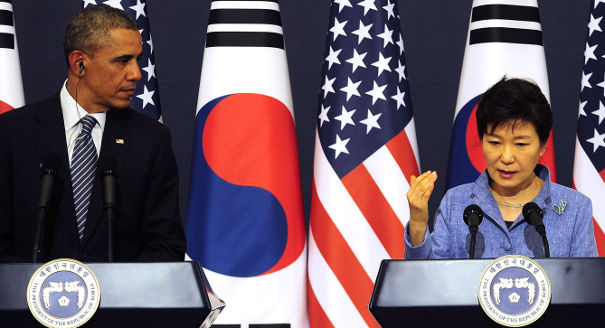
The idea that the United States at some point left Asia and only now is pivoting back to it under President Obama is inaccurate and unhelpful.
Source: U.S. News & World Report
The United States has been a Pacific power for 150 years by virtue of geography, history and vital national interests. And since 1945, the United States has been the principal player assuring Asia’s security and prosperity. Washington has provided military security through its alliances and military presence. It has provided economic security by offering a market into which Asian countries could export, and thus grow and prosper.
For these reasons, the idea that the United States somehow “left” Asia and only now is “pivoting” back to it under President Obama is inaccurate and unhelpful. In fact, American activities in Asia are longstanding and well established. And nearly everything President Obama is doing is consistent with, or builds upon, that longstanding U.S. role.
But it is absolutely correct to say that the United States has vital economic and security interests in Asia, including an abiding interest in open trade. That interest, in turn, depends on assuring freedom of navigation in international waters, an important mission for the U.S. Navy and one that China, in particular, has, in some ways, begun to challenge.Why should the United States care about Asia? For perspective, start with six countries that meet in Northeast Asia — China, Japan, South and North Korea, the United States, and Russia. Together, these comprise about 45 percent of global gross domestic product. They include the world’s three largest economies and hold some 50 percent of global foreign exchange reserves. They are its largest consumers of energy, its largest emitters of greenhouse gases, and, with the exception of France and India, the world’s leading proponents of civil nuclear power. They include major nuclear weapons states, three of five permanent members of the United Nations Security Council, and some of the world’s principal sources of patents for technological innovation. And North Korea is a threat to the peace of the world, developing nuclear weapons and ballistic missiles, and threatening to export both.
Now throw in Southeast Asia and India: That means another $4 trillion of nominal GDP, another major nuclear weapons state, and the world’s most heavily trafficked maritime trade routes and sea lanes. Put bluntly, what happens in Asia affects the United States in tangible ways.
But using the word “pivot” is unfortunate for several reasons:
First, it makes no sense to argue that the only way to pursue American interests in Asia is to “pivot” away from other parts of the world. Who thinks that an Iran with nuclear weapons, or an unstable Pakistan, or European economic stability, or the rise of extremism around the world matters “less” to U.S. interests than what happens in Asia? The U.S. is a global power and cannot simply “pivot” away from other difficult challenges.
Second, American allies, in particular, count on continuity of commitment. If the U.S. can pivot to Asia, then, quite logically, it can pivot away again. The metaphor of a “pivot” makes the United States sound like a power with attention deficit disorder. How reassuring is it to allies and partners to hear the United States described this way?
The U.S. faces new challenges in Asia, including the rise of Chinese power, growing nationalisms, territorial disputes and slowing economies. But the fundamentals that have guided American policy since 1945 still apply: military strength, close alliances, diplomatic activism, a commitment to free trade, the defeat of protectionism, and strong economic and fiscal fundamentals at home.
This article was originally published in U.S. News & World Report.

Vice President for Studies
Evan A. Feigenbaum is vice president for studies at the Carnegie Endowment for International Peace, where he oversees work at its offices in Washington, New Delhi, and Singapore on a dynamic region encompassing both East Asia and South Asia. He served twice as Deputy Assistant Secretary of State and advised two Secretaries of State and a former Treasury Secretary on Asia.
Recent Work
Evan A. Feigenbaum
Evan A. Feigenbaum
Carnegie does not take institutional positions on public policy issues; the views represented herein are those of the author(s) and do not necessarily reflect the views of Carnegie, its staff, or its trustees.
As we close out another season of Strategic Europe, it is worth taking stock of the deep shifts underway.

Rym Momtaz

The hybrid warfare landscape is evolving rapidly, leaving policymakers without clear strategies. To better inform their work in addressing emerging challenges, governments must dig deeper into the underlying dynamics at play.


Raluca Csernatoni, Alicia Wanless
The EU had to compromise to adopt a twenty-first sanctions package against Russia, exposing growing cracks in the union’s resolve. Is this latest, weaker round worth it to keep pressure on Moscow?
Rym Momtaz, ed.

Trump is distracted and Ukraine wants Europe to step up. The continent’s leaders must find their voice and assert it in talks with Russia.

Alissa de Carbonnel

Mounting economic strain and battlefield losses will not necessarily make the Kremlin less dangerous. They could instead push Moscow toward a more aggressive hybrid campaign designed to test NATO’s Eastern flank, exploit allied hesitation, and fracture European resolve.

Maksym Beznosiuk