

Article
Thomas de Waal
{
  "authors": [
    "Thomas de Waal"
  ],
  "type": "commentary",
  "centerAffiliationAll": "",
  "centers": [
    "Carnegie Endowment for International Peace",
    "Carnegie Europe",
    "Carnegie Russia Eurasia Center"
  ],
  "collections": [],
  "englishNewsletterAll": "",
  "nonEnglishNewsletterAll": "",
  "primaryCenter": "Carnegie Europe",
  "programAffiliation": "",
  "programs": [],
  "projects": [],
  "regions": [
    "Caucasus",
    "Russia",
    "Georgia"
  ],
  "topics": [
    "Political Reform",
    "Foreign Policy"
  ]
}
Source: Getty
Abkhazia is in crisis, but it is not a spillover from events in Ukraine. This is overwhelmingly a local crisis. For the past 20 years Abkhazia has lived in a world of its own.
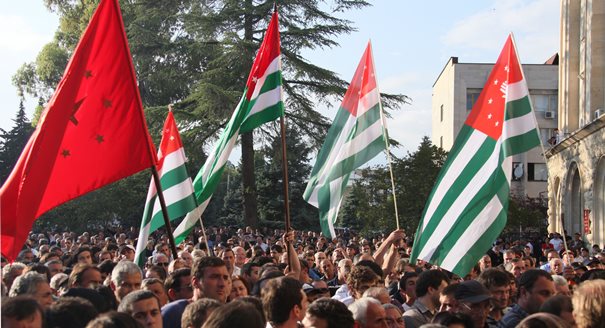
Abkhazia is in crisis. Late on May 27, the opposition took over the presidential administration building and Abkhaz President Alexander Ankvab left the city. Later the Abkhaz parliament passed a resolution of no-confidence in the prime minister and called on the president to resign.
It is tempting to see the current crisis as a spillover from events in Ukraine. That would be a mistake. This is overwhelmingly a local crisis. For the past 20 years, since it de facto broke away from Georgia, Abkhazia has lived in a world of its own.
Since he was elected in 2011, Ankvab has alienated a lot of this political class with a reputation for being aloof and indifferent to their problems.
Ankvab has had a bad six months. The Sochi Olympics, which Abkhaz hoped would bring an economic boon to the republic, were a disappointment and actually produced the opposite effect.
Russia’s annexation of Crimea also means that Moscow now controls a much more strategically valuable and reliable slice of the Black Sea coast, which lessens Abkhazia’s relative importance. Russian state money and tourism revenues which might have gone to Abkhazia are now likely to be diverted to Crimea.
The opposition is a diverse group and hard to characterize. One die-hard nationalist Russian commentator, has alleged—incredibly—that they are the instigators of a Western-backed coup.
Others see them as being backed by Moscow as a more reliable alternative than the difficult Ankvab—although the truth is probably that both the president and opposition have their patrons in Russia.
Two things can be said about the opposition with certainty. One is that most of them are disgruntled for being shut out of political office. Opposition leader Raul Khajimba is the perpetual nearly-man of Abkhaz politics having failed to win the presidency in 2004, when he was backed by Moscow, and again in 2011—when he was not. These men have also lost out by not getting access to the republic’s limited economic resources. The recent announcement of plans for oil exploration off the Abkhaz coast may have especially enraged them.
The second common denominator about the opposition is that they are generally more ethno-nationalist. They have made waves over the issue of plans for distribution of Abkhaz passports to the up to 50,000 ethnic Georgians living an uncertain existence in Gali district adjoining western Georgia. They allege that these Georgians, most of whom also have Georgian passports, could become a “fifth column.”
The immediate focus in the coming days will be on whether Ankvab and the opposition can agree on a political solution, perhaps through early elections. A longer-term concern is that Gali does not become the location of a new political—or even worse physical—battleground.

Senior Fellow, Carnegie Europe
Thomas de Waal is a senior fellow at Carnegie Europe, specializing in Eastern Europe and the Caucasus.
Recent Work
Thomas de Waal
Thomas de Waal
Carnegie does not take institutional positions on public policy issues; the views represented herein are those of the author(s) and do not necessarily reflect the views of Carnegie, its staff, or its trustees.

Are Germany’s economic, industrial, and political struggles becoming a liability for the EU’s ability to rise to the geopolitical moment?

Rym Momtaz, ed.

European Commission President Ursula von der Leyen is about to give her annual address on the state of the EU. Here’s what she won’t—but should—say.
Rym Momtaz

The aftermath of the Ceuta crisis shows Europe has drawn the wrong lessons. Rather than doubling down on failed migration policies, the EU needs to address the underlying roots of such episodes.

Richard Youngs

Canadian Prime Minister Mark Carney has twice inspired praise for standing up to U.S. President Donald Trump: at the 2026 World Economic Forum in Davos and on Canada-U.S. trade negotiations. Is Carney showing a third way better than the EU has in dealing with the Trump administration?
Rym Momtaz, ed.

The EU’s responses to two recent incidents expose the gulf between European perceptions and capabilities. Unless the union can bridge that gap, it will never become a real geostrategic power.
Rym Momtaz