

In The Media
Lina Khatib
{
  "authors": [
    "Lina Khatib"
  ],
  "type": "other",
  "centerAffiliationAll": "dc",
  "centers": [
    "Carnegie Endowment for International Peace",
    "Malcolm H. Kerr Carnegie Middle East Center"
  ],
  "collections": [],
  "englishNewsletterAll": "menaTransitions",
  "nonEnglishNewsletterAll": "",
  "primaryCenter": "Malcolm H. Kerr Carnegie Middle East Center",
  "programAffiliation": "MEP",
  "programs": [
    "Middle East"
  ],
  "projects": [],
  "regions": [
    "Gulf",
    "Middle East"
  ],
  "topics": [
    "Economy",
    "Political Reform",
    "Democracy"
  ]
}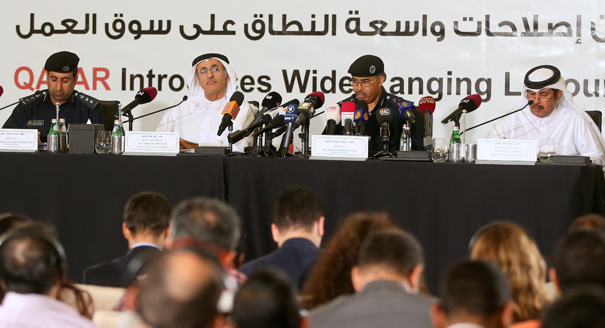
Source: Getty
The richest country in the world in terms of GDP per capita, Qatar has been performing well in global anti-corruption indices. However, one should consider how the indices define corruption.
Source: ANTICORRP
Qatar is judged by international anti-corruption indices to be among the highest performing countries in the Middle East and North Africa. The Qatari government has streamlined its regulations regarding business practices and engaged in reforms from above that have liberalized the Qatari economy and increased its strength and viability. However, Qatar is a neo-patrimonial absolute monarchy in which the state is not immune from private interests, and where the ruling family can bypass the rule of law. The complete control by the monarch of state institutions and policies leaves no space for bottom-up calls for reform, or for independent assessment of the performance of the state and the actions of the ruling family by civil society and the media. The permeation of informal networks (mainly in the form of tribal relations) within state institutions and civil society, the lack of interest in and avenues for political participation among Qatari citizens, and the clientelistic relationship between citizens and the state support the continuation of this status quo. This paper analyzes the structures and mechanisms of Qatar’s governance regime that reveal the contradictions inherent within the categories covered by anti-corruption indices. In doing so, it suggests a number of shortcomings in the methodologies and scope of those indices as they specifically apply to Qatar, and poses a number of questions regarding the kind of information that is difficult to find but which is crucial to address in order to form a clearer picture of corruption and anti-corruption practices in Qatar. The paper concludes that the absence of this information in the first place casts a shadow of doubt over the performance of Qatar in anti-corruption indices. Also, the indices’ focus on measuring the scope of state functions while not measuring the strength of state institutions is a key reason behind the discrepancy between Qatar’s anti-corruption ranking and the mechanisms and structure of its governance regime. Instead, the paper proposes specific indicators related to the governance regime that allow for a more comprehensive look at corruption and anti-corruption practices in Qatar.This paper was originally published by ANTICORRP.
Former Director, Middle East Center
Khatib was director of the Carnegie Middle East Center in Beirut. Previously, she was the co-founding head of the Program on Arab Reform and Democracy at Stanford University’s Center on Democracy, Development, and the Rule of Law.
Recent Work
Lina Khatib
Lina Khatib
Carnegie does not take institutional positions on public policy issues; the views represented herein are those of the author(s) and do not necessarily reflect the views of Carnegie, its staff, or its trustees.

With its public finances in shambles, the far right polling at 35 percent ahead of the 2027 presidential election, and a growing protest movement, is France’s crisis a threat to the EU’s geopolitical awakening?

Rym Momtaz, ed.

A notable degree of participative democracy has firmly arrived in Europe. But to have more far-reaching impact, democratic deliberation needs to move into a radically new phase.

Richard Youngs

The European Commissioner for Trade is headed to China. But after President Xi’s bridge-building visit to Washington, can a more isolated EU overcome Beijing’s stranglehold on critical raw materials? Who will blink first?
Rym Momtaz, ed.

The domestic impacts of how long it is taking to end the war in Ukraine have pushed the French electorate to the political extremes and compromised the country’s diplomatic capacity.
Rym Momtaz

Before the next wave of EU enlargement takes place, the union needs to grapple with thorny questions of how power is distributed among its members.


Emil Sondaj Hansen, Ditte Brasso Sørensen