

In The Media
Lina Khatib
{
  "authors": [
    "Lina Khatib"
  ],
  "type": "legacyinthemedia",
  "centerAffiliationAll": "dc",
  "centers": [
    "Carnegie Endowment for International Peace",
    "Malcolm H. Kerr Carnegie Middle East Center"
  ],
  "collections": [],
  "englishNewsletterAll": "menaTransitions",
  "nonEnglishNewsletterAll": "",
  "primaryCenter": "Malcolm H. Kerr Carnegie Middle East Center",
  "programAffiliation": "MEP",
  "programs": [
    "Middle East"
  ],
  "projects": [],
  "regions": [
    "Gulf",
    "Levant",
    "Iraq",
    "North America",
    "United States",
    "Middle East",
    "Syria"
  ],
  "topics": [
    "Political Reform",
    "Security",
    "Foreign Policy",
    "Military"
  ]
}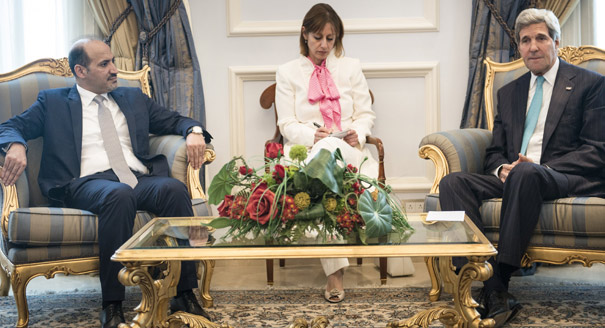
Source: Getty
It is time for the United States to take responsibility for the failures of its Middle East policies.
Source: Al Jazeera
Failed US policy toward the Syrian conflict plays a large role in the current Iraq crisis. As the advance of the Islamic State of Iraq and the Levant (ISIL) has shown, the Iraq problem cannot be understood in isolation from Syria. This means that the United States cannot be effective in its engagement in Iraq unless it addresses both crises simultaneously.
US President Barack Obama's remarks on June 19, in which he addressed US foreign policy vis-a-vis the region, spoke of the need to protect US strategic interests in Iraq. In addition to several contradictions, there was an elephant in the room - the failure of US foreign policy in both Iraq and Syria thus far.
Obama said that “only leaders that can govern with an inclusive agenda are going to be able to truly bring the Iraqi people together.” This raises the question as to why it is only now, as the Iraqi Prime Minister Nouri al-Maliki enters his third term in government, that the US has seemingly become aware of his lack of inclusiveness.Maliki’s divisive policies led even those who had been allied with the US against al-Qaeda during the 2007-2008 US army surge in Iraq, to now turn to ISIL. The US should have used its relationship with the Iraqi government to push for the implementation of measures of accountability and inclusiveness.
Insufficient support for the moderate opposition from the beginning of the crisis has also contributed to the rise of extremist groups who have ended up not only threatening Syria’s moderates, but also upstaging them, so that for the uninformed outside observer - such as many US citizens - Syria seems to have two choices: either Assad or ‘Islamist extremists.’
Obama also said that “it is in our national security interests not to see an all-out civil war inside of Iraq, not just for humanitarian reasons, but because that ultimately can be destabilizing throughout the region.”
One cannot help but be reminded of the situation in Syria, and how backtracking by the US on its engagement in the Syria file contributed to the 2011 uprising becoming an all-out civil war. Even then, the US continued to do very little to prevent this war from escalating into a scenario of regional destabilization, of which the current Iraq crisis is a vivid example.
The Obama speech continued with the assurance that “we also have an interest in making sure that we don't have a safe haven that continues to grow for ISIL and other extremist jihadist groups.”
Although the US is now working with Gulf partners to halt support for extremist groups, it is the weakness of US policy that helped such groups to thrive. When the US role diminishes, that space is left for regional actors to expand their scope of influence, and until very recently, extremist groups other than ISIL, like Jabhat al-Nusra, have been the method of choice for both Qatar and Saudi Arabia in trying to eradicate the Assad regime. The lack of a decisive foreign policy on Syria has also allowed the conflict to drag on, granting ISIL time to grow and expand. All this has meant that the US has made itself less relevant in the region.
But perhaps the greatest contradiction lay in the statement that the US “had already tried to maximize what we can do to support a moderate opposition” in Syria. The level of support that the Syrian moderate opposition, namely the Free Syrian Army, has received from the US has not been sufficient. Neither the military nor the political support offered by the US has been at the level required to tip the balance in favor of the moderate opposition and push the conflict towards resolution.
Insufficient support for the moderate opposition from the beginning of the crisis has also contributed to the rise of extremist groups who have ended up not only threatening Syria's moderates, but also upstaging them, so that for the uninformed outside observer - such as many US citizens - Syria seems to have two choices: either Assad or “Islamist extremists.”
Saying that the US has “tried to maximize” what it “can do” also puts the blame squarely on the moderate opposition and on actors and factors other than the US, painting the US as a helpless benefactor that has ultimately given up trying.
Halting the advance of ISIL in Iraq is a shared burden for the US, the Iraqi government and regional powers in the Middle East. Now is the time for the US to stop hiding behind its finger and take responsibility for the failures of its Middle East foreign policy. A significant change in words and actions is the only way the US can push the Syrian and Iraqi conflicts to end, protect its strategic interests in the Middle East, and reclaim its political currency.
Former Director, Middle East Center
Khatib was director of the Carnegie Middle East Center in Beirut. Previously, she was the co-founding head of the Program on Arab Reform and Democracy at Stanford University’s Center on Democracy, Development, and the Rule of Law.
Recent Work
Lina Khatib
Lina Khatib
Carnegie does not take institutional positions on public policy issues; the views represented herein are those of the author(s) and do not necessarily reflect the views of Carnegie, its staff, or its trustees.

Trump is distracted and Ukraine wants Europe to step up. The continent’s leaders must find their voice and assert it in talks with Russia.

Alissa de Carbonnel

Mounting economic strain and battlefield losses will not necessarily make the Kremlin less dangerous. They could instead push Moscow toward a more aggressive hybrid campaign designed to test NATO’s Eastern flank, exploit allied hesitation, and fracture European resolve.

Maksym Beznosiuk
Over the past ten years, NATO has held almost as many summits as it did during the entirety of the Cold War. Are they still useful, or is it time to stop holding annual meetings?

Rym Momtaz, ed.

As the EU confronts profound challenges, several leaders have called for fundamental reform to the union’s model—but only modest, superficial changes have resulted. What if Europe really could be reimagined from zero today: What should such a redesigned European order look like?

Richard Youngs, ed.
Nearly a year and a half after Europeans leaned into sucking up to Trump, the strategy has produced some benefits when it comes to Ukraine.
Rym Momtaz