

Commentary
Dmitri Trenin
{
  "authors": [
    "Dmitri Trenin"
  ],
  "type": "commentary",
  "centerAffiliationAll": "",
  "centers": [
    "Carnegie Endowment for International Peace",
    "Carnegie Russia Eurasia Center"
  ],
  "collections": [],
  "englishNewsletterAll": "",
  "nonEnglishNewsletterAll": "",
  "primaryCenter": "Carnegie Russia Eurasia Center",
  "programAffiliation": "",
  "programs": [],
  "projects": [],
  "regions": [
    "North America",
    "South America",
    "Russia"
  ],
  "topics": [
    "Foreign Policy"
  ]
}
Source: Getty
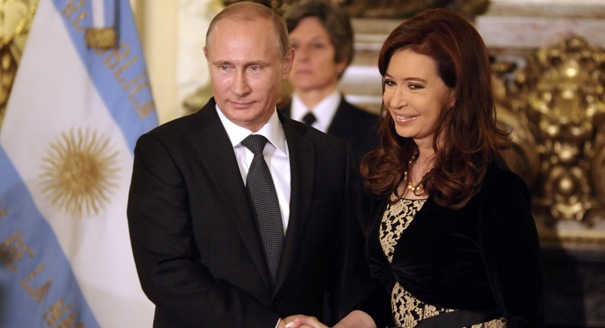
Vladimir Putin's trip to Latin America is aimed to demonstrate several things, both geopolitically and economically. Latin America will undoubtedly add to the agenda of U.S.-Russian relations.
Vladimir Putin's trip to Latin America is aimed to demonstrate several things. One, that Russia is a global, not a regional power, as Barack Obama recently described it. Conferring with leaders in the U.S.'s own backyard is a sure way to send that message. Two, that Russia's expulsion from the G8 only stimulates Moscow to work more closely with non-Western partners. The agreement on a BRICS bank, taken at the summit in Brazil's Fortaleza, advances the group beyond the summitry stage. Three, Moscow is not only defending its own interests vis-a-vis the United States; it appears ready to take up the grievances of others, whether the blockade of Cuba by the United States or the Falklands/Malvinas dispute between Argentina and the United Kingdom.
In contrast to the Chinese expansion to Latin America, which is almost all economics, Russia's engagement is increasingly laden with geopolitics. Vladimir Putin's meeting with 87-year-old Fidel Castro was symbolic, as a linking of two epochs. The last time Putin visited Havana in 2000, he closed down the Russian intelligence gathering facility in Lourdes, as a good will gesture toward the United States. In Putin's view, his outreach then, and after 9/11, was not sufficiently appreciated in Washington. With Russia's future naval and Air Force presence in Nicaragua, no matter how limited, Latin America will add to the agenda of U.S.-Russian relations. Fidel may chuckle.
Former Director, Carnegie Moscow Center
Trenin was director of the Carnegie Moscow Center from 2008 to early 2022.
Recent Work
Dmitri Trenin
Dmitri Trenin
Carnegie does not take institutional positions on public policy issues; the views represented herein are those of the author(s) and do not necessarily reflect the views of Carnegie, its staff, or its trustees.

A summer of escalation in the Black Sea has hurt Ukraine economically and is exacerbating world food security. A truce is needed—as is a broader reframing of Europe’s Ukraine strategy.

Thomas de Waal

Are Germany’s economic, industrial, and political struggles becoming a liability for the EU’s ability to rise to the geopolitical moment?

Rym Momtaz, ed.

European Commission President Ursula von der Leyen is about to give her annual address on the state of the EU. Here’s what she won’t—but should—say.
Rym Momtaz

The aftermath of the Ceuta crisis shows Europe has drawn the wrong lessons. Rather than doubling down on failed migration policies, the EU needs to address the underlying roots of such episodes.

Richard Youngs

Canadian Prime Minister Mark Carney has twice inspired praise for standing up to U.S. President Donald Trump: at the 2026 World Economic Forum in Davos and on Canada-U.S. trade negotiations. Is Carney showing a third way better than the EU has in dealing with the Trump administration?
Rym Momtaz, ed.