

Commentary
As we close out another season of Strategic Europe, it is worth taking stock of the deep shifts underway.
Rym Momtaz
{
  "authors": [
    "Isaac Webb"
  ],
  "type": "commentary",
  "centerAffiliationAll": "",
  "centers": [
    "Carnegie Endowment for International Peace",
    "Carnegie Russia Eurasia Center"
  ],
  "collections": [],
  "englishNewsletterAll": "",
  "nonEnglishNewsletterAll": "",
  "primaryCenter": "Carnegie Endowment for International Peace",
  "programAffiliation": "",
  "programs": [],
  "projects": [],
  "regions": [
    "North America",
    "United States",
    "Russia",
    "Eastern Europe",
    "Ukraine"
  ],
  "topics": [
    "Security",
    "Foreign Policy"
  ]
}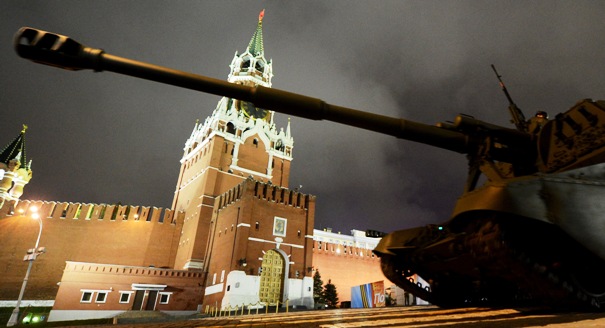
Source: Getty
With tensions running high and diplomacy struggling to find a way out of the Ukraine crisis, inflammatory rhetoric violates the first rule of foreign policy: do no harm.
Russia and the West are on the brink of World War III. Or so a spate of recent op-ed columns would lead one to believe. In the last several days, a number of provocative essays have appeared in the pages of prominent newspapers and online publications marking the 75th anniversary of the outbreak of World War II. Writing for the Washington Post Anne Applebaum suggested that “War in Europe is Not a Hysterical Idea.” Applebaum, the wife of Polish Foreign Minister Radoslaw Sikorski, wondered, after drawing parallels between pre-war Nazi Germany and Putin’s Russia, “is it hysterical to prepare for total war? Or is it naive not to do so?” Bloomberg View columnist Leonid Bershidsky argued, “The West Must Decide Whether Putin Is Hitler.”
It is not that war on the continent is unthinkable—Ukraine has taught us to prepare for worst-case scenarios. But by comparing Putin to Hitler, Applebaum and others make diplomacy impossible. The 1939 analogy suggests that Munich has come and passed, that humanitarian disaster awaits, and that war in Europe is not only possible but necessary. Applebaum’s comparison is not entirely new (humorists and twitterati have been referring to Putin as “Putler” since Russia invaded and annexed Crimea in March), but it represents a renewed alarmism that has become increasingly prevalent in mainstream media in recent weeks.
The September 5 Minsk ceasefire agreement shows us that the time for diplomacy has not passed. Ukrainian President Petro Poroshenko recently met with Putin in Minsk, and set in motion the diplomatic process that yielded the ceasefire agreement. If Putin is Hitler, such talks are meaningless.
The alarmism of Applebaum and others resonates in Russia. On September 2, Russia Today, a Kremlin-funded propaganda outlet aimed at foreign audiences, picked up on Applebaum’s op-ed. RT’s article, entitled “The Apocalypse from Applebaum: Putin Will Make Poland a Nuclear Target,” notes her relationship to Sikorski several times, implying that Applebaum is speaking not only for herself, but for her husband and perhaps even the West more broadly. The line between policy and punditry is thus blurred for the audience. One Russian news website, also emphasizing Applebaum’s relationship with Sikorski, argued that “Observers of events in Poland, on the basis of [Applebaum’s] statements, can certainly conclude which way the Polish Foreign Ministry will lean.”
In Russia's relationship with the West, perception is often paramount, and escalatory rhetoric can become a proxy for policy. Russian leaders interpret as aggressive, statements and actions Western leaders consider benign. Putin recently recounted the EuroMaidan Revolution at a youth forum northwest of Moscow: “Our Western partners, with the support of fairly radically inclined and nationalist-leaning groups, carried out a coup d’état there. No matter what anyone says, we all understand what happened. There are no fools among us. We all saw the symbolic pies handed out on the Maidan. This information and political support, what does it mean?” In the Western narrative, Assistant Secretary of State Victoria Nuland’s decision to hand out pies on the Maidan in Kyiv was a symbolic gesture in support of Ukrainian democracy, not a threat to Putin’s sphere of influence. Perception matters, and alarmist rhetoric shapes perception.
Such alarmism is particularly potent as the United States and Europe struggle to formulate a credible response to Russian actions in Ukraine and de-escalate the crisis. With tensions running high and diplomacy struggling to find a way out of the crisis, inflammatory rhetoric violates the first rule of foreign policy: do no harm.
Isaac Webb is a junior fellow in the Carnegie Endowment for International Peace’s Russia and Eurasia Program.
Isaac Webb
Former Junior Fellow, Russia and Eurasia Program
Carnegie does not take institutional positions on public policy issues; the views represented herein are those of the author(s) and do not necessarily reflect the views of Carnegie, its staff, or its trustees.

As we close out another season of Strategic Europe, it is worth taking stock of the deep shifts underway.

Rym Momtaz
The hybrid warfare landscape is evolving rapidly, leaving policymakers without clear strategies. To better inform their work in addressing emerging challenges, governments must dig deeper into the underlying dynamics at play.


Raluca Csernatoni, Alicia Wanless
The EU had to compromise to adopt a twenty-first sanctions package against Russia, exposing growing cracks in the union’s resolve. Is this latest, weaker round worth it to keep pressure on Moscow?
Rym Momtaz, ed.

Trump is distracted and Ukraine wants Europe to step up. The continent’s leaders must find their voice and assert it in talks with Russia.

Alissa de Carbonnel

Mounting economic strain and battlefield losses will not necessarily make the Kremlin less dangerous. They could instead push Moscow toward a more aggressive hybrid campaign designed to test NATO’s Eastern flank, exploit allied hesitation, and fracture European resolve.

Maksym Beznosiuk