

Commentary
Thomas de Waal
{
  "authors": [
    "Thomas de Waal"
  ],
  "type": "commentary",
  "centerAffiliationAll": "",
  "centers": [
    "Carnegie Endowment for International Peace",
    "Carnegie Europe",
    "Carnegie Russia Eurasia Center"
  ],
  "collections": [],
  "englishNewsletterAll": "",
  "nonEnglishNewsletterAll": "",
  "primaryCenter": "Carnegie Europe",
  "programAffiliation": "",
  "programs": [],
  "projects": [],
  "regions": [
    "Caucasus",
    "Armenia",
    "Eastern Europe",
    "Ukraine",
    "Western Europe",
    "United Kingdom"
  ],
  "topics": [
    "Civil Society",
    "Foreign Policy"
  ]
}
Source: Getty
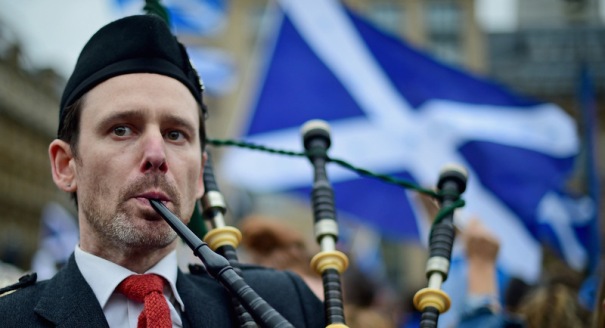
Separatists across Europe are hailing Scotland's referendum, but they also know that breaking up is a traumatic process.
At the recent meeting of the presidents of Armenia and Azerbaijan at the NATO summit in Wales, convened by U.S Secretary of State John Kerry, the issue of “territorial integrity” came up as usual.
The final NATO summit declaration formally pledged support for Azerbaijan’s territorial integrity—alongside that of Armenia, Georgia, and Moldova. This was despite Armenian objections that the plan under discussion by the Minsk Group of the OSCE foresees a future vote on secession for the Armenians of Nagorny Karabakh as a way of breaking the impasse in that conflict.
Secretary Kerry himself reportedly asked the question, “What about Scotland?” Because of course the “territorial integrity” of no less a country than the United Kingdom could be broken by Friday morning, if Scots vote “Yes” in the independence referendum.
In Armenia last week I sensed great excitement about the vote, based on the simple premise that a vote for separatism in Scotland legitimizes the case of Karabakh Armenians for independence. Highland Karabakhis are expressing highland solidarity with pro-independence Scots.
At the same time, Abkhaz are recalling the Kilmarnock-Sukhum twin-town scheme, which links their capital with a Scottish town and treating it as a good omen for their own independence aspirations.
Sergei Aksyonov, the new pro-Russian head of Crimea, has declared that if Scotland votes Yes, the world will have “no other option” but to recognize Crimea’s secession from Ukraine.
Conversely, a lot of world leaders are grumbling at David Cameron’s rashness in allowing the referendum to go ahead in the first place.
Nation states hate the idea of separatism, even in the most clear-cut cases. It smells too much of anarchy. That is why Somaliland has not been recognized as independent, even though it objectively has more statehood than its nominal “parent state” Somalia. And why, five European Union members, Cyprus, Greece, Romania, Slovakia, and Spain, have still not recognized the independence of Kosovo.
Scotland has set a good precedent in Europe by staging a democratic debate on separatism in which everyone with a stake in the outcome has been given a voice. Even so, as the actual vote nears, that debate has got more angry and bitter.
Breaking up a state is a traumatic process. If the pro-union camp is still in the lead in Scotland, it is mainly because voters fear a prospect of massive uncertainty resulting from a Yes vote. Unresolved questions range from whether an independent Scotland will get to keep the pound, to what will be the status of Queen Elizabeth to what will happen to pension entitlements.
People on all sides of the conflicts of the Caucasus know all about the pain of break-up. Those Abkhaz or Karabakh Armenians who cheer on the pro-independence Scots also recall in quieter moments that they did not start with independence slogans. The referendums on independence of the 1990s in Abkhazia, South Ossetia, Karabakh, and Transnistria, unrecognized by the rest of the world, came after a long interval of conflict and uncertainty.
Recalling the trauma, even these separatists might tell the Scots that breaking up with the United Kingdom is best avoided, when other alternatives are available.

Senior Fellow, Carnegie Europe
Thomas de Waal is a senior fellow at Carnegie Europe, specializing in Eastern Europe and the Caucasus.
Recent Work
Thomas de Waal
Thomas de Waal
Carnegie does not take institutional positions on public policy issues; the views represented herein are those of the author(s) and do not necessarily reflect the views of Carnegie, its staff, or its trustees.

With its public finances in shambles, the far right polling at 35 percent ahead of the 2027 presidential election, and a growing protest movement, is France’s crisis a threat to the EU’s geopolitical awakening?

Rym Momtaz, ed.

Ahead of a tough winter for Ukraine, Donald Trump’s swing back toward Russia bodes ill. But instead of panicking, Kyiv’s European allies are focusing on action.
Rym Momtaz

Funding Ukraine remains a priority for European leaders. As Russia’s war of aggression heads into another winter, two feasible options to mobilize support for Kyiv should be fast-tracked.


Vladyslav Rashkovan, Gregory P. Wilson

While the EU and European governments are embracing the much-lauded middle-power moment, this entails three difficult conundrums.

Richard Youngs

A notable degree of participative democracy has firmly arrived in Europe. But to have more far-reaching impact, democratic deliberation needs to move into a radically new phase.
Richard Youngs