

Commentary
As we close out another season of Strategic Europe, it is worth taking stock of the deep shifts underway.
Rym Momtaz
{
  "authors": [],
  "type": "other",
  "centerAffiliationAll": "dc",
  "centers": [
    "Carnegie Endowment for International Peace",
    "Malcolm H. Kerr Carnegie Middle East Center"
  ],
  "collections": [
    "Arab Awakening"
  ],
  "englishNewsletterAll": "menaTransitions",
  "nonEnglishNewsletterAll": "",
  "primaryCenter": "Carnegie Endowment for International Peace",
  "programAffiliation": "MEP",
  "programs": [
    "Middle East"
  ],
  "projects": [],
  "regions": [
    "North Africa",
    "Egypt"
  ],
  "topics": [
    "Political Reform",
    "Foreign Policy"
  ]
}
Source: Getty
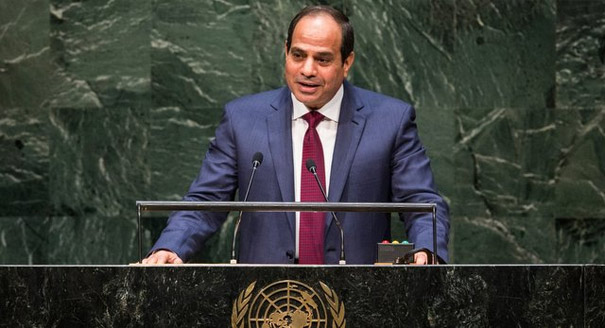
There is great concern that Egyptian President Abdel Fattah al-Sisi’s rule is fueling radicalization. Violence and terrorism in Egypt have increased markedly since the July 2013 coup, as the regime continues to close off avenues for peaceful political dissent.
Dear Mr. President:
We are dismayed that during your brief stay in New York for the United Nations General Assembly you will include Egyptian President Abdel Fattah al-Sisi on the short list of foreign leaders with whom you will meet one-on-one. This meeting will be understood around the world, and in Egypt, as a formal blessing for a leader who carried out a military coup against an elected government, who has overseen numerous acts of brutality against his own people, who gained his present office in an election held in an environment deemed to be undemocratic by international observers, and who has pursued a relentless course of domestic repression and persecution of dissent. Whatever assistance al-Sisi may or may not provide in the fight against violent extremism in the region is already outweighed by the radicalism and instability he is cultivating every day in Egypt through his oppressive policies.
Our Working Group spoke clearly about the uncritical embrace of Sisi’s predecessor,* but the situation today is far worse. There is great concern that al-Sisi’s rule is fueling radicalization; violence and terrorism in Egypt have increased markedly since the July 2013 coup, as the regime continues to close off avenues for peaceful political dissent. The post-coup crackdown has left more than 2000 protesters dead—including more than 1000 killed deliberately and systematically on a single day in August 2013, rivaling the Tiananmen massacre. Tens of thousands more are in prison, many detained without charge for extended periods or subject to mass trials in rigged courts, suffering torture and inhumane conditions. There are now more than 70 imprisoned Egyptians on extended hunger strikes protesting this brutality, and several are at death’s door, including American citizen Mohammed Soltan and youth leader Ahmed Douma.
Sisi’s government is also exerting increasing pressure on the few remaining Egyptian civil society groups that report on or criticize human rights abuses, particularly if they dare to cooperate with international organizations or accept their support. In fact, President al-Sisi signed into law on September 21—the very day on which he traveled to the United States—harsh new penalties including life in prison for any Egyptian accepting foreign funds for activities deemed to “harm the national interest.” The Egyptian government has used such vague charges to target its critics many times in the past and there is every reason to believe it will do so again. And journalists who report on all of the above face charges such as espionage and harsh penalties.
Will you raise these issues—unlawful killing, imprisonment, torture, targeting of journalists, stifling civil society—and how they may increase support for radical groups such as ISIS in your meeting with al-Sisi? Will you call for “inclusive government, that respects the human rights of all its citizens” in Egypt, as you have in Iraq? Most important, will you make your concerns explicit in public as well as private? During your September 22 speech before the Clinton Global Initiative, you pledged to stand in solidarity with detainees and harassed civil society activists in Egypt; they will be waiting to see if you follow through.
We urge you to do so. Because if you do not, your meeting with al-Sisi will be understood, and indeed rightly understood, as a sign to Egyptians that the United States has given its blessing to the ongoing massive campaign of repression and human rights abuses. Not only is it unnecessary to sacrifice core American principles in this way—the Egyptian government will cooperate against ISIS because it is in its interest to do so—but it is also dangerous, as it will fuel the very extremism that the United States, and its regional partners, say they seek to combat.
UN Secretary-General Ban Ki-Moon, after meeting with al-Sisi on September 21, cited his “concern about the absence of due process for detainees and sentencing of journalists in Egypt, and called for the release of those detained solely for exercising their right to freedom of expression and association.” We hope that you will do no less.
Sincerely,
The Working Group on Egypt
Robert Kagan (co-chair)
Brookings Institution**
Michele Dunne (co-chair)
Carnegie Endowment for International Peace**
Elliott Abrams
Council on Foreign Relations**
Ellen Bork
Foreign Policy Initiative**
Daniel Calingaert
Freedom House**
Reuel Marc Gerecht
Foundation for Defense of Democracies**
Neil Hicks
Human Rights First**
Peter Mandaville
George Mason University**
Sarah Margon
Human Rights Watch**
Stephen McInerney
Project on Middle East Democracy**
*Robert Kagan and Michele Dunne, “Time to Get Tough with Egypt and Morsi,” The Washington Post, February 20, 2013.
**This letter reflects the views of the individual signatories; institutional affiliations are listed for the purpose of identification only.
Carnegie does not take institutional positions on public policy issues; the views represented herein are those of the author(s) and do not necessarily reflect the views of Carnegie, its staff, or its trustees.

As we close out another season of Strategic Europe, it is worth taking stock of the deep shifts underway.

Rym Momtaz

The EU had to compromise to adopt a twenty-first sanctions package against Russia, exposing growing cracks in the union’s resolve. Is this latest, weaker round worth it to keep pressure on Moscow?
Rym Momtaz, ed.

Trump is distracted and Ukraine wants Europe to step up. The continent’s leaders must find their voice and assert it in talks with Russia.

Alissa de Carbonnel

Mounting economic strain and battlefield losses will not necessarily make the Kremlin less dangerous. They could instead push Moscow toward a more aggressive hybrid campaign designed to test NATO’s Eastern flank, exploit allied hesitation, and fracture European resolve.

Maksym Beznosiuk

Over the past ten years, NATO has held almost as many summits as it did during the entirety of the Cold War. Are they still useful, or is it time to stop holding annual meetings?
Rym Momtaz, ed.