

Research
- +6
Yasmine Farouk, Nathan J. Brown, Maysaa Shuja Al-Deen, …
{
  "authors": [
    "Michele Dunne"
  ],
  "type": "legacyinthemedia",
  "centerAffiliationAll": "dc",
  "centers": [
    "Carnegie Endowment for International Peace",
    "Malcolm H. Kerr Carnegie Middle East Center"
  ],
  "collections": [
    "Arab Awakening"
  ],
  "englishNewsletterAll": "menaTransitions",
  "nonEnglishNewsletterAll": "",
  "primaryCenter": "Carnegie Endowment for International Peace",
  "programAffiliation": "MEP",
  "programs": [
    "Middle East"
  ],
  "projects": [],
  "regions": [
    "North Africa",
    "Egypt"
  ],
  "topics": [
    "Political Reform",
    "Economy",
    "Security",
    "Military"
  ]
}
Source: Getty
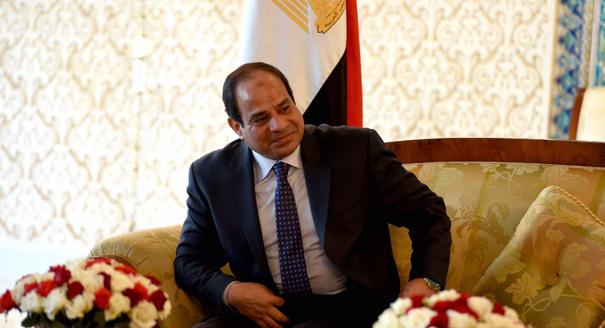
The question is whether the scorched earth methods practiced by Sisi and his government are helping to build legitimacy among the Egyptian population, or if they will fuel radicalization and alienate large swaths of the public.
Source: Al Jazeera
Citing a "stabilised political and security situation", Moody's Investor Service changed Egypt's rating to stable from negative on October 20, one of several recent reports assessing that the country's political unrest was dying down and forecasting that the economy should be headed for significant improvement.
No sooner had the ink dried on those reports than Egypt suffered the greatest number of deaths from terrorism in a single day - 31 soldiers killed - since 2005. The October 24 attack in the northern Sinai provoked a furious reaction from the Egyptian military, including the bulldozing of hundreds of houses in the border town of Rafah as well as adopting a new law that will send many civilians to military courts.
The October 24 attacks and their aftermath also come on top of a vast crackdown on the Muslim Brotherhood as well as various other groups, such as the liberal April 6 Youth Movement. It has left thousands of Egyptians jailed for a year or more now: some sentenced to multiyear terms for no more than marching in a demonstration, some enmeshed in chaotic mass trials, others not even charged yet, and some on extended hunger strikes.
There are at least two ways to explain the evident disconnect between the economic forecasts and the eruption of violence last week. Either the ratings are correct - and Egypt is stabilising generally despite a marginal insurgency in a remote region - or the ratings are incorrect, and Egypt is headed for more instability.If the ratings are correct and Egypt is stabilising, then one must argue that what is going on in Sinai is disconnected from what is happening in the rest of the country. The October 24 attacks certainly had a Sinai-specific context: A deadly game of cat-and-mouse between Egyptian security forces and local terrorist groups, with Ansar Beit al-Maqdis at the forefront.
The October 24 ambushes appeared to be revenge attacks for several specific moves by the Egyptian state against Ansar, including the October 11 killing of a senior Ansar leader and the October 21 sentencing to death of seven alleged Ansar militants for killing nine soldiers in Cairo in March. These were the first death sentences issued against Ansar, a group that has been carrying out attacks since 2011.
The Egyptian authorities' responses to the October 24 killings, however, raise questions about whether what happens in Sinai stays in Sinai.
There was the remarkable scene of Egyptian bulldozers demolishing houses to create a buffer zone in Rafah following allegations that militants or weapons had entered from Gaza to carry out the attacks. While the tunnels under Rafah have been a persistent and serious problem, the total media blackout in Sinai makes it impossible to know what actually happened and whether the demolitions were truly necessary or rather a hasty exertion of collective punishment against Sinai residents.
And collective punishment for the attacks went far beyond Sinai, as Egypt's President Abdel Fattah el-Sisi used the occasion to decree on October 27, that henceforth any civilians attacking or obstructing "vital" public facilities would be referred to military court. The decree applies, inter alia, to transportation networks, power stations, bridges, gas pipelines, and oilfields. But it also seems that it can be used to prosecute demonstrators blocking a road, an everyday occurrence in Egypt.
Sisi has also made it clear recently that, despite earlier hints to the contrary, he is now in no mood to reconsider the harsh anti-protest law issued in November 2013, which has been used to jail many prominent youth leaders of the 2011 anti-Mubarak revolution.
High anxiety about the broader implications of the Sinai attacks was also evident in a curious exchange between Egyptian authorities and the media. First, pro-Sisi talk show host Mahmoud Saad was barred from going on the air when the private channel al-Nahar accused him vaguely of "demotivating the army", apparently because one of his guests had the temerity to mention the 1967 defeat by Israel during a programme on October 24.
Two days later, editors of 17 newspapers (some government owned, some privately owned) issued a startling pledge to stop reporting on protests or statements that "might incite violence" - in effect, to pretend that unrest is not happening.
That pledge in turn provoked a strong reaction from other Egyptian journalists, several hundred of whom signed a counter statement arguing that "standing up to terrorism with a shackled media and sealed lips means offering the nation to extremism as an easy prey".
Egypt has a serious insurgency under way, based in but not limited to the Sinai, as attacks in many other locations throughout the country show. Among the most basic principles of counterinsurgency is that the government needs to enjoy legitimacy among the population that exceeds whatever legitimacy might be claimed by the insurgents.
The question is whether the scorched earth methods practised by Sisi and his government are helping to build legitimacy among the Egyptian population, including in economically disadvantaged areas such as north Sinai, the Western Desert, and Upper Egypt.
Or will they rather fuel radicalisation and alienate large swaths of the public? If the latter, Egypt could be looking at a long, grinding internal conflict that will thwart the very stability, security, and economic recovery in whose name Egyptians sacrificed their brief first attempt at a civilian-led democracy.

Former Nonresident Scholar, Middle East Program
Michele Dunne was a nonresident scholar in Carnegie’s Middle East Program, where her research focuses on political and economic change in Arab countries, particularly Egypt, as well as U.S. policy in the Middle East.
Recent Work



Yasmine Farouk, Nathan J. Brown, Maysaa Shuja Al-Deen, …
Robert Springborg, Emile Hokayem, Becca Wasser, …
Carnegie does not take institutional positions on public policy issues; the views represented herein are those of the author(s) and do not necessarily reflect the views of Carnegie, its staff, or its trustees.

Before the next wave of EU enlargement takes place, the union needs to grapple with thorny questions of how power is distributed among its members.


Emil Sondaj Hansen, Ditte Brasso Sørensen

The new U.S.–Denmark–Greenland agreement will help Washington exert political, economic, and financial dominance under the guise of security. Yet, it acknowledged Copenhagen’s and Nuuk’s sovereignty on the island.

Marc Pierini

A summer of escalation in the Black Sea has hurt Ukraine economically and is exacerbating world food security. A truce is needed—as is a broader reframing of Europe’s Ukraine strategy.

Thomas de Waal

Are Germany’s economic, industrial, and political struggles becoming a liability for the EU’s ability to rise to the geopolitical moment?

Rym Momtaz, ed.

European states control several Overseas Countries and Territories around the world that carry strategic, economic, and environmental weight. As great powers challenge the rules-based order, defending them is a geopolitical imperative for Europe.
Marc Pierini