

Commentary
The EU can impose sanctions but struggles to enforce them without the United States. With Washington increasingly disinterested in backing European interests, the bloc must now fend for itself.
Nicu Popescu, Tiago Antunes
{
  "authors": [
    "Akio Kawato"
  ],
  "type": "commentary",
  "centerAffiliationAll": "",
  "centers": [
    "Carnegie Endowment for International Peace",
    "Carnegie Russia Eurasia Center"
  ],
  "collections": [],
  "englishNewsletterAll": "",
  "nonEnglishNewsletterAll": "",
  "primaryCenter": "Carnegie Russia Eurasia Center",
  "programAffiliation": "",
  "programs": [],
  "projects": [],
  "regions": [
    "East Asia",
    "China",
    "Japan",
    "Russia"
  ],
  "topics": [
    "Economy",
    "Foreign Policy",
    "Global Governance"
  ]
}
Source: Getty
Pax Sinica has come. Countries in China’s orbit will be given security guarantees and trade preferences as long as they remain allegiant. Thus, the pivot to Asia will only drive Russia to unnecessary dependence on China.
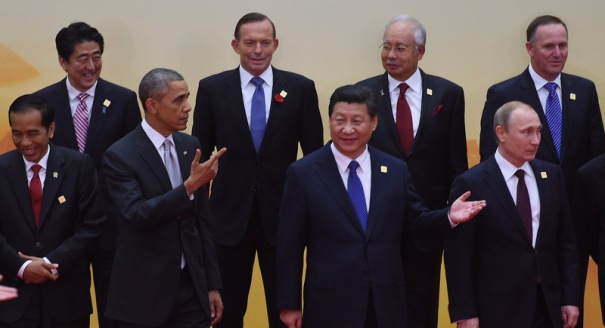
Chinese leader Xi Jinping is consolidating power. The APEC (Asia-Pacific Economic Cooperation) Summit in Beijing smacked of an ancient imperial pageant, to which foreign kings were summoned to pay tribute to and win the favor of the great Chinese emperor.
Russian King Vladimir Putin got an ambiguous promise from Xi Jinping that China will someday import natural gas through the Altai; Japanese King Shinzo Abe was granted an audience with Xi Jinping, indicating that Japan and China may end their dangerous confrontation; and the great American King Barack Obama was assured that China will not rule the world alone—yet.
In the Middle East, China has its own clout, especially in Iran. In Europe, the EU has lost its erstwhile economic and cultural lure, no country is fighting to preserve internal cohesion, some pundits have started to talk about the EU’s break-up à la the Soviet Union or the formation of a new “Berlin-Moscow-Beijing” axis, and the countries that used to crave membership in the EU are having second thoughts, looking elsewhere for sources of easy money. In such a milieu Chinese leaders’ visits are welcomed like manna from heaven.
China is rapidly expanding its network of currency swap agreements, widening the use of the Renminbi in international transactions. It is launching one after another new “International Development Bank” and a “Development Fund” for various regions, as if attempting to replace the IMF and IBRD. Pax Sinica has come (or perhaps “Pax Cynica”). Countries in China’s orbit will be given security guarantees and trade preferences as long as they remain allegiant to China, a revival of the ancient order of Chao gong and Ce feng.
However, all Chinese dynasties end at some point, and contemporary China’s weaknesses suggest that it is no exception. Firstly, its economy is not as robust as it looks. China’s phenomenal growth was realized through heavy dependence on foreign capital and technology. During the 2000s China banked about 200 billion dollars of foreign capital in foreign direct investments and trade surplus every year. Even today, about 50 percent of China’s exporting is done by foreign companies. Further, Beijing does not follow the principles of the market economy, which is a prerequisite for self-sustaining growth. Its banking system periodically generates huge numbers of bad loans, which may trigger high inflation, a recipe for the fall of many previous Chinese dynasties. Societal pressure for democratic reforms is simmering, as the recent movement in Hong Kong demonstrated. Finally, the danger of Islamic terrorism is mounting: one of the leaders of ISIS recently declared that China will eventually be its largest target. Despite all these draw-backs, however, China will remain a global power for quite some time.
For Russia, the only viable way out from the East-West quagmire is in finding a modus vivendi in the Ukraine crisis.Tweet This
How will Russia’s “pivot to Asia” operate in this environment? It is likely doomed to fail because Russia needs Asia more than Asia needs Russia. Japan is ending its confrontation with China, which it means that Japan will not need Russia as a balance vis-à-vis China so much as in the past. India is not powerful enough to become a meaningful ally for Russia. Thus, the pivot to Asia will only drive Russia to unnecessary dependence on China.
For Russia, the only viable way out from the East-West quagmire is in finding a modus vivendi in the Ukraine crisis. Russia counted too much on the ephemeral economic strength brought by high oil prices, and prematurely attempted to resurrect its reduced sphere of influence. Did those who inspired the archaic imperialistic ideas to President Putin correctly measure the limits and bounds of Russia’s power? Are they not risking bringing Russia into an impasse again?
Akio Kawato
Writer
Akio Kawato is a former Japanese diplomat and blogger.
Carnegie does not take institutional positions on public policy issues; the views represented herein are those of the author(s) and do not necessarily reflect the views of Carnegie, its staff, or its trustees.

The EU can impose sanctions but struggles to enforce them without the United States. With Washington increasingly disinterested in backing European interests, the bloc must now fend for itself.


Nicu Popescu, Tiago Antunes

Russia is testing the waters of NATO’s mutual defense clause. What do strikes in Romanian territorial waters mean for the alliance’s posture toward Moscow?

Dimitar Bechev

With its public finances in shambles, the far right polling at 35 percent ahead of the 2027 presidential election, and a growing protest movement, is France’s crisis a threat to the EU’s geopolitical awakening?

Rym Momtaz, ed.

Ahead of a tough winter for Ukraine, Donald Trump’s swing back toward Russia bodes ill. But instead of panicking, Kyiv’s European allies are focusing on action.
Rym Momtaz

Funding Ukraine remains a priority for European leaders. As Russia’s war of aggression heads into another winter, two feasible options to mobilize support for Kyiv should be fast-tracked.


Vladyslav Rashkovan, Gregory P. Wilson