

Commentary
Before the next wave of EU enlargement takes place, the union needs to grapple with thorny questions of how power is distributed among its members.
Emil Sondaj Hansen, Ditte Brasso Sørensen
{
  "authors": [
    "Ulrich Speck"
  ],
  "type": "commentary",
  "centerAffiliationAll": "",
  "centers": [
    "Carnegie Endowment for International Peace",
    "Carnegie Europe",
    "Carnegie Russia Eurasia Center"
  ],
  "collections": [],
  "englishNewsletterAll": "",
  "nonEnglishNewsletterAll": "",
  "primaryCenter": "Carnegie Europe",
  "programAffiliation": "",
  "programs": [],
  "projects": [],
  "regions": [
    "Russia",
    "Western Europe",
    "Germany"
  ],
  "topics": [
    "Foreign Policy"
  ]
}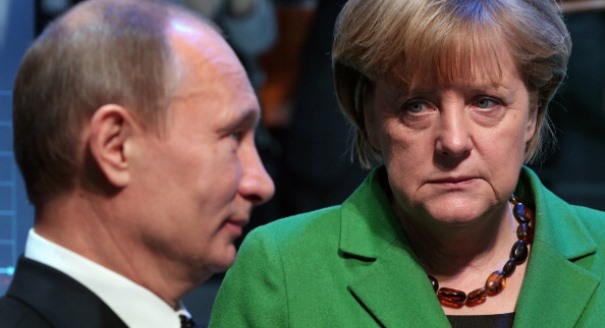
Source: Getty
In character and attitude, Germany and Russia are the antipodes in today’s international system. That could explain perhaps both the closeness the two countries have felt for years and the growing confrontation which has come with the Ukraine crisis.
Angela Merkel allegedly told Barack Obama that Vladimir Putin was living “in another world.” This is indeed how it looks, from a German perspective. In character and attitude, Germany and Russia are the antipodes in today’s international system. That could explain perhaps both the closeness the two countries have felt for years and the growing confrontation which has come with the Ukraine crisis.
The contrast between Germany and Russia can be described and explained by both countries’ historical experience. In the way it perceives international order and international politics, Russia continues to live in the system of great powers which existed in Europe for centuries. Stalin gave up socialist internationalism and fully returned to old-style power politics with the Hitler-Stalin pact in 1939, by cutting a deal dividing Eastern Europe with a Germany that drove great power politics to the extreme. The division of Europe into spheres of influence by Stalin, Churchill and Roosevelt in Yalta in 1945, as well as the bipolar order during the Cold War, stood in the tradition of nineteenth-century-style European power politics. The claim to spheres of interest has apparently survived the breakdown of the Soviet Union, as the war in Ukraine demonstrates.
It is precisely this break with the tradition of power politics and the integration into international and transnational entities which gives Germany its greatest asset: trust among neighbors and partners. Germany has become freer, safer and more prosperous than it has ever been before. Today it is the paradigmatic “postmodern” state, happy to prefer cooperation and coordination over what Germans see as futile, old-fashioned chimeras of national superiority and greatness. Even on the radical fringes, nobody is calling for bringing Strasbourg, Prague or Kaliningrad “home” to Germany.
The breakup of the Soviet Union did not lead to similar developments in Russia. The country has never really opened up to integration into the international system, shaped and backed up by the United States, and it has never been forced to do so, as Germany after World War II initially was. Maybe Russia was too large, still too powerful, and too wedded to its history as an empire. The idea of Russia being a global power didn’t disappear. It may even have been encouraged by the West: by the fact that the other veto powers in the UN Security Council agreed when Russia took the seat of the Soviet Union in 1991, and by the implicit treatment of Russia as a great power with a sphere of influence in the post-Soviet space (minus the Baltics) by Western powers.
Seeing itself as a classical great power, Russia wants to maximize its sovereignty and freedom to act. It does not compare itself to countries like Japan, India, Germany or France, which have integrated into the global system by accepting U.S. leadership. Instead, Russia, even with very limited power resources (besides nuclear weapons) takes the United States as the benchmark of its position in the international system. Moscow does not seek deep engagement with international institutions and international rules, it looks at them merely as instruments to aggrandize its power. What counts is power in an archaic sense: the ability to force others to do what one wants. The strong can command, the weak must obey. Ultimately it is all about military power.
This is a view of the world which Russia can only afford, or thinks it can afford, because of its position as an energy supplier in the international economic system. It mainly sells raw materials and imports manufactured goods. Germany, by contrast, is integrated into global value chains. It needs safe trade routes, a stable and reliable system of international rules and norms, prospering markets and well-governed states. Germany needs to be liked for economic reasons; it needs to have friendly relations with almost everybody. It is no accident that German power is soft, based on attraction, not on submission and force.
Since Helmut Kohl and Mikhail Gorbachev negotiated German reunification in 1990, it has appeared as if both countries would be on a trajectory to an ever closer partnership. The antipodes appeared to attract each other. Now both countries have been drawn into a conflict over a Ukraine that wants to break free from Russian domination and enter the postmodern, economic sphere of the EU. Not a new Cold War, but a new conflict between two systems built on antithetical principles.
Ulrich Speck
Former Visiting Scholar, Carnegie Europe
Speck was a visiting scholar at Carnegie Europe in Brussels, where his research focuses on the European Union’s foreign policy and Europe’s strategic role in a changing global environment.
Carnegie does not take institutional positions on public policy issues; the views represented herein are those of the author(s) and do not necessarily reflect the views of Carnegie, its staff, or its trustees.

Before the next wave of EU enlargement takes place, the union needs to grapple with thorny questions of how power is distributed among its members.


Emil Sondaj Hansen, Ditte Brasso Sørensen

The new U.S.–Denmark–Greenland agreement will help Washington exert political, economic, and financial dominance under the guise of security. Yet, it acknowledged Copenhagen’s and Nuuk’s sovereignty on the island.

Marc Pierini

A summer of escalation in the Black Sea has hurt Ukraine economically and is exacerbating world food security. A truce is needed—as is a broader reframing of Europe’s Ukraine strategy.

Thomas de Waal

Are Germany’s economic, industrial, and political struggles becoming a liability for the EU’s ability to rise to the geopolitical moment?

Rym Momtaz, ed.

European Commission President Ursula von der Leyen is about to give her annual address on the state of the EU. Here’s what she won’t—but should—say.
Rym Momtaz