

Commentary
Thomas de Waal
{
  "authors": [
    "Thomas de Waal"
  ],
  "type": "legacyinthemedia",
  "centerAffiliationAll": "dc",
  "centers": [
    "Carnegie Endowment for International Peace",
    "Carnegie Europe"
  ],
  "collections": [],
  "englishNewsletterAll": "ctw",
  "nonEnglishNewsletterAll": "",
  "primaryCenter": "Carnegie Europe",
  "programAffiliation": "russia",
  "programs": [
    "Russia and Eurasia"
  ],
  "projects": [],
  "regions": [
    "Caucasus",
    "Russia"
  ],
  "topics": [
    "Political Reform",
    "Security",
    "Foreign Policy"
  ]
}
Source: Getty
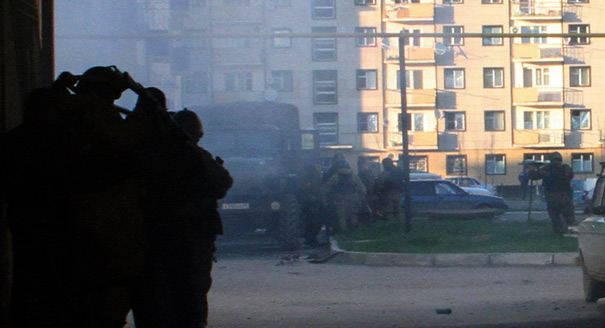
Twenty years after the outbreak of the First Chechen War, Moscow is still struggling to integrate the Chechen Republic into the Russian Federation.
Source: The Moscow Times
Today marks 20 years since the beginning of the First Chechen War, when Russian forces launched a three-pronged attack on Grozny, the Chechen capital, on Dec. 11, 1994.
On Dec. 1, 1994, as a Moscow Times reporter, I walked through the freezing streets of Grozny where crowds of male Chechens were gearing up for a fight. A few days earlier, a column of tanks led by the Russian-backed Chechen opposition had tried and failed to storm Grozny.
That left pro-independence Chechen leader and former Soviet General Dzhokhar Dudayev contemptuous and triumphant. But then Russian planes started attacking targets around the city.That day in Grozny, Dudayev convened a news conference in the musty bunker of his presidential palace — held there, he said, because foreign journalists were too scared of Russian aircraft. Dudayev read out a telegram, that threw a taunt at his erstwhile colleague, the head of the Russian air force, Pyotr Deineikin: "We will meet on the ground."
Ten days later, 40,000 Russian federal troops moved into Chechnya from three directions. Russian President Boris Yeltsin and his more hawkish advisers believed that the Dudayev regime would crumble within a few days and the president would reap the political benefits of a "small victorious war."
At some level it felt like a macho game, but it was all too real. When I next went to Grozny two months later, it resembled historical footage of Stalingrad during World War II: an apocalyptic landscape of ruins, mud, rampaging soldiers and desperate civilians.
Chechnya experienced horrific warfare on and off for the next decade. Twenty years on, the effects of those fateful days are still with Chechnya and Russia as a whole. The numbers of dead are in the tens of thousands; the numbers of crippled lives far greater than that.
And although Chechnya is mainly at peace and Grozny is rebuilt, the violence can burst out at any moment. After several stages of mutation, Chechnya's men of violence are now Islamist fanatics, whose views would terrify even the arch-secularist and Soviet veteran Dudayev. Earlier this month, on Dec. 4, militants unexpectedly attacked the Press House in central Grozny in what seemed to be partially an attempt to commemorate the outbreak of war a week early.
The Chechen war of 1994-96 has slipped through the cracks of memory, even in Chechnya itself. It does not fit conveniently in anyone's narrative of the recent past.
Chechnya now lives under the iron hand of Ramzan Kadyrov, who was 15 when the First Chechen war began. His father Akhmad was the chief Muslim cleric in Dudayev's Chechnya and fought against the Russians. Suppressing that history, both Kadyrov and Putin now adopt a false narrative that the West somehow bore responsibility for fostering Chechen resistance in 1994.
In his state of the union speech, delivered on the same day as the attacks in Grozny last week, Putin said: "We remember well who in that period practically openly supported separatism and even open terror in our country."
In actual fact, Western leaders were too soft. Western leaders were much too ready to overlook Yeltsin's war in the name of supporting Yeltsin personally and the principle of Russia's territorial integrity. In April 1996, U.S. President Bill Clinton even compared the war in Chechnya to Abraham Lincoln's struggle to preserve the Union.
By taking that line, Western leaders dealt a blow against those Russian liberals, like Sergei Kovalyov and Yegor Gaidar, who opposed the war and saw it as a threat to Russia's hopes of being a democracy. As political analyst Andrei Piontkovsky said, the war was launched ostensibly to keep Chechnya part of Russia, but ended up making Russia part of Chechnya.
The war of 1994 was never popular with the Russian public. The television coverage, especially by NTV, of the wanton destruction in Grozny, undermined its legitimacy from the start. Even then one could see the first seeds of a narrative that has since taken wider hold in Russia: that it is not worth keeping hold of the North Caucasus and would be better to cut it adrift.
Now it is some of the same nationalists who are fighting for the "Russian world" in eastern Ukraine who evince no interest in whether Chechnya stays part of the Russian Federation or not. And of course, if separatism was a synonym for wickedness in Russia of the early 1990s, then that is no longer the case, now that Moscow supports separatists in Abkhazia, South Ossetia and Ukraine.
The central paradox of Dec. 11, 1994, was that despite a declaration of independence that was mostly symbolic, most Chechens were resigned to being part of Russia until the Russian army brutally intervened, and in particular until the moment when the Russian air force devastated Grozny.
It was Yeltsin, not Dudayev, who separated Chechnya from Russia.
In war, the Russian military treated Chechnya as if it was a conquered country and Chechens as if they were enemies of Russia. I shall never forget the horrors I saw in Grozny in February 1995: fresh evidence of atrocities by Russian troops against the civilian population and comprehensive looting by soldiers of a city that was supposed to be part of their own country.
If Chechnya was Russian, why the behavior of a conquering army? Why a policy of Chechenization, in which laws made in the rest of Russia do not apply in Chechnya?
And how does Muslim non-Russian Chechnya fit into the narratives of a new nationalist Orthodox Russia that fights for ethnic Russian compatriots abroad?
These are questions that were first spoken in December 1994 and are not going away. As long as they beg for answers, Chechens will still suffer pain and Chechnya will be a place of danger for Russia.

Senior Fellow, Carnegie Europe
Thomas de Waal is a senior fellow at Carnegie Europe, specializing in Eastern Europe and the Caucasus.
Recent Work
Thomas de Waal
Thomas de Waal
Carnegie does not take institutional positions on public policy issues; the views represented herein are those of the author(s) and do not necessarily reflect the views of Carnegie, its staff, or its trustees.

The EU can impose sanctions but struggles to enforce them without the United States. With Washington increasingly disinterested in backing European interests, the bloc must now fend for itself.


Nicu Popescu, Tiago Antunes

Russia is testing the waters of NATO’s mutual defense clause. What do strikes in Romanian territorial waters mean for the alliance’s posture toward Moscow?

Dimitar Bechev

With its public finances in shambles, the far right polling at 35 percent ahead of the 2027 presidential election, and a growing protest movement, is France’s crisis a threat to the EU’s geopolitical awakening?

Rym Momtaz, ed.

Ahead of a tough winter for Ukraine, Donald Trump’s swing back toward Russia bodes ill. But instead of panicking, Kyiv’s European allies are focusing on action.
Rym Momtaz

Funding Ukraine remains a priority for European leaders. As Russia’s war of aggression heads into another winter, two feasible options to mobilize support for Kyiv should be fast-tracked.


Vladyslav Rashkovan, Gregory P. Wilson