

Paper
Yezid Sayigh
{
  "authors": [
    "Yezid Sayigh"
  ],
  "type": "legacyinthemedia",
  "centerAffiliationAll": "dc",
  "centers": [
    "Carnegie Endowment for International Peace",
    "Malcolm H. Kerr Carnegie Middle East Center"
  ],
  "collections": [
    "Arab Awakening"
  ],
  "englishNewsletterAll": "menaTransitions",
  "nonEnglishNewsletterAll": "",
  "primaryCenter": "Malcolm H. Kerr Carnegie Middle East Center",
  "programAffiliation": "MEP",
  "programs": [
    "Middle East"
  ],
  "projects": [],
  "regions": [
    "Levant",
    "Syria",
    "Middle East"
  ],
  "topics": [
    "Political Reform"
  ]
}
Source: Getty
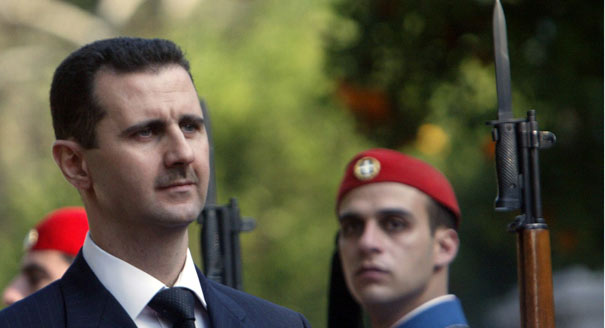
The Assad regime has repeatedly shown its confidence over the improvement of its strategic situation, but its refusal to engage politically with its own constituencies threatens it.
Source: Al-Hayat
The Assad regime has repeatedly exuded its confidence over the improvement of its strategic situation during the past twelve months. Territorial gains on some fronts, especially around Aleppo, in parts of the Hama and Homs countryside, and in the Qalamoun region and vicinity of the capital Damascus have encouraged it to maintain its hard-line approach in dealing with the stubborn Syrian rebellion. This focuses on military action, to the complete exclusion of any political process that might involve credible reforms in any area of public policy, not to mention meaningful power sharing. But the regime is increasingly stretched, militarily and financially, and so its refusal to engage politically with its own constituencies, let alone its adversaries, threatens it.
Despite the importance of regime gains and the threat its armed forces currently pose of completing the encirclement of Aleppo city in particular, it is visibly becoming more vulnerable in other parts of the country. The Islamic State of Iraq and al-Sham (ISIS) has been making incremental gains in eastern Hama and Homs provinces, where in theory it could eventually try to break through towards Idlib or Qalamoun. And local coalitions of moderate rebel groups and al-Qaeda affiliate Jabhat al-Nusra have made significant gains south and southwest of Damascus, and reappeared in the Qalamoun region. This is forcing the regime to pause its offensives further north and disperse its military effort, at a time when it must also face growing pressure from ISIS on its last remaining stronghold in Deir az-Zor city in the east.As numerous commentators have noted, the fact that the regime is calling up reservists who have already performed their military service and diverting conscripts from the National Defence Force, where they had previously been allowed to serve, back to the regular army, points to a worsening shortage of combat manpower. Consequently, it is becoming increasingly difficult for regime forces to shore up the frontline at all points. The army has been compelled repeatedly to rush battle-hardened units from one weak point to another in fire-fighting mode, whenever the irregular militias it relies on give way. Military sources say its hesitation to take Aleppo, which would be a big prize, is because it simply lacks the strength to do so.
The regime has not yet lost its edge over its opponents. The army’s extensive fortified positions and influxes of new Russian military technology mean that tough battles lie ahead before it might lose the Jabal Sha’er gas fields—which are now under its firm control once again—or Deir az-Zor to ISIS. But even if rebel or ISIS advances in any one area can be reversed, any significant new loss of life by the army—as at the Tabqa air base in August—or a direct threat to loyalist areas will have a powerful psychological impact on the regime’s social base. This has been showing growing discontent over constant human losses and declining living and economic conditions for months.
At the same time, the regime’s ability to contain dissent within loyalist constituencies—through subsidies and compensation for the families of war dead, for example—is decreasing due to a deepening financial shortfall. This also makes it harder to import its fuel and energy needs, as U.S. air strikes on ISIS oil refineries in the east and ISIS attacks on regime natural gas processing plants have cut electricity production just as winter approaches. Iranian assistance has declined and is unlikely to revive in light of the sharp drop in global oil prices, while Russia is reported to have refused a recent regime request for a new $1 billion credit line, while offering smaller amounts of aid and investment. Some economists anticipate that the regime will run out of funds by the end of 2015; even if this over-states the extent of the challenge or under-estimates its hidden reserves, it reduces the regime’s options for simply continuing its present policies indefinitely.
Dissent does not yet amount to an acute political crisis. But this may change with strategic shifts on the ground. In particular, the reappearance of Jabhat al-Nusra as a leading rebel force signals that the armed conflict in much of Syria may reduce to three main armed actors (excluding the Kurdish enclaves) within coming months: the regime, ISIS, and al-Nusra (acting as a coordinating framework for moderate rebel groups that agree to work with it). Instead of an armed rebellion that has been exceptional in its fragmentation and slow operational and political evolution, the regime will face two armed movements in ISIS and an al-Nusra-led coalition that have demonstrated a much higher level of command and control.
In the short-term, the regime will portray this as incontrovertible proof of what it has claimed all along—that its real opponents are all jihadist extremists—and offer itself once again as the obvious, natural ally of the U.S.-led coalition combating ISIS. Speaking to French periodical Paris-Match on November 28, Assad dangled such an alliance clearly, arguing that “Terrorism cannot be destroyed from the air, and you cannot achieve results on the ground without land forces who know the geographical details of the regions and move in tandem with the airstrikes.”
But if, as remains most likely, the U.S. and its coalition partners disappoint Assad’s hopes, the regime will come under increasing strain internally. Having lost the crucial advantage of its previous, relative superiority over the armed rebellion, the regime will need to generate even greater domestic and external resources, but these are already at the limit and cannot be increased without a high political price. Domestically, it will struggle to retain its already loose control over the semi-autonomous military and economic actors whose rise it encouraged as a means of devolving the burden of defence and revenue generation in loyalist areas. And if the regime appears unable or unwilling to protect vulnerable population centers or to mitigate the financial strains of loyalist communities, its home front may start to crumble.
At present, these remain only potential trends. So far, the regime has responded by intensifying security measures and centralizing control in Assad’s hands even further. Although he has used this in some instances to reinforce the regime’s policy of promoting what it calls “reconciliation” in some Damascus suburbs, the striving to micro-manage also betrays its inability to ensure compliance by society with other government policies—such as reporting for military service—or effective performance by its various coercive agencies. Similarly, when senior officers boast that they already anticipate moving on to Raqqa after retaking Aleppo, they exaggerate army capabilities, overlook the regime’s resource constraints, and under-estimate the threat of losing a second provincial capital in Deir az-Zor. Regime hopes of luring Syrian businessmen into repatriating their capital or reinvesting it in areas like Aleppo’s industrial zone have had modest results, and will continue to do so.
In theory, the regime could ease its material and political burden by engaging seriously with proposals to reduce levels of violence in the country—whether through a unilateral, general truce or the “Aleppo freeze” advocated by U.N. Special Envoy for Syria Staffan de Mistura. This would show a convincing responsiveness to the concerns of loyalist constituencies, which are being asked to bear the brunt of what is not only an endless battle, but one in which foes are once again increasing in potency.
The regime clearly believes that loyalist constituencies have no choice but to continue fighting, but its margin for maneuver is narrowing. It realizes that credible reforms would set it on the path to dismantling itself, but by insisting on an exclusively military approach, it takes itself closer to the point where it has no political or social cushion domestically. This is its Achilles’ Heel.
This article was originally published in Arabic in Al-Hayat.

Senior Fellow, Malcolm H. Kerr Carnegie Middle East Center
Yezid Sayigh is a senior fellow at the Malcolm H. Kerr Carnegie Middle East Center in Beirut, where he leads the program on Civil-Military Relations in Arab States (CMRAS). His work focuses on the comparative political and economic roles of Arab armed forces, the impact of war on states and societies, the politics of postconflict reconstruction and security sector transformation in Arab transitions, and authoritarian resurgence.
Recent Work
Yezid Sayigh
Yezid Sayigh
Carnegie does not take institutional positions on public policy issues; the views represented herein are those of the author(s) and do not necessarily reflect the views of Carnegie, its staff, or its trustees.

As the EU confronts profound challenges, several leaders have called for fundamental reform to the union’s model—but only modest, superficial changes have resulted. What if Europe really could be reimagined from zero today: What should such a redesigned European order look like?

Richard Youngs, ed.

The EU’s new migration policy is not suited to today’s realities. With climate change increasingly becoming a driver of displacement, Europe needs to rethink its deterrence-focused approach.

Shana Tabak
Europe seems to have accepted its sidelining in the Middle East. The EU must reassert its support for the international rules-based order and step up engagement.

Rym Momtaz

Preparing candidate countries for EU membership is no longer enough. As the enlargement process becomes a reality, the union must also prepare its own societies.

Iliriana Gjoni
Countries face several hurdles in joining the EU, including the final stage of ratifying their accession treaties. Procedural reforms and substantive adjustments could help move the process forward.

Stefan Lehne