

Article
C. Raja Mohan, Darshana M. Baruah
{
  "authors": [
    "C. Raja Mohan"
  ],
  "type": "legacyinthemedia",
  "centerAffiliationAll": "dc",
  "centers": [
    "Carnegie Endowment for International Peace",
    "Carnegie India"
  ],
  "collections": [],
  "englishNewsletterAll": "ctw",
  "nonEnglishNewsletterAll": "",
  "primaryCenter": "Carnegie India",
  "programAffiliation": "SAP",
  "programs": [
    "South Asia"
  ],
  "projects": [],
  "regions": [
    "South Asia",
    "India"
  ],
  "topics": [
    "Foreign Policy"
  ]
}
Source: Getty
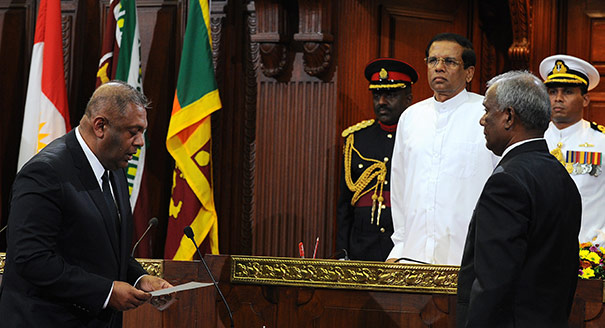
As a new government led by Maithripala Sirisena takes charge in Sri Lanka, India has a valuable opportunity to arrest the drift in bilateral relations over the last few years.
Source: Indian Express
As a new government led by Maithripala Sirisena takes charge in Sri Lanka, India has a valuable opportunity to arrest the drift in bilateral relations over the last few years.
The government of Narendra Modi, less constrained internally than the UPA government, is in a good position to rebuild the partnership with a country that occupies a vital position on India’s maritime frontiers to the south.
The reluctance of the outgoing president Mahinda Rajapaksa to address India’s concerns on much needed political reconciliation with the Tamil minority after the 2009 victory over the Liberation Tigers of Tamil Eeelam (LTTE) was a major source of tension between New Delhi and Colombo.India also watched warily Rajapaksa’s increasing political warmth towards Beijing. China’s growing presence in the Sri Lankan economy, especially its involvement in the development of strategic infrastructure like the Hambantota port and the frequent appearance of Chinese naval ships at the Colombo port had generated considerable anxiety in India’s national security establishment.
Rajapaksa’s active support to the Chinese proposal on the Maritime Silk Road during the visit of Chinese President Xi Jinping to Sri Lanka last September has magnified New Delhi’s concerns about Colombo’s embrace of Beijing.
The UPA government, which was supportive of Rajapaksa’s war against the LTTE, steadily lost goodwill in Colombo amid vacillations in its Sri Lanka policy under pressure from parties in Tamil Nadu.
New Delhi’s flip flops at Geneva in the UN debates on the human rights situation in Lanka were compounded by Prime Minister Manmohan Singh’s decision, under pressure from the Congress leadership, to skip visiting Colombo for the Commonwealth Summit in November 2013.
In this situation, Modi sought to restore some flexibility to Indian diplomacy by inviting Rajapaksa to his swearing-in last May over the objections of then Tamil Nadu Chief Minister J Jayalalithaa.
With a solid majority of its own in the Lok Sabha, the Modi government must now find a better balance between India’s interest in securing Tamil minority rights in Sri Lanka and the broader imperative of developing a stronger strategic partnership with Colombo.
Although Sirisena has won strong backing from the Tamil minority in the election, he may not necessarily find it easy to address India’s concerns, given his need to maintain support from the majority Sinhala community. India, then, will have to move with considerable political finesse and in taking up the Tamil question afresh with the new government. New Delhi can’t be seen as either abandoning the issue or trying to impose its will on Colombo.
Dealing with Colombo’s Beijing relationship might be equally tricky. Rajapaksa’s dealings, economic and political, with China have become controversial within Sri Lanka, and Sirisena has promised to evolve a more balanced approach in Colombo’s relations with both Beijing and New Delhi.
It might be unwise for India, however, to expect that Colombo will simply discard the China relationship that has given it a range of new economic and strategic options. For the Modi government, the challenge lies in finding ways to deepen its own economic and military cooperation with Sri Lanka, and accelerate the implementation of a variety of projects with Colombo.
There is no doubt that the issues involved — domestic political order and independent foreign policy — are highly sensitive to Sri Lanka. Yet, the new government in Colombo, and the stronger political dispensation in New Delhi, have the room to explore the prospects for an accommodation of each other’s interests.
An early visit to Colombo by External Affairs Minister Sushma Swaraj as part of India’s “neighbourhood first” diplomacy could indeed be the first step towards that exploration.
This article was originally published by the Indian Express.
Former Nonresident Senior Fellow, Carnegie India
A leading analyst of India’s foreign policy, Mohan is also an expert on South Asian security, great-power relations in Asia, and arms control.
Recent Work

C. Raja Mohan, Darshana M. Baruah


Alexander Gabuev, Paul Haenle, C. Raja Mohan, …
Carnegie does not take institutional positions on public policy issues; the views represented herein are those of the author(s) and do not necessarily reflect the views of Carnegie, its staff, or its trustees.

With its public finances in shambles, the far right polling at 35 percent ahead of the 2027 presidential election, and a growing protest movement, is France’s crisis a threat to the EU’s geopolitical awakening?

Rym Momtaz, ed.

Ahead of a tough winter for Ukraine, Donald Trump’s swing back toward Russia bodes ill. But instead of panicking, Kyiv’s European allies are focusing on action.
Rym Momtaz

Funding Ukraine remains a priority for European leaders. As Russia’s war of aggression heads into another winter, two feasible options to mobilize support for Kyiv should be fast-tracked.


Vladyslav Rashkovan, Gregory P. Wilson

While the EU and European governments are embracing the much-lauded middle-power moment, this entails three difficult conundrums.

Richard Youngs

Much has been said of the changes Brussels is trying to make to the EU enlargement process. Here’s why gradual integration might—or might not—be the answer.

Dimitar Bechev