

Article
C. Raja Mohan, Darshana M. Baruah
{
  "authors": [
    "C. Raja Mohan"
  ],
  "type": "legacyinthemedia",
  "centerAffiliationAll": "dc",
  "centers": [
    "Carnegie Endowment for International Peace",
    "Carnegie India"
  ],
  "collections": [],
  "englishNewsletterAll": "ctw",
  "nonEnglishNewsletterAll": "",
  "primaryCenter": "Carnegie India",
  "programAffiliation": "SAP",
  "programs": [
    "South Asia"
  ],
  "projects": [],
  "regions": [
    "United States",
    "South Asia",
    "India",
    "North America"
  ],
  "topics": [
    "Foreign Policy"
  ]
}
Source: Getty
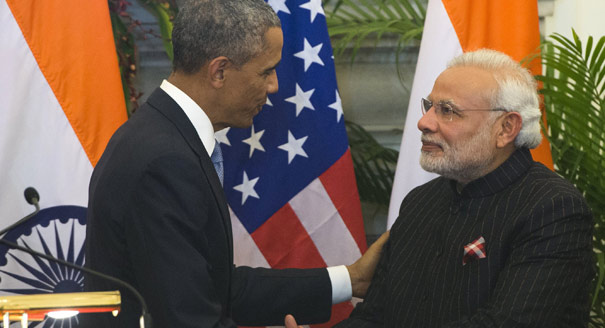
As they ended their three-day summit, Prime Minister Narendra Modi and President Barack Obama had every reason to feel vindicated that their political bet on each other had paid off handsomely.
Source: Indian Express
As they ended their three-day summit with a joint radio broadcast, Prime Minister Narendra Modi and President Barack Obama had every reason to feel vindicated that their political bet on each other had paid off handsomely.
Modi went for broke in finding a way to renew the momentum in the partnership with America, which he saw as central to his foreign and domestic strategies. Obama moved quickly after Modi’s election to end US antipathy towards the former chief minister of Gujarat, and invited him to the White House.
Once they found they could do business, they went full tilt at addressing outstanding issues like the civil nuclear initiative, reviving the stalled defence cooperation, exploring common ground on climate change, and expanding economic cooperation.As they tweeted on Tuesday afternoon — Modi bidding goodbye and Obama thanking his host — the two leaders demonstrated an unprecedented level of personal comfort.
If Obama has been widely acknowledged as a master of public communication, he met his match in Modi. Unlike his recent predecessors, who were stiff and formal in their engagement with world leaders, Modi understands the value of personal chemistry in shaping political outcomes.
Obama’s record on India in the seventh year at the White House now looks rather impressive. Contrary to the widespread perception that he is not warm towards India, Obama hosted Prime Minister Manmohan Singh as the first state guest at the White House in 2009. He is also the only US president to have visited India twice.
If George W Bush is rightly credited with re-imagining the relationship with India, Obama has advanced it beyond anyone’s expectations. Whatever his initial reservations about the civil nuclear initiative, Obama has helped wrap up what Bush had started.
Despite his initial belief that a resolution of the Kashmir question will help stabilise Afghanistan, Obama quickly moved away from the temptation to meddle in India-Pak disputes. After the failure of his overtures towards China early on in his presidency, Obama put India at the forefront of his pivot to Asia. He also became the first American president to support India’s claim to be a permanent member of the UN Security Council.
On the last day of his trip, Obama clearly articulated the unlimited possibilities for America and India in jointly promoting mutual prosperity, regional security and a stable global order. As he celebrated the virtues of Indian democracy, Obama also cautioned his hosts against the emerging threats to its cultural and religious pluralism.
Obama affirmed that India’s ability to continually affirm its democracy amidst so much diversity, is an example “for every other country on Earth”.
That Obama’s remarks were widely seen as unexceptionable in India is a testimony to the new maturity of the relationship. India and America are now ready to talk to each other frankly and in a spirit of genuine friendship rather than at each other.
This article was originally published in the Indian Express.
Former Nonresident Senior Fellow, Carnegie India
A leading analyst of India’s foreign policy, Mohan is also an expert on South Asian security, great-power relations in Asia, and arms control.
Recent Work

C. Raja Mohan, Darshana M. Baruah


Alexander Gabuev, Paul Haenle, C. Raja Mohan, …
Carnegie does not take institutional positions on public policy issues; the views represented herein are those of the author(s) and do not necessarily reflect the views of Carnegie, its staff, or its trustees.

A summer of escalation in the Black Sea has hurt Ukraine economically and is exacerbating world food security. A truce is needed—as is a broader reframing of Europe’s Ukraine strategy.

Thomas de Waal

Are Germany’s economic, industrial, and political struggles becoming a liability for the EU’s ability to rise to the geopolitical moment?

Rym Momtaz, ed.

European Commission President Ursula von der Leyen is about to give her annual address on the state of the EU. Here’s what she won’t—but should—say.
Rym Momtaz

Radical-right parties are expected to do well in upcoming elections in four of the EU's biggest member states. If successful, they could prevent the union from addressing key challenges ahead.

Stefan Lehne

The aftermath of the Ceuta crisis shows Europe has drawn the wrong lessons. Rather than doubling down on failed migration policies, the EU needs to address the underlying roots of such episodes.

Richard Youngs