

Commentary
With its public finances in shambles, the far right polling at 35 percent ahead of the 2027 presidential election, and a growing protest movement, is France’s crisis a threat to the EU’s geopolitical awakening?
Rym Momtaz, ed.
{
  "authors": [
    "Yan Xuetong"
  ],
  "type": "legacyinthemedia",
  "centerAffiliationAll": "",
  "centers": [
    "Carnegie Endowment for International Peace",
    "Carnegie China"
  ],
  "collections": [
    "China and the Developing World",
    "China’s Foreign Relations",
    "Belt and Road Initiative"
  ],
  "englishNewsletterAll": "",
  "nonEnglishNewsletterAll": "",
  "primaryCenter": "Carnegie China",
  "programAffiliation": "",
  "programs": [],
  "projects": [],
  "regions": [
    "North America",
    "United States",
    "East Asia",
    "China",
    "Southeast Asia"
  ],
  "topics": [
    "Foreign Policy"
  ]
}
Source: Getty
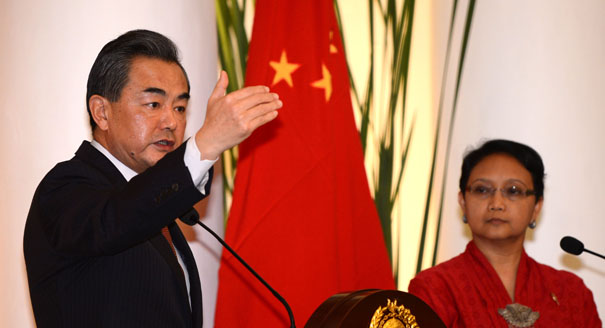
China must carefully consider which relationship is more important: relations with its neighboring countries or with the United States.
Source: China Daily
Which relationship is more important for China, that with the United States or with its neighbors?
The Chinese authorities used to be quite ambiguous on the question by stating both are essential, but with the nation’s rise and growth in comprehensive capabilities, it is necessary to give a clear answer.
The question has arisen because of a geopolitical fact, namely the US as the only superpower in this world is not one of China’s neighbors. It is a common view among certain scholars that the US should be the key part of China’s diplomacy, because if the relationship is improved, China’s rise would not meet any effective resistance. For others, peripheral diplomacy is more essential because without its neighbors’ support China’s rise will be a bubble.To better answer the question of which one is more important, it is necessary to first analyze China’s rise. Historically, all global powers rose as regional powers before becoming global powers. In the early stages of its rise, the US implemented the Monroe Doctrine and focused on Latin America; after World War II, the Soviet Union, which was growing in strength, took Europe as the focus.
China will be no exception, so it too needs a successful neighborhood policy first. That move can help win friends among its neighbors, because after World War II it is already an established rule that sovereignty and territory should not be violated; both the US and the Soviet Union influenced neighbors’ politics but without incorporating territory as they had done in the past.
A successful peripheral policy is also needed because the US will almost certainly try and block China’s rise. Structural conflicts are almost certain between a rising power and an existing one; the US leaders’ words and deeds have confirmed this principle of modern international relations theory. China needs to rally support to counterbalance the pressure.
A good peripheral policy will help China rally the needed support from its neighbors, because they can benefit from China’s rise. Two good examples are the Republic of Korea and Thailand, both of which have adopted favorable policies toward China following its growing comprehensive capabilities. China needs to cultivate more friends in the neighborhood.
A proper peripheral policy will also help avoid overexpansion, a common mistake that led to the decline and even downfall of many rising powers. Besides historical empires, the US too has shown signs of comparative decline over the past decade and many scholars attribute that to its overexpansion in the Middle East. If China’s ambitions get too big and cover too many parts of the globe, it might suffer in the same way.
Considering China’s current comprehensive capabilities, it would be better for it to emphasize its relations with its neighbors first. China has more than 20 neighboring countries, among which are important powers such as Russia, Japan and India. If most, or a majority, of its neighbors become supporters of China’s rise that would greatly improve the environment for China.
Such a move would also decrease opposition from the US because its rebalancing policy in the Asia-Pacific would be impossible without the support of local states.
Currently China is investing hugely in a significant part of its peripheral diplomacy, namely the “Belt and Road Initiatives.” This project best illustrates the importance of neighbors to China because both the maritime and the continental Silk Road must go through neighboring nations first. The interconnectedness of infrastructure, another key point of China’s diplomacy, is also possible only with the sincere cooperation of neighboring states.
In order to ensure these projects benefit China and help improve its relations with its neighbors, China needs to maintain good political bilateral relations, strengthen security cooperation, and coordinate economic interests. If the government agencies in charge do their jobs well, the project will play a key role in pushing China’s regional strategies.
While its neighbors face the choice of supporting or curbing China’s rise, China has to also consider its position carefully when a neighbor has conflict with a power.
For example, when an Asian state has a conflict of interest with the US, China will face a dilemma: If it supports the US, it would have a negative influence on the relationship with its neighbor, while taking sides with its neighbor would darken Sino-US ties. In such cases, it is more than necessary to consider all the possible effects.
The “Belt and Road Initiatives” have different strategic values for China’s peripheral diplomacy. The Silk Road Economic Belt stretches through Central Asia, where economic development lags behind and China’s interests are relatively smaller; the 21st Century Maritime Silk Road passes through Southeast Asia and South Asia, which has both full economic potential and strategic importance as it links the Asia-Pacific and other regions.
Therefore, more strategic resources need to be invested in the latter.

Yan Xuetong
Former President, Carnegie China Management Board, Carnegie-Tsinghua Center for Global Policy
Yan Xuetong was president of the Carnegie-Tsinghua Center Management Board until June 2020.
Carnegie does not take institutional positions on public policy issues; the views represented herein are those of the author(s) and do not necessarily reflect the views of Carnegie, its staff, or its trustees.

With its public finances in shambles, the far right polling at 35 percent ahead of the 2027 presidential election, and a growing protest movement, is France’s crisis a threat to the EU’s geopolitical awakening?

Rym Momtaz, ed.

Ahead of a tough winter for Ukraine, Donald Trump’s swing back toward Russia bodes ill. But instead of panicking, Kyiv’s European allies are focusing on action.
Rym Momtaz

Funding Ukraine remains a priority for European leaders. As Russia’s war of aggression heads into another winter, two feasible options to mobilize support for Kyiv should be fast-tracked.


Vladyslav Rashkovan, Gregory P. Wilson

While the EU and European governments are embracing the much-lauded middle-power moment, this entails three difficult conundrums.

Richard Youngs

Europe is facing rising populism internally as well as external pressures from Russia, China, Turkey, and the United States.

Dimitar Bechev