

Q&A
Suzanne Maloney, Aaron David Miller, Karim Sadjadpour
{
  "authors": [
    "Karim Sadjadpour"
  ],
  "type": "legacyinthemedia",
  "centerAffiliationAll": "dc",
  "centers": [
    "Carnegie Endowment for International Peace",
    "Malcolm H. Kerr Carnegie Middle East Center"
  ],
  "collections": [],
  "englishNewsletterAll": "menaTransitions",
  "nonEnglishNewsletterAll": "",
  "primaryCenter": "Carnegie Endowment for International Peace",
  "programAffiliation": "MEP",
  "programs": [
    "Middle East"
  ],
  "projects": [],
  "regions": [
    "Middle East",
    "Iran"
  ],
  "topics": [
    "Political Reform",
    "Foreign Policy"
  ]
}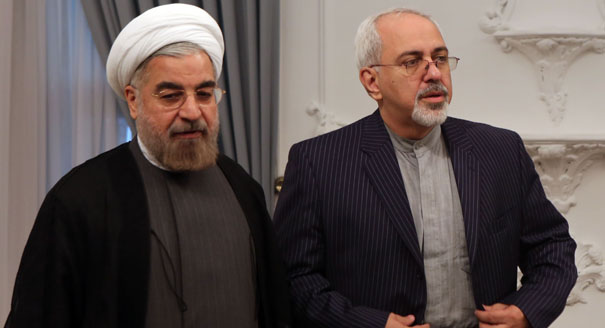
Source: Getty
While the United States and Iran have shared numerous adversaries, such as the Soviet Union, the Taliban, al-Qaeda, and now the Islamic Staet, the strategic enmity between the two countries has prevailed.
Source: European Council on Foreign Relations
“When you look at the main conflicts in today’s Middle East—Syria, Yemen, Bahrain, Lebanon, Iraq—one common element that transcends all these conflicts is the Iran-Saudi rivalry,” said Carnegie’s Karim Sadjadpour at the European Council on Foreign Relations. He explained that this conflict has three dimensions to it: ethnic, sectarian, and ideological. Both countries are confident that they’re the natural leader of the Islamic world and the Middle East, Sadjadpour continued.
In regards to the relationship between the United States and Iran, he argued that while both countries have shared numerous adversaries, such as the Soviet Union, the Taliban, al-Qaeda, and now the Islamic State, the strategic enmity between the United States and Iran has prevailed, driven more by Tehran than Washington. There’s a real fundamental incongruence between the urgent national security concerns of Iran, such as radical Sunni jihadism and Iran’s revolutionary ideology.
This presentation was originally published by European Council on Foreign Relations.

Senior Fellow, Middle East Program
Karim Sadjadpour is a senior fellow at the Carnegie Endowment for International Peace, where he focuses on Iran and U.S. foreign policy toward the Middle East.
Recent Work


Suzanne Maloney, Aaron David Miller, Karim Sadjadpour

Aaron David Miller, Karim Sadjadpour, Robin Wright
Carnegie does not take institutional positions on public policy issues; the views represented herein are those of the author(s) and do not necessarily reflect the views of Carnegie, its staff, or its trustees.

As we close out another season of Strategic Europe, it is worth taking stock of the deep shifts underway.

Rym Momtaz
The EU had to compromise to adopt a twenty-first sanctions package against Russia, exposing growing cracks in the union’s resolve. Is this latest, weaker round worth it to keep pressure on Moscow?
Rym Momtaz, ed.

Trump is distracted and Ukraine wants Europe to step up. The continent’s leaders must find their voice and assert it in talks with Russia.

Alissa de Carbonnel

Mounting economic strain and battlefield losses will not necessarily make the Kremlin less dangerous. They could instead push Moscow toward a more aggressive hybrid campaign designed to test NATO’s Eastern flank, exploit allied hesitation, and fracture European resolve.

Maksym Beznosiuk

Over the past ten years, NATO has held almost as many summits as it did during the entirety of the Cold War. Are they still useful, or is it time to stop holding annual meetings?
Rym Momtaz, ed.