

Commentary
Marc Pierini
{
  "authors": [
    "Marc Pierini"
  ],
  "type": "legacyinthemedia",
  "centerAffiliationAll": "dc",
  "centers": [
    "Carnegie Endowment for International Peace",
    "Carnegie Europe",
    "Malcolm H. Kerr Carnegie Middle East Center"
  ],
  "collections": [
    "Europe’s Southern Neighborhood"
  ],
  "englishNewsletterAll": "ctw",
  "nonEnglishNewsletterAll": "",
  "primaryCenter": "Carnegie Europe",
  "programAffiliation": "EP",
  "programs": [
    "Europe"
  ],
  "projects": [],
  "regions": [
    "Middle East",
    "Russia",
    "Europe",
    "Türkiye",
    "Levant",
    "Syria",
    "Iran"
  ],
  "topics": [
    "Political Reform",
    "Foreign Policy"
  ]
}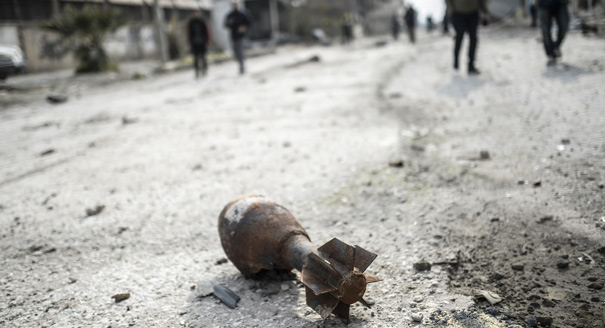
Source: Getty
Undoubtedly, the Syrian civil war will find its place in the history books as the ultimate example of cynical realpolitik.
Source: EUobserver
With the roar of conflict in eastern Ukraine, some disquieting developments in the Middle East might have been recently overlooked. Yet, interviews by Syrian president Bashar al-Assad and Turkish president Recep Tayyip Erdogan, a meeting of Syrian “opponents” in Moscow, and rumours inside the Washington Beltway add up to little hope for the Syrian quagmire.
In a recent interview with Jonathan Tepperman of Foreign Affairs, Assad clung to his usual mix of apparent overture and undented certainty that he and his clan are on the winning side of the Syrian war.
Alternating between a willingness to talk to genuine opponents (not exiled “puppets” of Western powers) and a readiness to co-operate with the United States against Islamic State militants, Assad ultimately delivered his father’s mantra - “Syria is the heart of the Middle East” - and one clear conclusion: “We all believe that Syria should go back to the way it was. We don’t have any other option”.In passing, Assad lashed out at Qatar, Saudi Arabia, and, most specifically, at Turkey for allegedly supporting the Islamic State.
Tepperman later took the unusual step of publishing an article in the Washington Post as well as a video to give his own impressions about Assad, “a man so unyielding and deeply deceptive - or delusional - that it’s impossible to imagine him ever negotiating an equitable end to Syria’s civil war.”
What the interview reveals - for those who have not met both father and son - is that Bashar al-Assad will cling to power irrespective of the destruction it requires. He will use any method to that end, from his residual stock of chemical weapons to alliance reversals to an extension of the conflict beyond Syria’s borders.
On Turkey’s side, there is no progress in sight either.
On 29 January, President Erdoğan explained on TRT Haber, a public television channel, his well-known position that a no-fly zone is necessary; that the fight against the Islamic State is not enough; and that the anti–Islamic State coalition should go after the Assad regime.
Meanwhile, Turkey will not let the coalition use the country’s air bases and will focus the bulk of its activity on humanitarian relief for Syrian refugees.
As impeccably logical as the link to the Assad regime may seem, Turkey’s position leaves an uneasy feeling in Western chancelleries, namely that the real reason for the Turkish lack of engagement against the Islamic State is in fact motivated by the sympathies among religious conservative voters for the Islamic State’s anti-Western narrative.
In Moscow on 26 and 27 January, a meeting of carefully handpicked “Syrian opponents” took place, followed on 28 and 29 January by meetings with the head of the Syrian delegation, ambassador Bashar Jaafari, and with Russian foreign minister Sergei Lavrov.
Moscow’s prudent intermediation is based on a group of opponents acceptable to Damascus and excludes any hint at regime change in Syria.
Unsurprisingly, the discussions did not yield a result.
Since the beginning of hostilities in eastern Ukraine, it has become clear that the Syrian civil war is being used by Moscow as an important “nuisance factor” in its multidimensional political conflict with Western powers.
It is certainly not of comparable importance to Crimea or Donbass, or even air force harassment tactics over northern Europe, but the Syrian conflict helps the Kremlin make its fierce opposition to the Western position felt once more.
As a sad reminder, observers must remember that the scale of the Syrian tragedy - 200,000 dead, 1 million injured, over 10 million displaced - doesn’t always impress in Moscow.
Last time I asked about this, the Russian answer was soberly blunt: “We lost 20 million in the Second World War.”
A number of other factors further compound the Syrian quagmire: US leader Barack Obama’s unwillingness to confront Assad militarily; the strong military involvement of Iran and Hezbollah on the ground; and the Russian weapon resupplies, which have been uninterrupted since spring 2011.
Given the seemingly intractable nature of the Syrian conflict, Washington has for some time been tempted to consider the “lesser of evils”: striking a deal with Assad.
The prospect of such a political arrangement is undoubtedly the most shameful that the millions of Syrian refugees or displaced people could ever imagine. And yet, it is no longer unimaginable given the resilience of the Islamic State and the impossibility to strike the militants effectively in northern Syria in the absence of an operational agreement with Turkey.
Two or three years ago, one could contemplate - albeit naively - the moment when Assad himself would become a liability to the Kremlin.
Not only did that moment not happen, but Syria has now become a “useful tragedy” in Moscow’s much wider anti-Western strategy.
No doubt, the Syrian civil war will find its place in the history books as the ultimate example of cynical realpolitik.

Senior Fellow, Carnegie Europe
Marc Pierini is a senior fellow at Carnegie Europe, where his research focuses on developments in the Middle East and Turkey from a European perspective.
Recent Work
Marc Pierini
Marc Pierini
Carnegie does not take institutional positions on public policy issues; the views represented herein are those of the author(s) and do not necessarily reflect the views of Carnegie, its staff, or its trustees.
Europe’s industrial supply chains leave it vulnerable to global shocks. The EU needs a pragmatic green industrial strategy that balances durable partnerships and bolsters homegrown clean tech without sacrificing low-carbon ambition.

Milo McBride, Pauline Gerard
Defense tech innovations will be at the heart of Europe’s new security strategy. But so far, Brussels has been making moves without a broader plan, undermining readiness and credibility.

Raluca Csernatoni

When the U.S.-Iran memorandum of understanding was announced, the UK, France, Germany, and Italy declared their readiness to help demine the Strait of Hormuz and lift nuclear sanctions on Tehran. But does Europe need new tools to recover a diplomatic role?

Rym Momtaz, ed.
The Franco-German relationship is on the rocks again. But unlike previous moments of tension, the epochal changes on the world stage require that both step up investment in their bilateral ties.
Rym Momtaz
As geopolitical rivalry weaponizes global supply chains, the EU’s true vulnerability lies in emerging-risk imports. For these goods, suppliers are growing more concentrated, substitution more difficult, and political risk is looming.

Sinan Ülgen