

Article
Thomas de Waal
{
  "authors": [
    "Thomas de Waal"
  ],
  "type": "commentary",
  "centerAffiliationAll": "",
  "centers": [
    "Carnegie Endowment for International Peace",
    "Carnegie Europe",
    "Carnegie Russia Eurasia Center"
  ],
  "collections": [],
  "englishNewsletterAll": "",
  "nonEnglishNewsletterAll": "",
  "primaryCenter": "Carnegie Europe",
  "programAffiliation": "",
  "programs": [],
  "projects": [
    "Eurasia in Transition"
  ],
  "regions": [
    "Middle East",
    "Türkiye",
    "Caucasus",
    "Armenia",
    "Western Europe"
  ],
  "topics": [
    "Foreign Policy"
  ]
}
Source: Getty
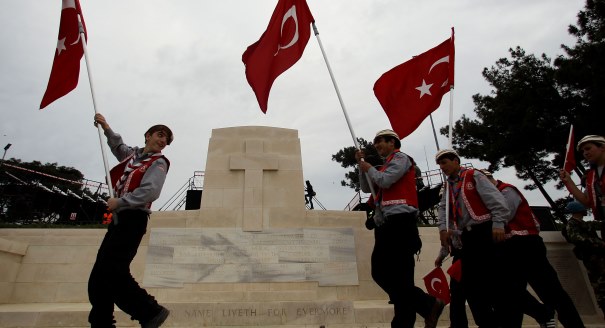
The Turkish government’s decision to hold a ceremony to commemorate the Gallipoli battles on April 24, in competition with the Armenian commemorations in Yerevan, looks like a political mistake.
In six weeks’ time, on April 24, Armenia and Turkey will hold competing centennial commemorations, each studying the international guest list to see who did and did not come.
It is a political row that could easily have been avoided if the Turkish government had moved its ceremony honoring the Battle of Gallipoli only one day later, to April 25. It has been obvious for many years that on April 24 Armenians will commemorate the centenary of the tragedy of 1915 they now know as the Armenian Genocide. They first marked that day in 1919 in British-administered Istanbul. In 1915, April 24 was the day that 200 Armenian leaders and intellectuals were arrested by the Ottoman authorities as a prelude to the mass deportation and partial destruction of the entire Armenian population of the empire.
April 25 was therefore the obvious day to hold international commemorations for the Gallipoli battles. Another possible date would have been March 18, the day in 1915 when the Allied force first sailed up the Straits and began the campaign. On that day in 1934, a moving and famous speech written by Turkish leader Mustafa Kemal (soon to be renamed Ataturk) was delivered. In it the mothers of his former adversaries were told to “wipe away their tears,” and that “there is no difference between the Johnnies and Mehmets to us, where they lie side by side here in this country of ours.”
However, current Turkish leader Recep Tayyip Erdoğan chose to hold the Gallipoli centennial ceremonies on April 24, precipitating a direct clash with the commemorations in Yerevan. The obvious conclusion is that this was a direct attempt to divert attention and guests from the Armenian commemorations.
By doing this, Erdoğan undid some of the good work he had done last year by issuing the first ever statement of condolences to the Armenians by a Turkish leader.
And it was also a political miscalculation. The Today Zaman newspaper reported on February 21 that preparations for the Gallipoli ceremonies had been suspended because “only five countries have accepted the invitation and they will not be represented by high-level officials.”
Official sources then dismissed the report, noting that Today Zaman is affiliated with Turkey’s new opposition, the Gulenist movement.
Even if it does go ahead, the Gallipoli ceremony lacks international resonance. It is fundamentally a story for six nations: Turkey, Australia, France, Great Britain, India, and New Zealand. Prince Charles will be coming from Britain, but there will be no high-level American guest for example.
Gallipoli and the Armenian deportations already had unfortunate connections that were best kept separate. The paranoid Young Turks may well have arrested the Armenian leaders as a kind of pre-emptive strike against presumed “fifth columnists” ahead of the anticipated Allied landings. The moving 1934 speech at Gallipoli was delivered on behalf of Ataturk by Interior Minister Şükrü Kaya, one of the Ottoman officials directly in charge of the Armenian deportations.
More recently, the Turkish government suggested it might not invite officials from New South Wales to the ceremony, after that Australian state parliament passed an Armenian genocide resolution.
For the government of Armenia, having a big turnout in Yerevan on April 24 is probably the main priority for 2015. (Although they would not say it out loud, it is probably a bigger priority than getting a genocide recognition resolution in the U.S. Congress.)
The Armenians have already secured the presence of French President Francois Hollande in Yerevan. And it is likely that a senior U.S. official, perhaps Secretary of State John Kerry, will attend as well.
Turkey has changed so much in the last few years that there will also be an Armenian remembrance ceremony on Taksim Square in the heart of Istanbul that same evening.
Fortunately, those who want to attend the ceremonies in both in Yerevan and in Istanbul—where the fateful events of April 24, 1915 actually occurred—may be able to do both. The travel company that runs the air link between Istanbul and Yerevan is planning to organize a special charter flight so that people can be part of the commemorations in both cities on the same day.

Senior Fellow, Carnegie Europe
Thomas de Waal is a senior fellow at Carnegie Europe, specializing in Eastern Europe and the Caucasus.
Recent Work
Thomas de Waal
Thomas de Waal
Carnegie does not take institutional positions on public policy issues; the views represented herein are those of the author(s) and do not necessarily reflect the views of Carnegie, its staff, or its trustees.

The aftermath of the Ceuta crisis shows Europe has drawn the wrong lessons. Rather than doubling down on failed migration policies, the EU needs to address the underlying roots of such episodes.

Richard Youngs

Canadian Prime Minister Mark Carney has twice inspired praise for standing up to U.S. President Donald Trump: at the 2026 World Economic Forum in Davos and on Canada-U.S. trade negotiations. Is Carney showing a third way better than the EU has in dealing with the Trump administration?

Rym Momtaz, ed.

The EU’s responses to two recent incidents expose the gulf between European perceptions and capabilities. Unless the union can bridge that gap, it will never become a real geostrategic power.
Rym Momtaz

European states control several Overseas Countries and Territories around the world that carry strategic, economic, and environmental weight. As great powers challenge the rules-based order, defending them is a geopolitical imperative for Europe.

Marc Pierini

In supporting Europe’s far-right, MAGA and Russia both want the same thing: a weaker EU. Europe must defend itself without abandoning the openness these forces exploit.

Armida van Rij