

Book
Europe is facing rising populism internally as well as external pressures from Russia, China, Turkey, and the United States.
Dimitar Bechev
{
  "authors": [
    "Mario Abou Zeid",
    "Mamoun Abu-Nowar",
    "Kamel Wazne"
  ],
  "type": "legacyinthemedia",
  "centerAffiliationAll": "dc",
  "centers": [
    "Carnegie Endowment for International Peace",
    "Malcolm H. Kerr Carnegie Middle East Center"
  ],
  "collections": [],
  "englishNewsletterAll": "menaTransitions",
  "nonEnglishNewsletterAll": "",
  "primaryCenter": "Malcolm H. Kerr Carnegie Middle East Center",
  "programAffiliation": "MEP",
  "programs": [
    "Middle East"
  ],
  "projects": [],
  "regions": [
    "Levant",
    "Syria",
    "Middle East"
  ],
  "topics": [
    "Political Reform",
    "Security"
  ]
}
Source: Getty
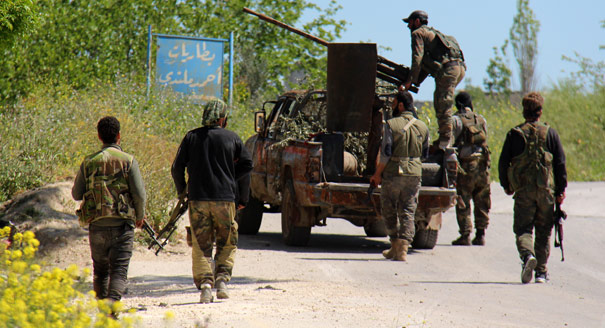
An alliance of opposition forces has seized control of a second strategic city from government troops.
Source: Al Jazeera’s Inside Story
A loose alliance of rebel groups in Syria is claiming a second significant victory against government forces in less than a month. The opposition offensive in northern Idlib province was spearheaded by al-Qaeda’s affiliate in Syria, Nusra Front. Fighting under the banner, “Army of Conquest,” rebel allies seized control of the provincial capital Idlib at the end of March.
A broader union of fighters says it has now overrun nearby Jisr al Shughur. The city was one of the first places to take up arms against president Assad, when security forces cracked down on protests.
The fight for Idlib province comes ahead of UN-backed talks in Geneva on May 4.
So can opposition groups present a united front in the push for peace? Or will the pursuit of different agendas eclipse the fight against a common enemy? Carnegie’s Mario Abou Zeid spoke with Al Jazeera’s Inside Story.
This interview was originally broadcast by Al Jazeera’s Inside Story.

Former Research Analyst, Middle East Center
Abou Zeid was a research analyst at the Carnegie Middle East Center, where his work focuses on political developments in Lebanon, Syria, Iraq, and Iran.
Mamoun Abu-Nowar
Kamel Wazne
Carnegie does not take institutional positions on public policy issues; the views represented herein are those of the author(s) and do not necessarily reflect the views of Carnegie, its staff, or its trustees.

Europe is facing rising populism internally as well as external pressures from Russia, China, Turkey, and the United States.

Dimitar Bechev

A notable degree of participative democracy has firmly arrived in Europe. But to have more far-reaching impact, democratic deliberation needs to move into a radically new phase.

Richard Youngs

Before the next wave of EU enlargement takes place, the union needs to grapple with thorny questions of how power is distributed among its members.


Emil Sondaj Hansen, Ditte Brasso Sørensen

The new U.S.–Denmark–Greenland agreement will help Washington exert political, economic, and financial dominance under the guise of security. Yet, it acknowledged Copenhagen’s and Nuuk’s sovereignty on the island.

Marc Pierini

A summer of escalation in the Black Sea has hurt Ukraine economically and is exacerbating world food security. A truce is needed—as is a broader reframing of Europe’s Ukraine strategy.

Thomas de Waal