

• Research
  • Strategic Europe
  • About
  • Experts
Carnegie Europe logoCarnegie lettermark logo
EUUkraine
  • Donate
{
  "authors": [
    "Maha Yahya",
    "Rod Nordland",
    "Christopher Gunness",
    "Aymenn Jawad Al-Tamimi",
    "Wayne White"
  ],
  "type": "legacyinthemedia",
  "centerAffiliationAll": "dc",
  "centers": [
    "Carnegie Endowment for International Peace",
    "Malcolm H. Kerr Carnegie Middle East Center"
  ],
  "collections": [],
  "englishNewsletterAll": "menaTransitions",
  "nonEnglishNewsletterAll": "",
  "primaryCenter": "Malcolm H. Kerr Carnegie Middle East Center",
  "programAffiliation": "MEP",
  "programs": [
    "Middle East"
  ],
  "projects": [],
  "regions": [
    "Gulf",
    "Levant",
    "Iraq",
    "Middle East"
  ],
  "topics": [
    "Political Reform",
    "Security"
  ]
}

Source: Getty

In The Media
Malcolm H. Kerr Carnegie Middle East Center

ISIS: Is the Caliphate Cracking?

There are signs of internal dissension within the self-proclaimed Islamic State. But even if it is in partial retreat, it is a likely threat in the Middle East—and to Western interests—for years to come.

Link Copied
By Maha Yahya, Rod Nordland, Christopher Gunness, Aymenn Jawad Al-Tamimi, Wayne White
Published on Apr 9, 2015

Source: KCRW’s To the Point

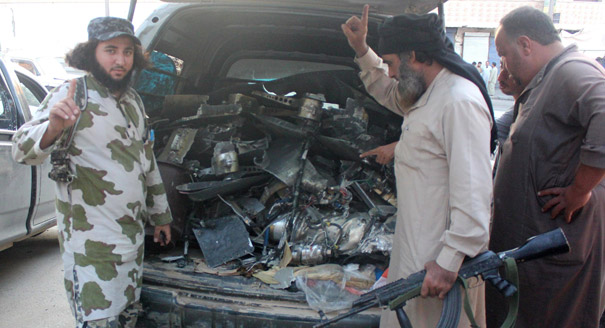
The losses of Kobani in Syria and Tikrit in Iraq are being taken as evidence that the so-called Islamic State is in trouble. Its revenue is reportedly drying up, and untrained recruits are replacing experienced soldiers. But ISIS still is spreading terror.

Iraq’s Prime Minister Haider Al-Abadi is due at the White House on Tuesday, and it’s all about the war against ISIS, the so-called Islamic State. Last year, ISIS looked like the world’s most dangerous terrorist group—intent on restoring the Caliphate that once ruled all Muslims. Unique for extreme brutality and brilliant Internet propaganda, ISIS forced the United States and Iran into an unlikely coalition against it. Now, ISIS is losing captured territory, its sources of money and even competent soldiers. There are signs of internal dissension. But even if it's in partial retreat, it’s a likely threat in the Middle East—and to Western interests—for years to come.

Guests:
Rod Nordland, New York Times (@rodnordland)
Christopher Gunness, United Nations Relief and Works Agency (@ChrisGunness)
Aymenn Jawad Al-Tamimi, Middle East Forum (@ajaltamimi)
Wayne White, Middle East Policy Council (@middleeastinst)
Maha Yahya, Carnegie Middle East Center (@CarnegieMEC)

This apperance was originally broadcast on KCRW’s To the Point.

About the Authors

Maha Yahya

Director, Malcolm H. Kerr Carnegie Middle East Center

Maha Yahya is director of the Malcolm H. Kerr Carnegie Middle East Center, where her research focuses on citizenship, pluralism, and social justice in the aftermath of the Arab uprisings.

Rod Nordland

Christopher Gunness

Aymenn Jawad Al-Tamimi

Wayne White

Authors

Maha Yahya
Director, Malcolm H. Kerr Carnegie Middle East Center
Maha Yahya
Rod Nordland
Christopher Gunness
Aymenn Jawad Al-Tamimi
Wayne White
Political ReformSecurityGulfLevantIraqMiddle East

Carnegie does not take institutional positions on public policy issues; the views represented herein are those of the author(s) and do not necessarily reflect the views of Carnegie, its staff, or its trustees.

More Work from Carnegie Europe

  • Commentary
    Strategic Europe
    Taking the Pulse: Is it NATO’s Job to Support Trump’s War of Choice?

    Donald Trump has demanded that European allies send ships to the Strait of Hormuz while his war of choice in Iran rages on. He has constantly berated NATO while the alliance’s secretary-general has emphatically supported him.

      • Rym Momtaz

      Rym Momtaz, ed.

  • Commentary
    Strategic Europe
    Russia’s Imperial Retreat Is Europe’s Strategic Opportunity

    The war in Ukraine is costing Russia its leverage overseas. Across the South Caucasus and Middle East, this presents an opportunity for Europe to pick up the pieces and claim its own sphere of influence.

      William Dixon, Maksym Beznosiuk

  • Research
    Planetary vs International Security: Economic Growth at the Crossroads

    Economic growth is at the heart of a dilemma between planetary and international security.

      Olivia Lazard

  • Commentary
    Strategic Europe
    Europe and the Arab Gulf Must Come Together

    The war in Iran proves the United States is now a destabilizing actor for Europe and the Arab Gulf. From protect their economies and energy supplies to safeguarding their territorial integrity, both regions have much to gain from forming a new kind of partnership together.

      • Rym Momtaz

      Rym Momtaz

  • Commentary
    Strategic Europe
    Taking the Pulse: Is France’s New Nuclear Doctrine Ambitious Enough?

    French President Emmanuel Macron has unveiled his country’s new nuclear doctrine. Are the changes he has made enough to reassure France’s European partners in the current geopolitical context?

      • Rym Momtaz

      Rym Momtaz, ed.

Get more news and analysis from
Carnegie Europe
Carnegie Europe logo, white
Rue du Congrès, 151000 Brussels, Belgium
  • Research
  • Strategic Europe
  • About
  • Experts
  • Projects
  • Events
  • Contact
  • Careers
  • Privacy
  • For Media
  • Gender Equality Plan
Get more news and analysis from
Carnegie Europe
© 2026 Carnegie Endowment for International Peace. All rights reserved.