

In The Media
Jessica Tuchman Mathews
{
  "authors": [
    "Jessica Tuchman Mathews"
  ],
  "type": "legacyinthemedia",
  "centerAffiliationAll": "",
  "centers": [
    "Carnegie Endowment for International Peace",
    "Malcolm H. Kerr Carnegie Middle East Center"
  ],
  "collections": [
    "Iranian Proliferation"
  ],
  "englishNewsletterAll": "",
  "nonEnglishNewsletterAll": "",
  "primaryCenter": "Carnegie Endowment for International Peace",
  "programAffiliation": "",
  "programs": [],
  "projects": [],
  "regions": [
    "Middle East",
    "Iran"
  ],
  "topics": [
    "Political Reform",
    "Foreign Policy",
    "Nuclear Policy",
    "Global Governance"
  ]
}
Source: Getty
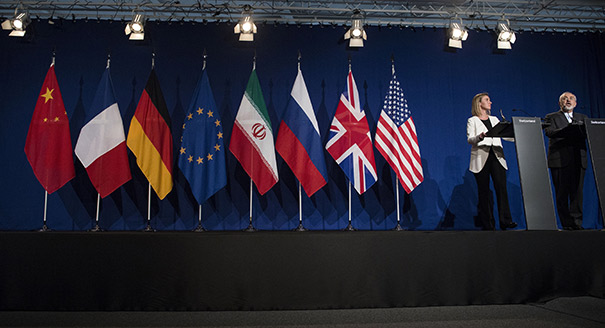
The agreement with Iran, if one is finally reached, will not be the end, but a beginning. It must be strong and carefully framed and minutely monitored, but it need not be watertight in order for it to ultimately open the way to a permanently nonnuclear Iran.
Source: New York Review of Books
The following article will appear in the May 7, 2015 issue of The New York Review.
During the months of negotiating a nuclear agreement with Iran, opponents of a deal have loudly anticipated failure, either because a deal wouldn’t be reached, wouldn’t be good enough, or wouldn’t be upheld by Tehran. Charging that the impending deadline made the US too eager to reach a deal, House Speaker John Boehner unaccountably made the pressure worse by announcing that if a deal wasn’t struck soon, Congress would immediately impose new sanctions on Iran—an act that would preemptively destroy any hope of a final agreement.Republican presidential candidates one-upped each other in expressing disapproval of the negotiations. Scott Walker promised to revoke the deal on “day one” in the White House. Ted Cruz said that anyone who doesn’t reject the deal “isn’t fit to be president.” Senate Foreign Relations Committee Chairman Bob Corker promoted an early vote on a bill that ostensibly would give Congress a voice on the acceptability of the deal but was actually laced with poison pills that could destroy the negotiating process. So while most Americans hoped for an agreement, Congress geared up to restart a ferocious debate on a question of paramount national security about an agreement that did not yet exist.
The deal finally reached on April 2 was a surprise. While the announcement referred only to “parameters,” summarized in individual press releases by each participant country, taken together, the elements that were made public are stronger than outsiders (and, reportedly, some insiders) expected. Iran agrees to cut the number of its centrifuges from about 19,000 to 6,100 (5,060 in operation). Rather than export its 10,000-kilogram stockpile of enriched uranium, Iran agrees to shrink it to 300 kilograms. As was expected, no facilities are to be destroyed, but the underground enrichment facility at Fordow, of particular concern because it is impervious to most bombing, will be converted to a research center.* No enrichment will take place there for at least fifteen years. The plutonium-producing reactor at Arak will be permanently reconfigured, and Iran has committed “indefinitely” not to reprocess spent fuel, the process that separates out the pure plutonium needed for a bomb. Various commitments last from ten to as long as twenty-five years...
This article was originally published in the New York Review of Books.

Distinguished Fellow
Mathews is a distinguished fellow at the Carnegie Endowment for International Peace. She served as Carnegie’s president for 18 years.
Recent Work
Jessica Tuchman Mathews
Jessica Tuchman Mathews
Carnegie does not take institutional positions on public policy issues; the views represented herein are those of the author(s) and do not necessarily reflect the views of Carnegie, its staff, or its trustees.

European Commission President Ursula von der Leyen is about to give her annual address on the state of the EU. Here’s what she won’t—but should—say.

Rym Momtaz

The aftermath of the Ceuta crisis shows Europe has drawn the wrong lessons. Rather than doubling down on failed migration policies, the EU needs to address the underlying roots of such episodes.

Richard Youngs

Canadian Prime Minister Mark Carney has twice inspired praise for standing up to U.S. President Donald Trump: at the 2026 World Economic Forum in Davos and on Canada-U.S. trade negotiations. Is Carney showing a third way better than the EU has in dealing with the Trump administration?
Rym Momtaz, ed.

The EU’s responses to two recent incidents expose the gulf between European perceptions and capabilities. Unless the union can bridge that gap, it will never become a real geostrategic power.
Rym Momtaz

European states control several Overseas Countries and Territories around the world that carry strategic, economic, and environmental weight. As great powers challenge the rules-based order, defending them is a geopolitical imperative for Europe.

Marc Pierini