

Paper
Ashley J. Tellis
{
  "authors": [
    "Ashley J. Tellis"
  ],
  "type": "legacyinthemedia",
  "centerAffiliationAll": "dc",
  "centers": [
    "Carnegie Endowment for International Peace"
  ],
  "collections": [],
  "englishNewsletterAll": "ctw",
  "nonEnglishNewsletterAll": "",
  "primaryCenter": "Carnegie Endowment for International Peace",
  "programAffiliation": "SAP",
  "programs": [
    "South Asia"
  ],
  "projects": [],
  "regions": [
    "North America",
    "United States",
    "South Asia",
    "India",
    "East Asia",
    "China"
  ],
  "topics": [
    "Security",
    "Foreign Policy"
  ]
}
Source: Getty
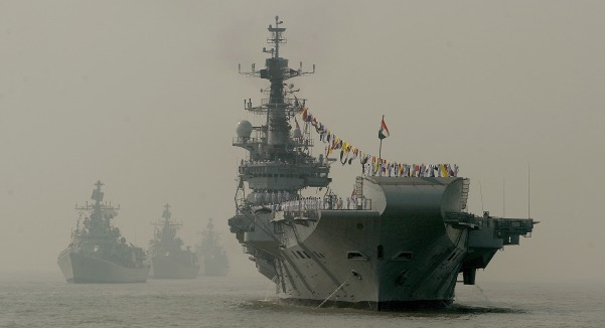
Joint development of India’s next-generation aircraft carrier could be the next big idea in Indian-U.S. relations.
Source: Hindustan Times
Ever since the conclusion of the India-US nuclear deal, policymakers have wondered what the next “big idea” in transforming bilateral ties might be. Though no successor initiative could ever replicate that accord, there exists an opportunity that holds the promise of making new waves in bilateral collaboration if only Washington and New Delhi are imaginative enough to grasp it: jointly developing India’s next-generation aircraft carrier.
Working together to develop this vessel promises to substantially bolster India’s naval combat capabilities, fend off the emerging Chinese challenge to India’s control of the Indian Ocean, and cement the evolving strategic bond between the United States and India for many decades to come.
During President Barack Obama’s January 2015 visit to India, the two nations agreed to “form a working group to explore aircraft carrier technology sharing and design.” Prime Minister Narendra Modi, disregarding the reservations of some of his advisers, boldly chose to accept the US offer of partnership.In so doing, Modi was guided by a clear recognition of the importance of the Indian Ocean for both India’s prosperity and its security—and his conviction that a strong Indian Navy, with the most capable sea-based aviation possible, was essential for the realisation of India’s strategic aims.
These aims, which include preserving secure maritime frontiers, are on the cusp of challenge by the People’s Liberation Army Navy (PLAN).
Thanks to its anti-piracy patrols in the Gulf of Aden, Beijing has already taken the first steps towards maintaining a near-continuous presence in the western Indian Ocean. Chinese nuclear and conventional attack submarines have recently undertaken their first operational cruises in the wider basin, and since 2012, Chinese ships have systematically conducted oceanographic and bathymetric surveys, almost certainly as a prelude to major (and perhaps extended) deployments in the future.
The prospect of a major Chinese naval presence in the Indian Ocean, therefore, promises transform a hitherto secure rear into a springboard from which coercive power can be brought to bear in new directions against the Indian landmass.
In this context, the future appearance of a Chinese aircraft carrier and its associated escorts in the Indian Ocean would signal a major shift in the regional balance of power.
Because aircraft carriers make a qualitative difference to a country’s power projection capabilities, the likelihood of such a Chinese presence, especially during a crisis or a conflict, justifies developing the requisite Indian capabilities necessary to neutralise it.
While attack submarines and land-based air power are important components of such a defence, carrier capabilities are highly desirable as well because they would complicate PLAN operations by forcing the Chinese fleet to guard against attacks from their seaward side, even as they coped with offensive operations emanating from the Indian peninsula.
In preparing for such contingencies, cooperative development of the Indian Navy’s next large-deck aircraft carrier is a very big deal—industrially, operationally, and strategically. No country today has the technical capacity to design and build aircraft carriers like the United States. And no country today would profit as much from collaborating with the US in carrier design and construction as India.
Consummating this aspiration will require partnering in everything from vessel design to physical construction to sea trials. The Indian Navy, undoubtedly, will lead this effort, which is already underway: its Naval Design Bureau has completed the technology assessment, feasibility studies, and analysis of alternatives, and is now deeply immersed in activities relating to engineering design. At this point, therefore, there is a quickly closing window of opportunity for a comprehensive partnership with the US Naval Sea Systems Command and, as appropriate, with US private industry.
Partnership with these entities in all the major functional areas associated with ship design would permit the Indian Navy to build the most formidable man-o’-war possible. What the Indian sea service should not do in any case is to succumb to the temptation of making the bilateral partnership merely an exercise in procuring specific technologies: that would deny New Delhi the potential of developing the most effective aircraft carrier imaginable and it would represent a lost opportunity to further deepen the India-US strategic partnership.
Beyond technical assistance, shared doctrine, training, and intelligence are equally vital for ensuring the continued superiority of the Indian Navy over its Chinese counterpart in the Indian Ocean.
To assure this outcome, the current pattern of military-to-military interactions ought to be bolstered further. The US and Indian navies should plan an ambitious schedule of small and large exercises that specifically involve carrier battle groups on both sides, paying particular attention to honing their respective skills in anti-air, anti-surface, and anti-submarine warfare.
These activities should not be restricted to bilateral interactions alone but, as has slowly become the norm in recent years, should involve all the key regional partners such as Japan, Australia, Singapore, and eventually, even Vietnam.
If the United States were to partner with India now in developing its first indigenously constructed supercarrier, it will have contributed mightily to aiding the Indian Navy to meet the emerging Chinese naval threat while simultaneously becoming a “net provider of security” in the Indian Ocean.
It would send a powerful signal that India-US defence cooperation is intended to advance their highest mutual interests, including preserving, as former Secretary of State Condoleezza Rice once phrased it, an Asian “balance of power that favours freedom.” And, finally, it would signal to important—but still sceptical—Indian audiences, especially in the military, that the United States can collaborate with India on vital projects of strategic import in ways that only Russia and Israel have done thus far.
This article was originally published in the Hindustan Times.
Former Senior Fellow
Ashley J. Tellis was a senior fellow at the Carnegie Endowment for International Peace.
Recent Work
Ashley J. Tellis
Ashley J. Tellis
Carnegie does not take institutional positions on public policy issues; the views represented herein are those of the author(s) and do not necessarily reflect the views of Carnegie, its staff, or its trustees.

European Commission President Ursula von der Leyen is about to give her annual address on the state of the EU. Here’s what she won’t—but should—say.

Rym Momtaz

Radical-right parties are expected to do well in upcoming elections in four of the EU's biggest member states. If successful, they could prevent the union from addressing key challenges ahead.

Stefan Lehne

The aftermath of the Ceuta crisis shows Europe has drawn the wrong lessons. Rather than doubling down on failed migration policies, the EU needs to address the underlying roots of such episodes.

Richard Youngs

Canadian Prime Minister Mark Carney has twice inspired praise for standing up to U.S. President Donald Trump: at the 2026 World Economic Forum in Davos and on Canada-U.S. trade negotiations. Is Carney showing a third way better than the EU has in dealing with the Trump administration?
Rym Momtaz, ed.

The EU’s responses to two recent incidents expose the gulf between European perceptions and capabilities. Unless the union can bridge that gap, it will never become a real geostrategic power.
Rym Momtaz