

In The Media
Vikram Nehru
{
  "authors": [
    "Vikram Nehru"
  ],
  "type": "other",
  "centerAffiliationAll": "",
  "centers": [
    "Carnegie Endowment for International Peace"
  ],
  "collections": [],
  "englishNewsletterAll": "",
  "nonEnglishNewsletterAll": "",
  "primaryCenter": "Carnegie Endowment for International Peace",
  "programAffiliation": "",
  "programs": [],
  "projects": [],
  "regions": [
    "Southeast Asia",
    "Myanmar"
  ],
  "topics": [
    "Political Reform",
    "Democracy"
  ]
}
Source: Getty
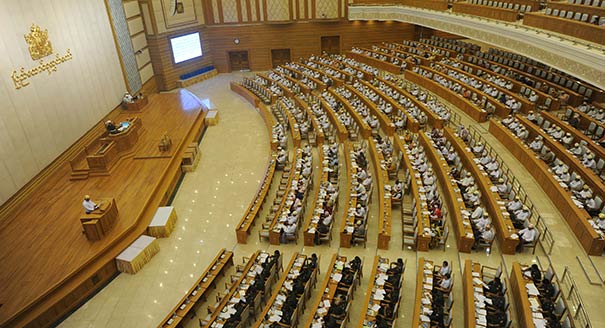
The likelihood that potential constitutional amendments in Myanmar will influence the 2015 general election is small to negligible.
Myanmar is having its own high-level six-party talks on constitutional reform including the most influential political personalities in the country:
Two meetings have already been held; a third is expected soon. But apart from calling the meetings a success, participants have been tight-lipped about what has been discussed and whether any agreements have been reached.
The talks have generated speculation about an impending announcement of constitutional amendments that may influence the 2015 general election. But the likelihood of this is small to negligible. This backgrounder explains why.
The 2008 constitution prepared by the military junta under Senior General Than Shwe provides for new democratic institutions and elections, but it also guarantees that the military retains significant legislative and executive authority as well as full control over all internal military and security matters. The provisions reflected the ruling military junta’s deeply held belief that the military was the only institution capable of maintaining Myanmar’s unity and territorial integrity and protecting its citizens from enemies, foreign and domestic.
Article 436 stipulates that amendments to the constitution require a supermajority of parliamentary support, exceeding 75 percent of the vote. Since the constitution reserves a quarter of the seats in the lower house for Myanmar’s military, this effectively gives the military a de facto veto over any constitutional change.
Article 59(f) bars any candidate for president whose spouse, children, or parents are foreign citizens, which was designed specifically to prevent Aung San Suu Kyi from ever attaining the highest office in the land (her children are British).
Under domestic and international pressure to amend these two constitutional articles, President Thein Sein created a constitutional review committee in 2013. But since then, little progress has been made.
A draft constitutional reform bill could be submitted for discussion during the next parliamentary session, but much will depend on whether the six-party talks make headway.
Even if there were to be agreement on proposed constitutional amendments, Article 436(a) requires that any significant changes be put to a nationwide referendum.
But there is little chance this could happen before the end of May, when the rainy season commences and makes the logistics of a nationwide vote virtually impossible in a country with little infrastructure. Moreover, the government does not appear to have made any plans or logistical preparations or even finalized voter lists for a referendum.
So a referendum in May is unlikely. If parliament and the Thein Sein administration are serious about holding one, then the earliest it could be held would be in November as a parallel exercise to the election.
In any event, a referendum on constitutional amendments would neither affect the November election nor influence its results. The new parliament would first have to ratify the referendum results and then consider the pace and manner of implementation. For example, if the referendum vote favors eliminating the military’s veto over constitutional change, then the next administration and parliament would determine when and how to implement the transition.
Thus, while the referendum is unlikely to shape the outcome of the 2015 election, the results of the election will have a significant bearing on how swiftly the referendum’s outcome will be implemented.
Last Updated: May 6, 2015
Former Nonresident Senior Fellow, Asia Program
Nehru was a nonresident senior fellow in the Carnegie Asia Program. An expert on development economics, growth, poverty reduction, debt sustainability, governance, and the performance and prospects of East Asia, his research focuses on the economic, political, and strategic issues confronting Asia, particularly Southeast Asia.
Recent Work
Vikram Nehru
Vikram Nehru
Carnegie does not take institutional positions on public policy issues; the views represented herein are those of the author(s) and do not necessarily reflect the views of Carnegie, its staff, or its trustees.
Excitement is in the air following Aleksandar Vučić’s defeat in Serbia. To build a truly democratic state, the movement that unseated the former president must learn from the mistakes of the past.

Ivan Vejvoda

A notable degree of participative democracy has firmly arrived in Europe. But to have more far-reaching impact, democratic deliberation needs to move into a radically new phase.

Richard Youngs

The domestic impacts of how long it is taking to end the war in Ukraine have pushed the French electorate to the political extremes and compromised the country’s diplomatic capacity.

Rym Momtaz

Before the next wave of EU enlargement takes place, the union needs to grapple with thorny questions of how power is distributed among its members.


Emil Sondaj Hansen, Ditte Brasso Sørensen

Radical-right parties are expected to do well in upcoming elections in four of the EU's biggest member states. If successful, they could prevent the union from addressing key challenges ahead.

Stefan Lehne