

Research
- +6
Yasmine Farouk, Nathan J. Brown, Maysaa Shuja Al-Deen, …
{
  "authors": [
    "Michele Dunne"
  ],
  "type": "legacyinthemedia",
  "centerAffiliationAll": "dc",
  "centers": [
    "Carnegie Endowment for International Peace",
    "Malcolm H. Kerr Carnegie Middle East Center"
  ],
  "collections": [
    "Arab Awakening"
  ],
  "englishNewsletterAll": "menaTransitions",
  "nonEnglishNewsletterAll": "",
  "primaryCenter": "Carnegie Endowment for International Peace",
  "programAffiliation": "MEP",
  "programs": [
    "Middle East"
  ],
  "projects": [],
  "regions": [
    "Middle East",
    "North Africa",
    "Levant"
  ],
  "topics": [
    "Political Reform",
    "Security",
    "Economy"
  ]
}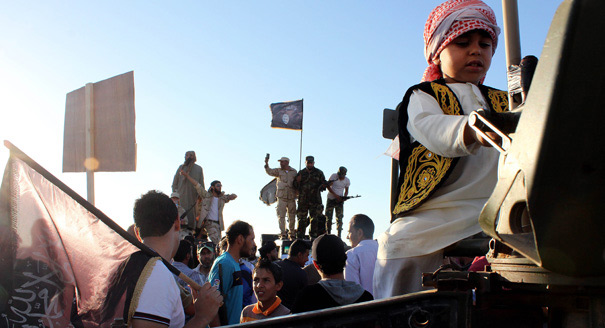
Source: Getty
Youth unemployment in the Middle East is among the highest in the world but it remains an inadequate explanation for radicalization.
Source: World Economic Forum
“There is no space for young people, who are under lots of pressure,” an Egyptian journalist told me, adding that “ISIS is playing in the back of everyone’s mind,” a rather shocking comment coming as it did from an avowedly secular, educated young man from an affluent background.
Anecdotal accounts of why young people from Egypt, Tunisia and other countries in the Middle East and North Africa (MENA) region join or at least support jihadi movements often mention a sense of grave injustice related to personal or political grievances, paired with profound alienation from their own societies.
According to Imen Triki, a lawyer who has represented many jihadis returning to Tunisia, “In Syria, they are told they’ll get houses, they’ll get wives. These people are so alienated from our society that some choose this option in a heartbeat.” A sense of purpose also seems to be an important motivator; “I would prefer to die a martyr in Syria than drinking beer here in Tunis,” said one young man from a poor district of the city.Unemployment as one among several contributors to youth alienation comes up repeatedly in discussions of radicalization, and it stands to reason that young people with no prospects may be easily lured by promises of work and status. The statistics on youth unemployment in MENA are stunning, the highest in the world, ranging between 25% and 60% in much of the region, according to a recent report by Education for Employment.
Certainly youth in the region are keenly aware of the problem; in a recent survey of 18-35-year old residents of MENA countries, on average 80% said that unemployment is a major issue, with that figure rising to over 90% among those surveyed in Egypt, Tunisia, Morocco, Jordan, Lebanon and Syria. Compounding the problem is the fact that those with university educations are even more likely than their less-educated counterparts to be unemployed or underemployed, and to be stuck in a prolonged period of “waithood”; observers since de Tocqueville have noted that those who rebel are often not the most disadvantaged members of a society, but rather those with disappointed expectations of economic and social advancement.
Still, youth unemployment in MENA alone remains an inadequate explanation for radicalization, as there is much anecdotal evidence of those who left jobs, spouses, even children to join jihadi causes. Ahmed al-Darawy is a case in point: a 38-year old Egyptian from a prosperous family, who became a police officer in hopes of furthering reform. He became disillusioned with the police but started a successful career in telecommunications, joined the 2011 revolution as a secular activist and even ran for parliament ‒ but then despaired of real change once secular and Islamist activists turned against each other in 2013.
He left for Syria, where he was killed in May 2014 fighting for ISIS. Darawy’s story is one of high expectations and serial disappointment leading to despair; as a fellow activist said, “we had huge ambitions … when none of them was realized, the disappointment was as high as the ambitions.”
In fact, Darawy’s story suggests a different sort of link between unemployment and radicalization ‒ that both may be related to frustrated expectations. Education for Employment, which has worked on tackling the youth employment challenge in MENA since 2002, notes a “grave mismatch” between the skills demanded by employers and those offered by universities in the region; and that even when youth have merit and motivation, many lack the personal connections needed to get good jobs.
Only the private sector can generate those jobs and it should, in theory, invest in education to prepare the labour force. But EFE reports that MENA governments have in general been hostile to private sector business, especially when it comes to individual entrepreneurs and SMEs without connections to government ‒ the very companies most likely to generate jobs for youth entering the workforce.
To move beyond the oft-repeated arguments about youth unemployment and radicalization, one might consider them as two phenomena with roots in a single problem: the unwillingness of many MENA governments and ruling elites to give space to a rising generation, which wants to carry out bottom-up change that is economic (led by entrepreneurs and SMEs) as well as political and social (led by social movements, civil society, and political parties).
In some ways the dignity-and-freedom uprisings of 2011 and what my colleague Maha Yahya has called the “fatal attraction” of Arab youth to ISIS are two sides of the same coin: a young generation rejecting the economic and political order that their parents built or at least accepted. When an American doctoral student who spent time with Salafi Islamists asked one why the jihadis were always smiling while other young Tunisians seemed glum, the Tunisian replied, “It’s because we have hope.”
Youth also feel a strong hostility from their elders; a young Egyptian blogger recently told me he sensed a “revenge agenda” against his entire generation from the state, particularly the police, for the role of youth in the 2011 uprising. This generational conflict is palpable in the MENA region now, and constitutes a major obstacle to turning the region’s youth bulge into a demographic dividend instead of a security liability.
This article was originally published by the World Economic Forum.

Former Nonresident Scholar, Middle East Program
Michele Dunne was a nonresident scholar in Carnegie’s Middle East Program, where her research focuses on political and economic change in Arab countries, particularly Egypt, as well as U.S. policy in the Middle East.
Recent Work



Yasmine Farouk, Nathan J. Brown, Maysaa Shuja Al-Deen, …
Robert Springborg, Emile Hokayem, Becca Wasser, …
Carnegie does not take institutional positions on public policy issues; the views represented herein are those of the author(s) and do not necessarily reflect the views of Carnegie, its staff, or its trustees.

European states control several Overseas Countries and Territories around the world that carry strategic, economic, and environmental weight. As great powers challenge the rules-based order, defending them is a geopolitical imperative for Europe.

Marc Pierini

Mounting economic strain and battlefield losses will not necessarily make the Kremlin less dangerous. They could instead push Moscow toward a more aggressive hybrid campaign designed to test NATO’s Eastern flank, exploit allied hesitation, and fracture European resolve.

Maksym Beznosiuk

Over the past ten years, NATO has held almost as many summits as it did during the entirety of the Cold War. Are they still useful, or is it time to stop holding annual meetings?

Rym Momtaz, ed.

As the EU confronts profound challenges, several leaders have called for fundamental reform to the union’s model—but only modest, superficial changes have resulted. What if Europe really could be reimagined from zero today: What should such a redesigned European order look like?

Richard Youngs, ed.

As Russia's war on Ukraine drags on, NATO is expanding its footprint in the Black Sea. Turkey, Romania, and Bulgaria are upgrading their fleets and deepening trilateral cooperation.

Dimitar Bechev