

Commentary
Andrei Kolesnikov
{
  "authors": [
    "Andrei Kolesnikov"
  ],
  "type": "legacyinthemedia",
  "centerAffiliationAll": "",
  "centers": [
    "Carnegie Endowment for International Peace",
    "Carnegie Russia Eurasia Center"
  ],
  "collections": [],
  "englishNewsletterAll": "",
  "nonEnglishNewsletterAll": "",
  "primaryCenter": "Carnegie Endowment for International Peace",
  "programAffiliation": "",
  "programs": [],
  "projects": [],
  "regions": [
    "Middle East",
    "Syria",
    "Russia"
  ],
  "topics": [
    "Political Reform",
    "Foreign Policy"
  ]
}
Source: Getty
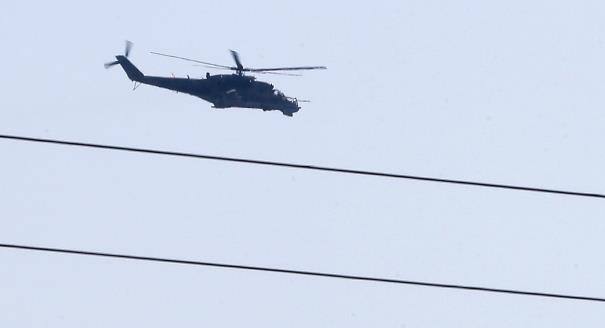
Russia’s involvement in Syria helps Vladimir Putin distract Russians from their country’s economic woes. However, Russian power seems to lack any long-term vision.
Source: Project Syndicate
When Russian President Vladimir Putin addressed the United Nations General Assembly on September 28, he knew he would grab the world’s attention and upstage US President Barack Obama with his call for a united front in the battle against the Islamic State. But Putin was addressing Russians, too, knowing full well the need to distract them from their country’s increasingly obvious economic woes.
Last year, the distraction was the annexation of Crimea, followed by the encouragement of pro-Russia separatists in eastern Ukraine. The recent dispatch of Russian aircraft, missiles, and a few thousand troops to Syria is a flag-waving substitute for that failed “Novorossiya” project. Putin’s critics rightly see his Syrian adventure as yet another appeal to Russian nostalgia for the Soviet past: the USSR was mighty – and Putin claims that Russia can and does have the same power.
But to what end? Wrong-footing the United States and the West may be good tactics in the short term, but there seems to be no long-term vision of the purposes that Russian power is supposed to serve, other than to preserve the power of Russia’s elites. As a result, the regime mimics the forms of democracy while using its propaganda to foment an aggressive form of nationalism.In the early years of this century the combination of high oil prices and economic growth dulled the elites’ appetite for strategic thinking and allowed them to ignore the subsequent rollback of health-care, education, and social-welfare reforms. The regime and the public now see the current situation as more or less normal – a “non-crisis crisis.” Because perception shapes reality, everything is normal, nothing has to be done, and Putin – having supposedly restored Russia’s dignity – can enjoy his approval ratings of more than 80%.
To Putin, restoring Russia’s dignity is the same as resurrecting its “great-power status” following the collapse of the Soviet Union and its humiliating “defeat” by the West in the Cold War. Exercising power externally apparently compensates for the fact that dignity within the country is far from restored: Today’s Russian citizen remains defenseless before his bosses, the utility companies, the courts, and the police – and yet, whatever his hardships, he remains proud of his nation and its leader.
There is, of course, another explanation of why Putin’s popularity is still growing in the face of a worsening economy: those unable to fend for themselves naturally look to the state for help – and are hardly likely to bite the hand feeds them. What Westerners decry as human-rights abuses ordinary Russians are likely to praise as policies to rid the country of “alien” practices and protect the majority from the “subversive” minority. The regime’s hostility toward gays and lesbians may offend the West, but it strikes a sympathetic chord with most Russians.
Because those same Russians regard the war in Ukraine as defensive and just, war becomes justified; history’s dark pages are rewritten; and hostile language becomes the norm. Not long ago, ordinary Russians spoke openly about the number of deaths and casualties suffered in their country’s military operations; now, following Putin’s presidential decree on “secret losses,” they keep quiet. Even though the decree may well conflict with the Russian Constitution and the Law on State Secrets, the list of classified information now includes Russian military losses during peacetime operations.
The consequence is a country divided between loyal and disloyal, patriotic and unpatriotic – that is, between those who toe the party line and those who refuse. If the polls are accurate, the loyal and obedient are a clear majority – at least so far. This explains support for the separatists in eastern Ukraine’s Donbas region and for Putin’s intervention in Syria. If the US cannot accept this, it merely proves that America insists on hegemony, whether in Europe, through NATO, or in the Middle East.
Such logic is bolstered by Putin’s self-interested reinterpretation of history, which justifies the 1939 Winter War against Finland, the Molotov-Ribbentrop Pact of 1939, and the 1979 Soviet invasion in Afghanistan. The Attorney General’s Office has even been occupying itself with a ludicrous retrospective analysis of the decision in 1954 to transfer Crimea from the jurisdiction of the Russian Soviet Federative Socialist Republic to that of the Ukrainian Soviet Socialist Republic. Worryingly, the same analysis is being carried out on the legality of the independence of the Baltic states after the collapse of the Soviet Union.
Where will all this lead? Just as in the Soviet era, today’s rulers equate themselves with the state. The state is then reduced to the leader’s inner circle and the top echelon of the financial and political elites, secure in their power because ordinary citizens have been duped into an uncritical and extreme form of nationalism.
Putin’s embattled opponents can safely predict a long period of political, economic, and intellectual stagnation – certainly until the parliamentary election next year and the presidential election two years later. The stagnation will probably last into the following political cycle, too. But it cannot last forever: at some point, the regime’s survival will require offering the public something other than nationalism and nostalgia. The question is whether Putin, now deepening Russia’s involvement in yet another foreign military adventure, understands this.
Former Senior Fellow, Carnegie Russia Eurasia Center
Kolesnikov was a senior fellow at the Carnegie Russia Eurasia Center.
Recent Work
Andrei Kolesnikov
Andrei Kolesnikov
Carnegie does not take institutional positions on public policy issues; the views represented herein are those of the author(s) and do not necessarily reflect the views of Carnegie, its staff, or its trustees.
In Ukraine, Gaza, and Iran, AI warfare has come to dominate, with barely any oversight or accountability. Europe must lead the charge on the responsible use of new military technologies.

Raluca Csernatoni

Montenegro and Albania are frontrunners for EU enlargement in the Western Balkans, but they can’t just sit back and wait. To meet their 2030 accession ambitions, they must make a strong positive case.


Dimitar Bechev, Iliriana Gjoni
Donald Trump has repeatedly bashed NATO and European allies, threatening to annex Canada and Greenland and deploring their lack of enthusiasm for his war of choice in Iran. Is this latest round of abuse the final straw?

Rym Momtaz, ed.
Donald Trump’s repudiation of NATO goes against the Make America Great Again vision of a U.S.-centered foreign policy. If the goal is to preserve the alliance by boosting Europe’s commitments, leaning into France’s vision is the most America First way forward.
Rym Momtaz
The wars in Ukraine and the Middle East are existential threats to Europe as a peace project. Leaders and citizens alike must reaffirm their solidarity to face up to today’s multifaceted challenges.

Marc Pierini