

Commentary
Perry Cammack, Cassia Bardos
{
  "authors": [
    "Perry Cammack"
  ],
  "type": "legacyinthemedia",
  "centerAffiliationAll": "dc",
  "centers": [
    "Carnegie Endowment for International Peace",
    "Malcolm H. Kerr Carnegie Middle East Center"
  ],
  "collections": [
    "Iranian Proliferation",
    "Arab Awakening"
  ],
  "englishNewsletterAll": "menaTransitions",
  "nonEnglishNewsletterAll": "",
  "primaryCenter": "Carnegie Endowment for International Peace",
  "programAffiliation": "MEP",
  "programs": [
    "Middle East"
  ],
  "projects": [],
  "regions": [
    "Middle East",
    "Iran",
    "Syria",
    "Levant"
  ],
  "topics": [
    "Political Reform",
    "Foreign Policy",
    "Nuclear Policy"
  ]
}
Source: Getty
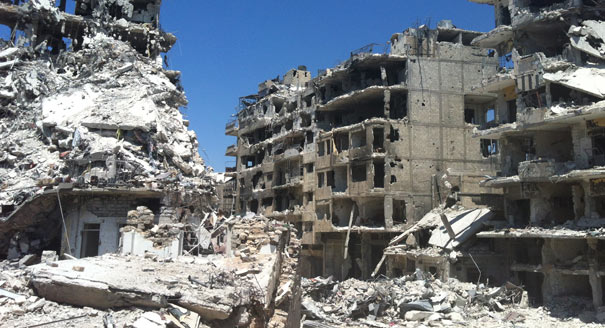
A combination of pressure and diplomacy may allow the United States to help bring an end to the war in Syria.
Source: Hill
Given America’s difficult track record of interventions across the Middle East since 9/11, President Obama’s reticence toward increased military involvement in Syria has largely been warranted. It is easy to criticize the administration for not doing enough. But the policy options have consistently been terrible, and it is difficult to demonstrate how doing more would have led to better outcomes. Nonetheless, a number of near-simultaneous developments in recent months have created a possible opening for a more active approach. This approach would incorporate Iran into a renewed international effort aimed at an eventual political settlement for Syria, backed by a more direct challenge to Tehran’s support for President Bashar al-Assad.
What has changed? The regime’s battlefield setbacks have begun to mount with increasing speed, reflecting the demographic reality of Syria’s minority rule. The recent understanding between Ankara and Washington brings Turkey into the anti-ISIL coalition and with it the prospect of increased Turkish military activity inside Syria. The efforts of leading Arab states to support the Syrian opposition have become more effective. And the Iran nuclear agreement itself opens previously unavailable diplomatic avenues.
As a first step, the United States should promote a renewed multilateral dialogue involving key international and local players, including Saudi Arabia and, for the first time, Iran. Despite profound animosity between Riyadh and Tehran, they have shared interests in countering ISIL, supporting Syria’s territorial integrity, and preventing a regional conflagration. Humanitarian access should also be on the agenda.The longer-term goal would be to precipitate a political transition in Damascus. Neither Iran nor Russia has felt the need to compromise on their commitment to Assad, and they may not yet be ready to start. But as it becomes increasingly clear he has no future, Tehran and Moscow must be made to eventually understand that protecting their diminishing returns requires acquiescence to a new governing arrangement that removes him from power, while preserving what little of the Syrian state remains, including its army. Conversely, the Arab states need to accept that reducing the level of violence will require at least some accounting for Iranian and Russian interests in Syria, though these must not meaningfully accrue to Hizballah.
The logic for incorporating Tehran into regional diplomacy is not a naïve belief that Iran is a stabilizing force, but recognition that a process which excludes Iran will continue to fail. Leveraging this engagement into tangible progress requires prioritizing Syria as a centerpiece in the renewed efforts to counter Iran’s regional inference. Iranian leader Ali Khamenei has signaled his intention to compartmentalize the nuclear agreement from Iran’s broader policies. The United States should do the same.
First, the United States should prioritize ending the Syrian regime’s indiscriminate aerial bombing of civilians, which takes a horrific human toll, exacerbates the refugee crisis and ultimately strengthens ISIL. Washington should signal to Russia and Iran that if they are unwilling, or unable, to convince Damascus to end these attacks, it is prepared to work with partners to expand its air campaign to prevent them. While a full-fledged no-fly zone is a more complex operation than often understood, there are more limited military responses which could be effective in deterring these attacks.
Second, the United States should seek to focus the ongoing anti-ISIL air campaign to areas where the opposition is active and away from government-controlled areas. As the battlefield continues to evolve, ISIL and the Syrian army have increasingly been drawn into direct fighting. If areas of opposition activity can be prioritized, the potential benefit to Assad can be minimized, even as his broader deterioration continues. Although U.S. efforts to train moderate Syrian forces have been disappointing, they are likely to show some incremental progress. Going forward, the administration should make clear that Syrian military action against U.S.-trained forces will draw a response.
Third, the United States should search for opportunities to hamper Iranian resupply routes to Syria and Hizballah, using the nuclear agreement’s five-year renewal of a conventional arms embargo as a tool. While it is not realistic to fully impede Iranian support for Syria and Hizballah, an episode in April shows a possible way forward, when deft diplomacy -- and the deployment of a U.S. aircraft carrier -- persuaded an Iranian supply convoy suspected of containing arms for the Houthi rebels in Yemen to turn back.
The Obama administration combined pressure and diplomacy to achieve the international nuclear agreement with Iran. Controversial though it is, the agreement represents the best option to ensure that Iran does not obtain a nuclear weapon. There will be no quick end to the tragic Syrian civil war. But in light of Assad’s weakness, this same combination of pressure and diplomacy offers a plausible opening in Syria that had previously been lacking.

Former Nonresident Fellow, Middle East Program
Perry Cammack was a nonresident fellow in the Middle East Program at the Carnegie Endowment for International Peace, where he focuses on long-term regional trends and their implications for American foreign policy.
Recent Work
Perry Cammack, Cassia Bardos
Perry Cammack
Carnegie does not take institutional positions on public policy issues; the views represented herein are those of the author(s) and do not necessarily reflect the views of Carnegie, its staff, or its trustees.

The EU can impose sanctions but struggles to enforce them without the United States. With Washington increasingly disinterested in backing European interests, the bloc must now fend for itself.


Nicu Popescu, Tiago Antunes

Russia is testing the waters of NATO’s mutual defense clause. What do strikes in Romanian territorial waters mean for the alliance’s posture toward Moscow?

Dimitar Bechev

With its public finances in shambles, the far right polling at 35 percent ahead of the 2027 presidential election, and a growing protest movement, is France’s crisis a threat to the EU’s geopolitical awakening?

Rym Momtaz, ed.

Ahead of a tough winter for Ukraine, Donald Trump’s swing back toward Russia bodes ill. But instead of panicking, Kyiv’s European allies are focusing on action.
Rym Momtaz

Funding Ukraine remains a priority for European leaders. As Russia’s war of aggression heads into another winter, two feasible options to mobilize support for Kyiv should be fast-tracked.


Vladyslav Rashkovan, Gregory P. Wilson