

Commentary
As we close out another season of Strategic Europe, it is worth taking stock of the deep shifts underway.
Rym Momtaz
{
  "authors": [
    "Denis Volkov"
  ],
  "type": "commentary",
  "centerAffiliationAll": "",
  "centers": [
    "Carnegie Endowment for International Peace",
    "Carnegie Russia Eurasia Center"
  ],
  "collections": [
    "Inside Russia"
  ],
  "englishNewsletterAll": "",
  "nonEnglishNewsletterAll": "",
  "primaryCenter": "Carnegie Endowment for International Peace",
  "programAffiliation": "",
  "programs": [],
  "projects": [],
  "regions": [
    "Middle East",
    "Syria",
    "Russia"
  ],
  "topics": [
    "Political Reform",
    "Foreign Policy"
  ]
}
Source: Getty
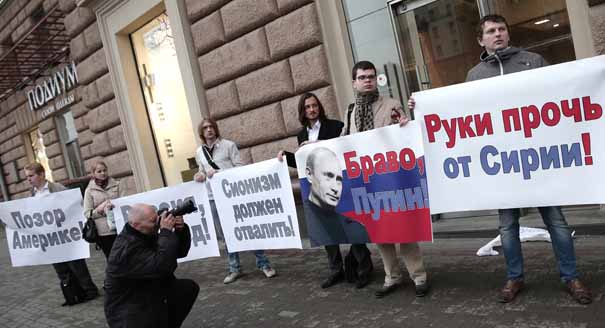
Little more than a week into Russia’s bombing campaign in Syria, new evidence has emerged about the Russian public’s attitudes towards Putin’s latest military intervention.
The Levada Center, a Moscow-based polling organization, has conducted surveys on Russian public opinion about the crisis in Syria since 2013. In September, shortly before the Russian military started airstrikes against anti-Assad forces in northern Syria, Levada found that 65 percent of Russians favored providing diplomatic support to Syria, while 55 percent favored giving humanitarian aid to the country. Twenty percent opposed providing diplomatic support, and 29 percent opposed giving humanitarian aid. Survey participants were divided evenly on whether to supply arms and economic support, and strongly opposed military intervention and refugee assistance.
Last week, Levada convened a number of impromptu focus groups on war in Syria. Participants offered a variety of opinions on Russia’s military campaign: “This is not our war!” and “Wasn’t Afghanistan enough?” said some. Still, it is worth remembering that most Russians opposed intervention in Ukraine in late 2013; only a few months later, the population rallied behind President Vladimir Putin’s annexation of Ukraine. And already, some respondents have indicated that they might be supportive of further intervention in Syria: Russia doesn’t “need a war, but we’re ready for one!”
When focus group participants were asked whether there are Russian troops in Syria, many responded: “Do you mean officially?” Last year, when Levada asked survey participants whether there were Russian troops in eastern Ukraine, they often got the response: “not officially.” Any attempts to elicit a further response failed. Today, no one doubts Russia’s military presence in Syria—it is openly discussed on television—but media personalities and government officials have insisted that “only a limited contingent” has been deployed.
Focus group participants objected to suggestions that the Russian presence in Syria would be ramped up. Indeed, most expressed confidence that there would be no “major war.” Facilitators remarked on the “mantra-like” use of the phrase “limited presence,” noting that participants sounded as if they were trying to convince themselves that Russia would not get dragged further into the conflict. This suggests that some Russians entertain the possibility that the government might misrepresent the scale of the operation, but almost no one openly admits such misgivings.
The majority of the Russian public has only a vague notion about what is happening in Syria, relying on scraps of information disseminated by state television: only 15 percent of Russians follow developments in the country closely, and one-third of the population pays no attention at all. Before Russia launched its campaign, about half of the respondents to the Levada poll said that they did not care about the Russian government’s Syria policy. Now, more people are paying attention, but they have little emotional investment in the conflict; survey participants express little sympathy for the refuges and victims of the civil war that has been raging since 2011.
As long as the number of Russian troops in Syria does not rise, the war will remain a “virtual” one for the majority of the public. Respondents’ claims that they are prepared for war reflect a widespread belief in the might of the Russian military machine, not individual Russians’ willingness to go to into combat. The fewer Russian boots on the ground and the fewer casualties, the more the population will support the intervention.
The Right Spin
Russians view the conflict in Syria through the prism of confrontation with the U.S., and as a defense of the country’s “geopolitical interests.” Relations with the U.S. have become a catchall explanation (and justification) for the Russian government’s behavior: Crimea, for example, was purportedly annexed to prevent NATO from establishing bases in Sevastopol. Perhaps predictably, participants in Levada’s focus groups last week said that Russia must not leave Syria because “otherwise the Americans will immediately go there.”
Thus, the developments in Syria show yet again that the Russian public lacks the ability, resources, and motivation to interpret global events rationally. State media’s biased coverage of events in Syria today—as during the crises in Ukraine, Georgia, and Chechnya—has convinced Russians that there is a global conspiracy to “weaken and humiliate Russia.”
Further, the standoff with the U.S. also gives everyday Russians a sense that their country is reestablishing the greatness of the Soviet Union. For this reason, many Russians take pleasure in Western criticism of Russian policy.
However, the Russian public does not appear to be opposed to cooperation with Western nations in Syria (there is no quantitative data to support this assertion yet, but this has been the case in the past, particularly when it confirms Russia’s status as a world power). At the same time, many focus group respondents have expressed skepticism about the possibility of such cooperation, doubting Washington’s willingness to work with Moscow to help its Syria policy succeed. Certain participants went as far as to suggest that the U.S. benefits from the existence of ISIS and therefore won’t fully support the fight against Islamic extremism.
Though Russians may ultimately support intervention in Syria, the fact is that Putin is not using the war to bolster his approval ratings; the vast majority of the population already supports him, and the next presidential election is not for another three years.
Why, then, has Russia launched airstrikes in northern Syria? The most straightforward explanation is that Russia began its military campaign to achieve specific foreign policy goals: to pull Russia out of global isolation, distract the international community from the situation in eastern Ukraine and Crimea, reinforce Assad’s regime, and to show that Russia’s strategy in the Middle East is superior to that of the U.S.
The objective of Russia’s television propaganda is thus to secure support for political decisions that have already been made. With Syria, as with other domestic and foreign issues, the Russian government is taking public opinion into account not for the sake of the opinion itself, but in order to minimize the costs of implementing its policy.
Denis Volkov is a sociologist and an expert at the Levada Center in Moscow
Denis Volkov
Director of the Levada Center in Moscow
Denis Volkov is the director of the Levada Center in Moscow.
Carnegie does not take institutional positions on public policy issues; the views represented herein are those of the author(s) and do not necessarily reflect the views of Carnegie, its staff, or its trustees.
As we close out another season of Strategic Europe, it is worth taking stock of the deep shifts underway.

Rym Momtaz

The hybrid warfare landscape is evolving rapidly, leaving policymakers without clear strategies. To better inform their work in addressing emerging challenges, governments must dig deeper into the underlying dynamics at play.


Raluca Csernatoni, Alicia Wanless
The EU had to compromise to adopt a twenty-first sanctions package against Russia, exposing growing cracks in the union’s resolve. Is this latest, weaker round worth it to keep pressure on Moscow?
Rym Momtaz, ed.

Trump is distracted and Ukraine wants Europe to step up. The continent’s leaders must find their voice and assert it in talks with Russia.

Alissa de Carbonnel

Mounting economic strain and battlefield losses will not necessarily make the Kremlin less dangerous. They could instead push Moscow toward a more aggressive hybrid campaign designed to test NATO’s Eastern flank, exploit allied hesitation, and fracture European resolve.

Maksym Beznosiuk