

Commentary
Yukon Huang, Isaac B. Kardon, Matt Sheehan
{
  "authors": [
    "Yukon Huang"
  ],
  "type": "legacyinthemedia",
  "centerAffiliationAll": "dc",
  "centers": [
    "Carnegie Endowment for International Peace",
    "Carnegie China"
  ],
  "collections": [],
  "englishNewsletterAll": "asia",
  "nonEnglishNewsletterAll": "",
  "primaryCenter": "Carnegie China",
  "programAffiliation": "AP",
  "programs": [
    "Asia"
  ],
  "projects": [],
  "regions": [
    "North America",
    "United States",
    "East Asia",
    "China"
  ],
  "topics": [
    "Economy",
    "Foreign Policy",
    "Technology"
  ]
}
Source: Getty
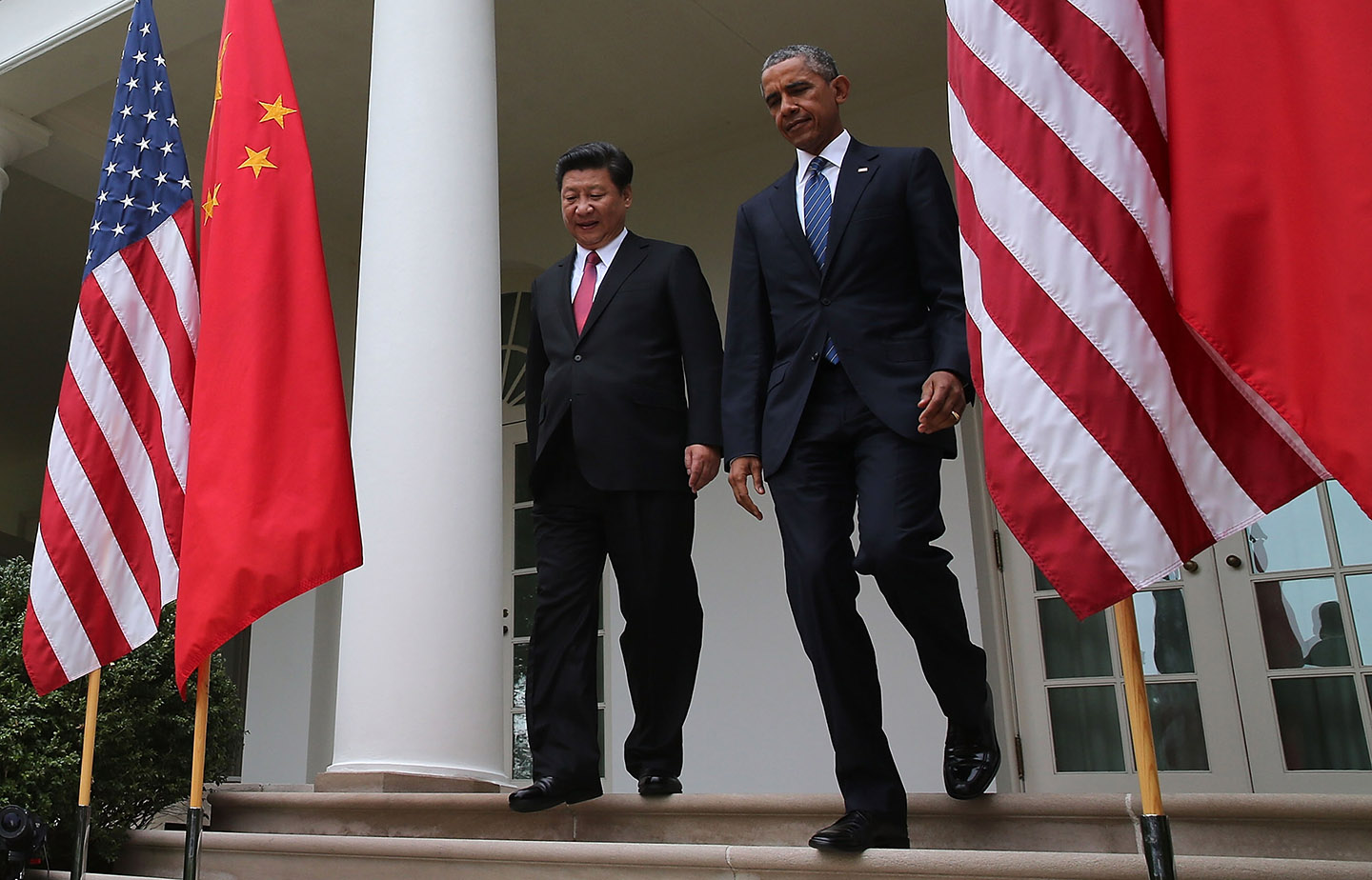
The statements released by China and the United States following President Xi’s visit give insight into the priorities of the both countries, and also the thorny issues in their relationship.
Source: Financial Times
President Xi Jinping’s visit to the US in late September was risky, coming at a time when China’s economy was seemingly in trouble. Would he be on the defensive and appear weak since market perceptions of China have turned more negative in recent months? Yet the economic realities are less alarming and Beijing has the potential to put its economy on a more sustainable growth path if it so chooses.
Mr Xi’s visit was a meeting between two powers, each with its own strengths and insecurities. China is now the largest economy in the world in terms of purchasing power parity. Thus it is not surprising Gallup polls showed that in 2014, 52 per cent of the American public believed that China was the world’s leading economic power, and with this perception comes many overhyped fears. When the Chinese were asked the same question, they responded that America was the world’s leading economic power. And the Chinese are right. A country’s economic might is determined not solely by the size of its economy but also by its per capita income level, which determines its capacity to deal with issues such as foreign policy and security. By that measure, China now ranks about 80th globally and is the first developing country to become a great power. This explains its insecurity and reluctance to assume the responsibilities expected of a great power.The US suggests that China should take on more responsibilities, while Beijing maintains that any change in the international order should be based on the new economic realities. This sense is conveyed in China’s official statement on Mr Xi’s visit, which covers 49 points. It begins with the headlined theme for the visit — “The new model of major country relationship between China and the US” — a characterisation that the US does not ascribe to, illustrating the uncertainties on both sides.
The US perspective is recorded in three separate documents issued by the White House, covering 42 specific points. The first subject in the first statement is Afghanistan and peacekeeping, signalling America’s continued preoccupation with security and the Middle East, followed by bilateral relations where cyber security is prominent. The major achievement from the US perspective is getting China to acknowledge that while cyber espionage for security purposes is acceptable, it should not be used to secure economic advantage.
The second statement covers US-China economic issues encapsulated in 27 points, ranging from support for the international financial institutions to the ongoing negotiations on a bilateral investment treaty and protection of intellectual property rights. Climate change stands out in being addressed in a separate statement. Clearly, the White House sees Mr Xi’s visit as a means to use China’s commitment to climate change to push the agenda domestically, where there is still much debate.
How likely is it that the promises on the two key areas of cyber security and climate change will be honoured? The answer lies in the role that economic pressures will play over the coming years.
China’s willingness to commit to climate change goals and put in place a cap-and-trade regime reflects in part domestic political demands from a rising middle class that is no longer willing to tolerate the environmental degradation that came from unbridled double-digit growth. But China’s agreement finally to commit to carbon emission ceilings by 2030 reflects the realisation that the energy intensity of its growth will have peaked by then given the growing dominance of services over manufacturing — much as happened in the Europe and the US generations ago. Thus there is a high probability of China achieving its climate change objectives — especially since, unlike in the US, there is no disagreement among its leadership about its scientific basis.
As for cyber security, China sees its major challenge as overcoming the middle-income trap, which can be done by moving to a more technologically advanced economy. Very few developing countries have succeeded in making the shift to high-income status and those that have managed it, such as Korea and Japan, did so through indigenous technology. Theft is a tempting option that has driven success among many great powers at a similar stage in their development — the US has been accused of stealing from Europe as a newly industrialising nation and stealing patents from Germany after the second world war, while South Korea has been attacked for stealing military secrets. As Mr Xi has noted, while government-inspired actions are one matter and can be regulated, accounting for rogue players is another given the ease of access to information that the internet provides. The effort by the US to disentangle security and economic objectives would be a big achievement, but the likelihood of success is low given the strains on the economy that China is facing and a widely shared belief — among the leadership and the wider public — that security and economic objectives are interrelated.
The real barrier separating China and the US is the lack of trust. Pew surveys show that 55 per cent of Americans have an unfavourable view of China, compared, for example, with 38 per cent of the British. From that perspective, perhaps years from now the chief outcome of Mr Xi’s visit will come from having designated 2016 as China-US Tourism Year. The fact that, on a per-capita basis, nearly twice as many Britons as Americans visit China explains in part the lack of understanding between China and the US. Regarding economic relations, Mr Xi’s visit signals that future tensions will be less about exchange rates and trade issues and more about the competitive pressures in dealing with technology transfers and market access as a rising power tries to close the gap with the leading economic power. Thus the bilateral investment treaty that China is now negotiating with both the US and Europe represents the shift in the focus of attention that this will bring.
This article was originally published in the Financial Times.

Senior Fellow, Asia Program
Huang is a senior fellow in the Carnegie Asia Program where his research focuses on China’s economy and its regional and global impact.
Recent Work

Yukon Huang, Isaac B. Kardon, Matt Sheehan
Yukon Huang, Genevieve Slosberg
Carnegie does not take institutional positions on public policy issues; the views represented herein are those of the author(s) and do not necessarily reflect the views of Carnegie, its staff, or its trustees.
Donald Trump has repeatedly bashed NATO and European allies, threatening to annex Canada and Greenland and deploring their lack of enthusiasm for his war of choice in Iran. Is this latest round of abuse the final straw?

Rym Momtaz, ed.
Donald Trump’s repudiation of NATO goes against the Make America Great Again vision of a U.S.-centered foreign policy. If the goal is to preserve the alliance by boosting Europe’s commitments, leaning into France’s vision is the most America First way forward.
Rym Momtaz

The wars in Ukraine and the Middle East are existential threats to Europe as a peace project. Leaders and citizens alike must reaffirm their solidarity to face up to today’s multifaceted challenges.

Marc Pierini
The U.S.-sponsored TRIPP deal is driving the Armenia-Azerbaijan peace process forward. But foreign and domestic hurdles remain before connectivity and economic interdependence can open up the South Caucasus.



Thomas de Waal, Areg Kochinyan, Zaur Shiriyev
Donald Trump has demanded that European allies send ships to the Strait of Hormuz while his war of choice in Iran rages on. He has constantly berated NATO while the alliance’s secretary-general has emphatically supported him.
Rym Momtaz, ed.