

Paper
Yezid Sayigh
{
  "authors": [
    "Yezid Sayigh"
  ],
  "type": "legacyinthemedia",
  "centerAffiliationAll": "dc",
  "centers": [
    "Carnegie Endowment for International Peace",
    "Malcolm H. Kerr Carnegie Middle East Center"
  ],
  "collections": [
    "Conflict and Refugees"
  ],
  "englishNewsletterAll": "menaTransitions",
  "nonEnglishNewsletterAll": "",
  "primaryCenter": "Malcolm H. Kerr Carnegie Middle East Center",
  "programAffiliation": "MEP",
  "programs": [
    "Middle East"
  ],
  "projects": [],
  "regions": [
    "Levant",
    "Lebanon",
    "Syria",
    "Jordan",
    "Middle East"
  ],
  "topics": [
    "Political Reform",
    "Security"
  ]
}
Source: Getty
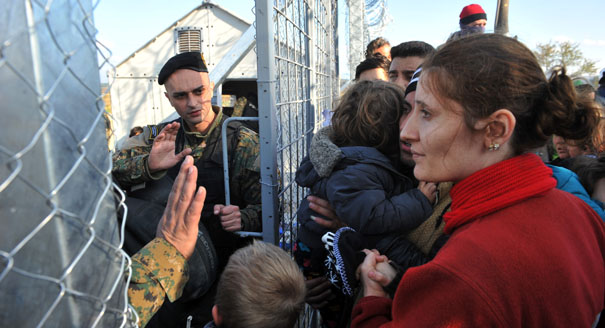
The measures that the European Union has taken towards the refugee crisis are mostly palliative, temporary fixes that leave the EU largely in a reactive mode.
Source: EU Institute for Security Studies
The response of EU member states to the arrival of over one million refugees, asylum seekers, and migrants in 2015 helped stabilise the immediate crisis. But while expedient, the measures they took are mostly palliative, temporary fixes that leave the EU largely in a reactive mode. More needs to be done. The refugee crisis is likely to continue or worsen, but even if it does not its scope and scale already mean that its consequences will take many more years to be overcome.
This issue needs to feature prominently in the EU’s Global Strategy on Foreign and Security Policy (EUGS) if it is to meet the challenge. But for this, it must stop thinking of each refugee crisis as a short-term ‘emergency’, and replace its narrow focus on providing humanitarian assistance with policy responses based on a better understanding of the long-term drivers and trends of those crises and focused on sustainable development rather than emergency relief.The scale of the challenge is evident. In 2015, the number of forcibly displaced persons worldwide exceeded 60 million, prompting UN High Commissioner for Refugees António Guterres to call for “a paradigm change” in response to a challenge that “is now clearly dwarfing anything seen before.” To effect such a change, the EU must correct two distortions skewing its policy responses.
First, conceptualising refugee crises as emergencies enables national governments to justify contributions as necessary and finite to their domestic publics, but obscures understanding of what generates and sustains refugee flows. This discourages long-term planning and preparation, and precludes more effective responses. Armed conflict is certainly the immediate driver of displacement, but focusing on it too narrowly as the primary event overlooks the long-term trends that have already accentuated vulnerabilities and undermined resilience in local communities, resulting in greater levels of displacement once conflict starts.
Second, EU policy responses are also skewed by the restriction of interventions in refugee crises to humanitarian assistance, especially delivery of food aid, followed by water, sanitation, and shelter. Certainly these are critical to physical survival, but single-minded adherence to an emergency framework for intervention restricts the development of new approaches that may better meet the needs of an unprecedented global refugee crisis. In order to offer better prospects of developing long-term sustainability and resilience, this means, most obviously, facilitating the engagement of forcibly displaced persons in host economies – assisting them to assist themselves and to contribute to their hosts, for example through training, funding, and legalising work as a growing number of experts in the region urge. It also means helping to build and fund coping mechanisms for host governments and communities to relieve the strain and mitigate anti-refugee sentiment.
Clearly, the cooperation of local governments or de facto authorities is necessary for such an approach to succeed. It cannot be implemented everywhere. But even the complex case of Syria suggests what can be done. Already, a significant number of Syrian refugees undertake informal, low-paid work in Lebanon, Jordan, and Turkey, generate consumer demand, and inject rental money into the housing market. This has distorted local wages and rents, straining relations with host communities, but also provides income streams for many, and has frankly alleviated an otherwise disastrous situation. The UNHCR and other agencies have also helped by providing refugees with vouchers and rent subsidies to be spent locally, while helping select central and municipal authorities to cope with expanding demand on public services so as to minimise negative impacts on nationals.
But the UNHCR – as the primary implementing agency for the EU and other major donors – and most humanitarians remain locked within an emergency framework when it comes to planning and preparation for the future. They collect extensive data, but do not engage in data analysis that might lead to alternative approaches. This risks being a self-defeating approach as aid fatigue sets in and per capita assistance to refugees drops, at the same time as their dependency on aid deepens. Paradoxically, it is the EU that is already testing the merit of a different approach, by seeking Turkey’s agreement to issue work permits to Syrian refugees in order to regulate their employment while discouraging them from migrating to Europe.
The EU’s purpose is selfserving, but could pave the way to rethinking its general approach more radically. Three factors should compel it to do so. First, the return of refugees to their countries is always very slow even after peace is restored: in 2014, a mere 126,800 of some 60 million refugees worldwide were able to go back home.
Second, conflict trends and the scale of dislocation and physical destruction in the Middle East and North Africa region, which alone accounts for half the world’s total of forcibly displaced persons, show the potential for more flows – and parts of sub-Saharan Africa and Central and South Asia are no different.
And third, aid fatigue, the eurozone’s continuing travails, global geo-political rivalries, and the rapidly shrinking revenue of OPEC oil producers who might have contributed a greater share of humanitarian assistance all make maintaining the emergency framework non-viable.
Not providing humanitarian assistance is not an option. But neither is it a sufficient response. To make a difference, the EU must develop a new paradigm capable of changing the conditions and cost-benefit calculations of millions of refugees wherever they are, not only those landing on its shores.
This article was originally published by the EU Institute for Security Studies.

Senior Fellow, Malcolm H. Kerr Carnegie Middle East Center
Yezid Sayigh is a senior fellow at the Malcolm H. Kerr Carnegie Middle East Center in Beirut, where he leads the program on Civil-Military Relations in Arab States (CMRAS). His work focuses on the comparative political and economic roles of Arab armed forces, the impact of war on states and societies, the politics of postconflict reconstruction and security sector transformation in Arab transitions, and authoritarian resurgence.
Recent Work
Yezid Sayigh
Yezid Sayigh
Carnegie does not take institutional positions on public policy issues; the views represented herein are those of the author(s) and do not necessarily reflect the views of Carnegie, its staff, or its trustees.

European states control several Overseas Countries and Territories around the world that carry strategic, economic, and environmental weight. As great powers challenge the rules-based order, defending them is a geopolitical imperative for Europe.

Marc Pierini

Mounting economic strain and battlefield losses will not necessarily make the Kremlin less dangerous. They could instead push Moscow toward a more aggressive hybrid campaign designed to test NATO’s Eastern flank, exploit allied hesitation, and fracture European resolve.

Maksym Beznosiuk

Over the past ten years, NATO has held almost as many summits as it did during the entirety of the Cold War. Are they still useful, or is it time to stop holding annual meetings?

Rym Momtaz, ed.

As the EU confronts profound challenges, several leaders have called for fundamental reform to the union’s model—but only modest, superficial changes have resulted. What if Europe really could be reimagined from zero today: What should such a redesigned European order look like?

Richard Youngs, ed.
As Russia's war on Ukraine drags on, NATO is expanding its footprint in the Black Sea. Turkey, Romania, and Bulgaria are upgrading their fleets and deepening trilateral cooperation.

Dimitar Bechev