

Commentary
Perry Cammack, Cassia Bardos
{
  "authors": [
    "Perry Cammack"
  ],
  "type": "legacyinthemedia",
  "centerAffiliationAll": "dc",
  "centers": [
    "Carnegie Endowment for International Peace",
    "Malcolm H. Kerr Carnegie Middle East Center"
  ],
  "collections": [
    "Arab Awakening"
  ],
  "englishNewsletterAll": "menaTransitions",
  "nonEnglishNewsletterAll": "",
  "primaryCenter": "Carnegie Endowment for International Peace",
  "programAffiliation": "MEP",
  "programs": [
    "Middle East"
  ],
  "projects": [],
  "regions": [
    "Middle East",
    "Syria",
    "Levant"
  ],
  "topics": [
    "Political Reform",
    "Economy",
    "Security",
    "Military",
    "Foreign Policy"
  ]
}
Source: Getty
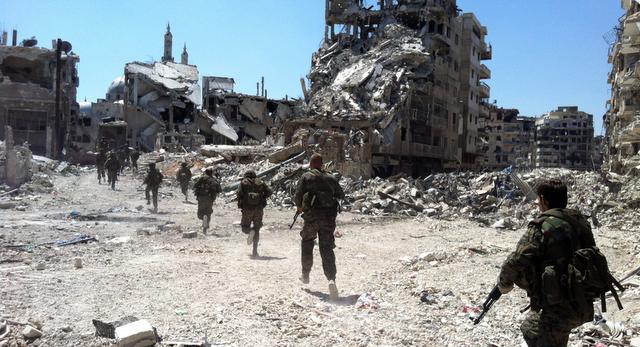
Five years of war in Syria have left large swathes of the country in ruin. While an end to the war is nowhere in sight, a reconstruction bill that is likely to run well over $100 billion means that planning for Syria's eventual rebuilding must start now.
Source: Syria Deeply
Five years of war in Syria have left large swathes of the country in ruin. And with the peace process on the brink of collapse, an end to the war is nowhere in sight. But with a reconstruction bill that is likely to run well over $100 billion, planning for Syria's eventual rebuilding must start now
The cataclysmic destruction of Syria challenges human comprehension. The old city of Aleppo, which like Damascus claims to be the oldest settlement on the planet, has been reduced to rubble. Homs was once the country’s third most populous city, but has mostly beendepopulated.
With the international Syria peace process teetering on the edge of collapse, a political solution seems distant. But every war must end. The rebirth of Dresden, Berlin, and Stalingrad (later renamed Volgograd) after the unthinkable destruction of World War II is a testament to human resiliency and a symbol of what may eventually be possible in Syria. Regardless of whether Syria can be stitched together as a unitary state or is instead permanently partitioned, rebuilding its infrastructure to even modest pre-war levels will require a generational effort...
Former Nonresident Fellow, Middle East Program
Perry Cammack was a nonresident fellow in the Middle East Program at the Carnegie Endowment for International Peace, where he focuses on long-term regional trends and their implications for American foreign policy.
Recent Work
Perry Cammack, Cassia Bardos
Perry Cammack
Carnegie does not take institutional positions on public policy issues; the views represented herein are those of the author(s) and do not necessarily reflect the views of Carnegie, its staff, or its trustees.

Ahead of a tough winter for Ukraine, Donald Trump’s swing back toward Russia bodes ill. But instead of panicking, Kyiv’s European allies are focusing on action.

Rym Momtaz

Funding Ukraine remains a priority for European leaders. As Russia’s war of aggression heads into another winter, two feasible options to mobilize support for Kyiv should be fast-tracked.


Vladyslav Rashkovan, Gregory P. Wilson

While the EU and European governments are embracing the much-lauded middle-power moment, this entails three difficult conundrums.

Richard Youngs

Europe is facing rising populism internally as well as external pressures from Russia, China, Turkey, and the United States.

Dimitar Bechev

A notable degree of participative democracy has firmly arrived in Europe. But to have more far-reaching impact, democratic deliberation needs to move into a radically new phase.
Richard Youngs