

Commentary
Dmitri Trenin
{
  "authors": [
    "Dmitri Trenin"
  ],
  "type": "legacyinthemedia",
  "centerAffiliationAll": "",
  "centers": [
    "Carnegie Endowment for International Peace",
    "Carnegie Russia Eurasia Center"
  ],
  "collections": [
    "Inside Russia"
  ],
  "englishNewsletterAll": "",
  "nonEnglishNewsletterAll": "",
  "primaryCenter": "Carnegie Russia Eurasia Center",
  "programAffiliation": "",
  "programs": [],
  "projects": [],
  "regions": [
    "Russia"
  ],
  "topics": [
    "Security",
    "Military"
  ]
}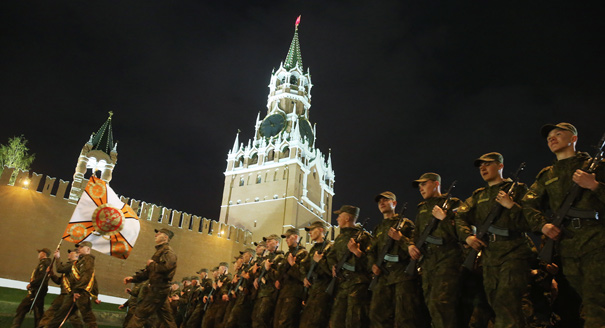
Source: Getty
Beginning in 2008, Putin ushered in military reforms and a massive increase in defense spending to upgrade Russia’s creaky military. Thanks to that project, Russia has recently evinced a newfound willingness to use force to get what it wants.
Source: Foreign Affairs
After the collapse of the Soviet Union, the Russian military rotted away. In one of the most dramatic campaigns of peacetime demilitarization in world history, from 1988 to 1994, Moscow’s armed forces shrank from five million to one million personnel. As the Kremlin’s defense expenditures plunged from around $246 billion in 1988 to $14 billion in 1994, according to the Stockholm International Peace Research Institute, the government withdrew some 700,000 servicemen from Afghanistan, Germany, Mongolia, and eastern Europe. So much had the prestige of the military profession evaporated during the 1990s that when the nuclear submarine Kursk sank in the Barents Sea in 2000, its captain was earning the equivalent of $200 per month.
From 1991 to 2008, during the presidency of Boris Yeltsin and the first presidential term of Vladimir Putin, Russia used its scaled-down military within the borders of the former Soviet Union, largely to contain, end, or freeze conflicts there. Over the course of the 1990s, Russian units intervened in ethnic conflicts in Georgia and Moldova and in the civil war in Tajikistan—all minor engagements. Even for the operation in Chechnya, where Yeltsin sent the Russian military in 1994 in an attempt to crush a separatist rebellion, the Russian General Staff was able to muster only 65,000 troops out of a force that had, in theory, a million men under arms.Beyond the borders of the former Soviet Union, Russia acted meekly. It sought a partnership with the United States and at times cooperated with NATO, joining the peacekeeping operation led by that alliance in Bosnia and Herzegovina in 1996. To be sure, after realizing in the mid-1990s that NATO membership was off the table, Moscow protested vehemently against the alliance’s eastern expansion, its 1999 bombing campaign in Yugoslavia, and the 2003 U.S. invasion of Iraq, but Russia was too weak to block any of these moves. The Kremlin’s top priority for military development remained its nuclear deterrent, which it considered the ultimate guarantor of Russia’s security and sovereignty.
Those days of decay and docility are now gone. Beginning in 2008, Putin ushered in military reforms and a massive increase in defense spending to upgrade Russia’s creaky military. Thanks to that project, Russia has recently evinced a newfound willingness to use force to get what it wants. First, in February 2014, Moscow sent soldiers in unmarked uniforms to wrest control of Crimea from Ukraine, implicitly threatening Kiev with a wider invasion. It then provided weaponry, intelligence, and command-and-control support to the pro-Russian separatists in Ukraine’s Donbas region, checking Kiev’s attempts to defeat them. And then, in the fall of 2015, Russia ordered its air and naval forces to bomb militants in Syria fighting President Bashar al-Assad, intervening directly in the Middle East for the first time in history.
These recent interventions are a far cry from the massive campaigns the Soviet Union used to undertake. But the fact is, Russia is once again capable of deterring any other great power, defending itself if necessary, and effectively projecting force along its periphery and beyond. After a quarter century of military weakness, Russia is back as a serious military force in Eurasia.
The story of Russia’s military modernization begins with its 2008 war in Georgia. In August of that year, Russian forces routed troops loyal to the pro-Western president, Mikheil Saakashvili, and secured the breakaway republics of Abkhazia and South Ossetia as Russian protectorates. The five-day campaign was a clear success: Moscow prevented NATO from expanding into a former Soviet state that was flirting with membership, confirmed its strategic supremacy in its immediate southern and western neighborhood, and marked the limits of Western military involvement in the region. By increasing its military footprint in Abkhazia and South Ossetia, Russia also bolstered its control of two strategically important areas in Transcaucasia—securing the approach to Sochi, the location of the Russian president’s southern residence and Russia’s informal third capital, in the former, and placing Russian forces within striking distance of Tbilisi in the latter…
This article was originally published in Foreign Affairs.
Former Director, Carnegie Moscow Center
Trenin was director of the Carnegie Moscow Center from 2008 to early 2022.
Recent Work
Dmitri Trenin
Dmitri Trenin

The new U.S.–Denmark–Greenland agreement will help Washington exert political, economic, and financial dominance under the guise of security. Yet, it acknowledged Copenhagen’s and Nuuk’s sovereignty on the island.

Marc Pierini

A summer of escalation in the Black Sea has hurt Ukraine economically and is exacerbating world food security. A truce is needed—as is a broader reframing of Europe’s Ukraine strategy.

Thomas de Waal

Are Germany’s economic, industrial, and political struggles becoming a liability for the EU’s ability to rise to the geopolitical moment?

Rym Momtaz, ed.

European Commission President Ursula von der Leyen is about to give her annual address on the state of the EU. Here’s what she won’t—but should—say.
Rym Momtaz

The EU’s responses to two recent incidents expose the gulf between European perceptions and capabilities. Unless the union can bridge that gap, it will never become a real geostrategic power.
Rym Momtaz