

Paper
Yezid Sayigh
{
  "authors": [
    "Yezid Sayigh"
  ],
  "type": "legacyinthemedia",
  "centerAffiliationAll": "dc",
  "centers": [
    "Carnegie Endowment for International Peace",
    "Malcolm H. Kerr Carnegie Middle East Center"
  ],
  "collections": [],
  "englishNewsletterAll": "menaTransitions",
  "nonEnglishNewsletterAll": "",
  "primaryCenter": "Malcolm H. Kerr Carnegie Middle East Center",
  "programAffiliation": "MEP",
  "programs": [
    "Middle East"
  ],
  "projects": [],
  "regions": [
    "Levant",
    "Syria",
    "Middle East"
  ],
  "topics": [
    "Political Reform"
  ]
}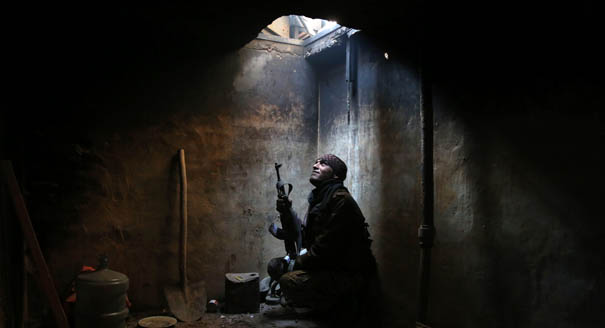
Source: Getty
The Syrian opposition cannot rely on outside intervention and must solve its leadership and structural problems to overcome future challenges.
Source: Al-Hayat
The opposition to the regime of Syrian President Bashar al-Assad faces mounting challenges. Most immediate is the threat of further human costs and loss of territory posed by the sharp escalation of violence by Russia and the Assad regime in recent weeks. More worrying still is the possibility that the U.S. administration, the principal member of the external coalition supporting the opposition and co-sponsor of the Geneva peace talks, may allow itself to be coerced into ceding on several issues of vital concern to the opposition. These include insistence on Assad’s departure from office by the end of a transitional period (if not sooner), negotiating transitional powers and arrangements before discussing constitutional amendments (and not basing the latter on the regime’s revised constitution of 2012), and resisting Russian and regime attempts to impose their own nominees on the opposition delegation.
International efforts to restore the cessation of hostilities in Syria and salvage the peace talks are both justified and necessary. But the opposition cannot afford to focus excessively on this short-term objective. A credible political solution to the conflict is extremely unlikely to be reached before the U.S. is distracted with its own presidential elections, and a new U.S. administration will not direct serious attention to what it regards as a secondary foreign policy issue before Spring 2017 at the earliest. So while the Syrian opposition must deal effectively with complex military and diplomatic pressures in the coming twelve months, it also needs to anticipate the challenges it will meet at the end of that period, and prepare appropriate responses.
The challenges will mount, not least because the Assad regime will spend the interim building on the political, military, and organizational advantages that have given it a slight edge since the start of the conflict. As always, it will present itself as a capable state actor that remains in control of some two-thirds of all Syrians who remain in the country. The regime will claim, as it has done in the past, that it is restoring public services and food supply, commencing physical reconstruction without waiting for the end of the conflict or international assistance, and renewing economic activity. And in parallel it will seek to negotiate local truces through which it can neutralize local communities and opposition fighters and free up its own troops, while planning new offensives.The opposition must improve its own performance in the same three spheres very considerably if it is not to fall behind irretrievably, in which case it will be marginalized, if not defeated. Politically, its main representative body, the National Coalition, has done reasonably well in forming the Higher Negotiations Committee and presenting credible proposals at Geneva. But if the talks move forward, then it will face a much harder task of maintaining unity while engaging with proposals for transitional power-sharing that offer significantly less than it seeks, but which it has not been able to overturn in the battlefield. This requires building a high degree of cohesion within the main opposition frameworks, and solid support among the civilian activists, local administrative councils, and armed factions on the ground.
The opposition must overcome its main weakness: lack of leadership and structure. Operationally, this means creating an executive body capable of taking day-to-day decisions, assigning and delegating responsibilities, and devising political strategies. It also requires building structures allowing meaningful integration with the opposition inside Syria, bringing the latter into leadership positions and establishing understandings and processes for political decision-making that end the debilitating petty politics of the National Coalition and its constituent factions and rivals. Only in this way does the opposition have any chance of preparing itself to take part in governing the country, an unfamiliar task for which its performance in liberated areas has not prepared it, and to avoid being out-maneuvered or absorbed by the far more experienced and integrated regime networks that permeate everything in Syria.
Militarily, the opposition demonstrated its improved ability in the defeat of the major regime offensive in northern Hama in October 2015. But its subsequent losses in Lattakieh province, around Aleppo city, and at Sheikh Miskin in the south also revealed its continuing limitations. The regime army has clearly benefited from direct Russian assistance to improve battlefield management, enabling it to shift the weight of military offensives smoothly from one front to another. The rebels are still mainly localized and disconnected, in contrast, and have not yet learned how to compensate for their limited manpower and firepower by improving strategic management. Nor have they taken or sustained military initiatives to counter Russian air power, for example through repeated guerilla attacks on air bases or devising effective tactical uses for the Russian- and Chinese-made anti-aircraft missile systems they have acquired from captured army stores or regional black markets.
The armed opposition’s external backers are also seriously under-performing. The separate military operations centers in Turkey and Jordan have noticeably different approaches, reflecting the divergent agendas of the participating governments – U.S., Turkey, Qatar, Jordan, and Saudi Arabia. Turkey has already sent significant quantities of arms and ammunition into Syria and transferred fighters from Idlib province to the opposition enclave at ‘Azaz north of Aleppo, but it could do more to put rebel fighters through comprehensive retraining over the coming twelve months, especially in command roles, and help them develop strategic management and operational plans. However, the capacity of the relevant Turkish agencies is stretched and their attention distracted by domestic challenges, and it still seeks US leadership. In southern Syria, micro-management by the military operations center in Amman has weakened the rebel Southern Front and granted an opportunity for ISIS affiliates to expand. The U.S. could do more to change things, but the rebel groups cannot afford to rely on this; they must do more to pool combat and intelligence resources, agree strategic priorities that go beyond their local sectors, and form province-level operational commands.
Much the same is required if the opposition is to meet the final challenge, of providing effective civilian administration in the areas of Syria it controls. This is important if the opposition is to retain popular support – or regain it where local communities have been subjected to rival or weakly performing structures, such as in Idlib city - and to counter the regime’s edge. Restoration of the cessation of hostilities would allow local councils and relief committees to consolidate and expand their services, but even if fighting resumes the opposition must do far more to integrate administrative functions within each locality and to replicate successful models and procedures throughout opposition-held areas.
This means paying attention to revenue generation, collection and dissemination of data, identifying and addressing gaps in the supply of basic commodities and shortfalls in skills and capacities, and backing all this with an administrative system, communications strategy, and a standardized framework for local courts and police. But it also means recognizing local administrative councils as part of the opposition’s political leadership, not subordinate to it, empowering them and reinforcing its representation of the Syrian uprising.
Meeting any of these challenges, let alone all of them, constitutes a very tall order for an opposition that has largely failed on every one and whose learning curve has been dangerously low over the past five years. Admittedly there are moreover severe limits to what can be achieved in a fixed time. But the opposition cannot afford to repeat the strategic mistake it made in 2012, when it avoided meeting these challenges by clinging to the hope that the U.S. would intervene in Syria. Expectations that a hawkish new U.S. president will necessarily adopt a more assertive policy towards the Assad regime (and Russia) in 2017 are more than likely to be disappointed, given the changes that have taken place in the domestic and international contexts shaping U.S. foreign policy making. The opposition cannot rely on this. It must instead methodically build the elements of endurance and sustainability. Simply thinking ahead would be a good start, so as not to be taken completely unawares in a year’s time.
This article was originally published in Arabic in Al-Hayat.

Senior Fellow, Malcolm H. Kerr Carnegie Middle East Center
Yezid Sayigh is a senior fellow at the Malcolm H. Kerr Carnegie Middle East Center in Beirut, where he leads the program on Civil-Military Relations in Arab States (CMRAS). His work focuses on the comparative political and economic roles of Arab armed forces, the impact of war on states and societies, the politics of postconflict reconstruction and security sector transformation in Arab transitions, and authoritarian resurgence.
Recent Work
Yezid Sayigh
Yezid Sayigh
Carnegie does not take institutional positions on public policy issues; the views represented herein are those of the author(s) and do not necessarily reflect the views of Carnegie, its staff, or its trustees.

As the EU confronts profound challenges, several leaders have called for fundamental reform to the union’s model—but only modest, superficial changes have resulted. What if Europe really could be reimagined from zero today: What should such a redesigned European order look like?

Richard Youngs, ed.
The EU’s new migration policy is not suited to today’s realities. With climate change increasingly becoming a driver of displacement, Europe needs to rethink its deterrence-focused approach.

Shana Tabak
Europe seems to have accepted its sidelining in the Middle East. The EU must reassert its support for the international rules-based order and step up engagement.

Rym Momtaz
Preparing candidate countries for EU membership is no longer enough. As the enlargement process becomes a reality, the union must also prepare its own societies.

Iliriana Gjoni
Countries face several hurdles in joining the EU, including the final stage of ratifying their accession treaties. Procedural reforms and substantive adjustments could help move the process forward.

Stefan Lehne