

Q&A
Darshana M. Baruah, Satyendra Prasad, Denghua Zhang
{
  "authors": [
    "Darshana M. Baruah"
  ],
  "type": "legacyinthemedia",
  "centerAffiliationAll": "",
  "centers": [
    "Carnegie Endowment for International Peace",
    "Carnegie India"
  ],
  "collections": [],
  "englishNewsletterAll": "",
  "nonEnglishNewsletterAll": "",
  "primaryCenter": "Carnegie Endowment for International Peace",
  "programAffiliation": "",
  "programs": [],
  "projects": [],
  "regions": [
    "North America",
    "United States",
    "South Asia",
    "India"
  ],
  "topics": [
    "Security",
    "Foreign Policy",
    "Nuclear Policy"
  ]
}
Source: Getty
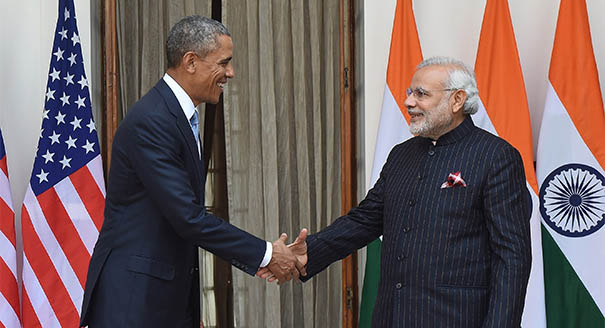
The final meeting between Obama and Modi will be a reflection of the achievements in the last two years, and will lay the groundwork for the future.
Source: South Asian Voices
As Prime Minister Modi gears up to meet President Obama for the last time before the change in the U.S. administration, the United States-India relationship has a distinctly positive outlook. While overall ties have seen remarkable improvement, maritime security has been a key area of cooperation, with an enthusiastic Bharatiya Janata Party (BJP)-led government having reviewed old discussions and explored new possibilities. The upcoming visit will take stock of progress made in this and other areas, as well as lay the foundation for future cooperation.
By the time Modi came to power in 2014, the United States had recovered from its government shutdown in 2013, rolled out its rebalance strategy, and identified India as a key partner in its Asia-Pacific policies. At the same time, tensions in the South China Sea were on the upswing, as Beijing showcased a more assertive foreign policy by defending what it considers its own territory, as well as exploring economic and security cooperation around the world. The Asia-Pacific region became the focus of geopolitical competition, and the world began to wonder what role India, the other rising power, will play.
With maritime developments dominating the security space in the region, collaboration on this front was a natural choice. India’s increasing willingness to work with other nations on maritime security made a difference, as the United States has been keen to work with India in this realm even before Modi. Modi’s invitation to Obama as the chief guest of India’s 66th Republic Day celebrations saw the conclusion of a number of agreements, furthering the bilateral relationship.
India’s orientation toward the maritime domain and the enthusiasm to be seen as a credible security actor has opened up ample space for partnership. Modi’s enthusiasm to project India as a global power combined with the changing power dynamics in maritime Asia as well Chinese expansion into the Indian Ocean forced New Delhi to re-calibrate its maritime policies. Synchronization between Washington’s rebalance and India’s Act East Policy was another boost. As India began to increase its interactions with other navies, expectations that New Delhi will play a greater security role increased. In order to manage expectations, it became important for New Delhi to spell out its priorities and clarify red lines in its new maritime outlook, as illustrated by the United States-India Joint Strategic Vision for the Asia-Pacific and Indian Ocean Region. It identifies the South China Sea as a common area of interest, with both committed to upholding norms and freedom of navigation.
Nevertheless, New Delhi’s decision to keep the Asia-Pacific and the Indian Ocean as two separate theaters provides insight into India’s priorities and commitments in the region. While India clearly wants to play a bigger role in the Asia-Pacific, its mandate on the Indian Ocean reveals its intent of remaining the dominant power there. New Delhi’s foray in the South China Sea, however, has largely been through bilateral engagements with Southeast Asian nations or with Association of Southeast Asian Nations (ASEAN), rather than through collaboration with a third party such as the United States. This perhaps underlines India’s hesitation to respond to Washington’s call for joint patrols in the South China Sea.
In the Indian Ocean Region, cooperation under the Indian and U.S. administrations has been energetic, through dialogues, maritime exercises such as Malabar, discussions on maritime domain awareness, and collaboration in humanitarian assistance and disaster relief. Almost every Modi-Obama meeting since 2014 has had maritime security on the agenda. This has become solid ground for cooperation in Indo-U.S. defense ties. However, New Delhi is conscious of the repercussions of this along the Sino-Indian border. Thus, for now, New Delhi will continue taking the lead in the Indian Ocean, and avoid confrontational steps in the South China Sea.
There are other areas of the relationship which require further work going ahead, and are expected to be discussed when Modi visits Washington this week.
As the Obama regime winds down, Modi’s upcoming visit is likely to be a renewal of commitment to the relationship, rather than serious discussions on particular issues. However, India’s potential inclusion in the Nuclear Suppliers Group (NSG) will surely be raised. Though Washington has re-affirmed its support for India’s membership, New Delhi will be seeking a greater push on the matter, given China’s decision to block India’s entry as well as its support for Pakistan’s admission into the group. Modi’s visit will precede the NSG plenary meeting later this week, and India is expected to make its best case to the United States for a positive result. New Delhi has high expectations from Washington, and will expect the United States to set the tone at the NSG meeting to consider India’s application for membership.
Other areas likely to be mentioned are the Defense Technology and Trade Initiative (DTTI), foundational agreements in defense, climate change, India’s permanent seat at the United Nations Security Council (UNSC), and maritime security. It is unlikely that the meeting will result in any new agreements or frameworks, especially on defense, as those would be concluded under other official channels. There could be some announcement on cyber cooperation. The joint statement issued will perhaps underline continuation of talks on defense cooperation, and reiterate both nations’ commitment to freedom of navigation.
This final meeting between Obama and Modi will be a reflection of the achievements in the last two years, and will lay the groundwork for the future. While expectations from the upcoming visit are modest, the Modi-Obama relationship has added a momentum to the bilateral relationship which would require the same attention, if not more, from the next U.S. president.

Former Nonresident Scholar, South Asia Program
Darshana M. Baruah was a nonresident scholar with the South Asia Program at the Carnegie Endowment for International Peace where she directs the Indian Ocean Initiative.
Recent Work

Darshana M. Baruah, Satyendra Prasad, Denghua Zhang
Darshana M. Baruah
Carnegie does not take institutional positions on public policy issues; the views represented herein are those of the author(s) and do not necessarily reflect the views of Carnegie, its staff, or its trustees.
The full list of humiliations Europe has endured since Donald Trump returned to the White House makes for grim reading. But Washington’s adversarial approach to its allies undermines its own power base.

Rym Momtaz
The closure of the Strait of Hormuz has triggered a global energy crisis, but Europe is stuck in reaction mode. Without more strategic foresight, the EU will remain dependent on fossil fuels and will never be truly secure.


Milo McBride, Pauline Gerard
Debate is heating up on how Turkey could be integrated into a common European defense framework. Commercial and industrial deals offer a better chance at alignment than sweeping political efforts.

Marc Pierini
After spending much of 2025 trying to placate Donald Trump, some European leaders are starting to change posture. But is even a hostile Washington still so important to Europe that the U.S. president’s outbursts are worth putting up with?
Rym Momtaz, ed.
European leaders have now not only lost faith in Donald Trump’s U.S. presidency, but also in America’s hegemony as a whole. But short-term challenges make an immediate divorce unwise.
Rym Momtaz