

Commentary
Evan A. Feigenbaum
{
  "authors": [
    "Evan A. Feigenbaum"
  ],
  "type": "legacyinthemedia",
  "centerAffiliationAll": "dc",
  "centers": [
    "Carnegie Endowment for International Peace"
  ],
  "collections": [],
  "englishNewsletterAll": "asia",
  "nonEnglishNewsletterAll": "",
  "primaryCenter": "Carnegie Endowment for International Peace",
  "programAffiliation": "AP",
  "programs": [
    "Asia"
  ],
  "projects": [],
  "regions": [
    "South Asia",
    "India",
    "Pakistan",
    "East Asia",
    "China",
    "Central Asia",
    "Kazakhstan",
    "Kyrgyz Republic",
    "Tajikistan",
    "Turkmenistan",
    "Uzbekistan",
    "Russia",
    "Eastern Europe",
    "Belarus"
  ],
  "topics": [
    "Economy",
    "Trade",
    "Foreign Policy",
    "Global Governance"
  ]
}
Source: Getty
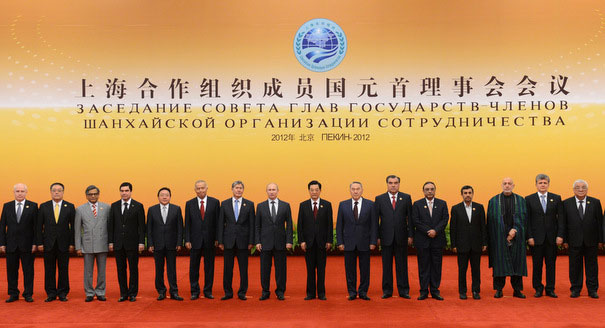
The Shanghai Cooperation Organization will likely become less functional and coherent as the group gets bigger. Form will start to drive function, and the group will begin to search for a purpose.
Source: Voice of America
Speaking to the Voice of America, Carnegie’s Evan Feigenbaum explained why the Shanghai Cooperation Organization (SCO) is likely to become weaker, less coherent, and more diffuse as it expands to include India and Pakistan and potentially other partners in future. He argued that all such institutions weaken when form begins to drive function rather than the other way around. That has been the experience across Asia since the end of the Cold War. Feigenbaum explored the origin of the SCO in a single, focused function: the settlement of border and territorial disputes among China and four Central Asian neighbors. As it has grown to include Uzbekistan and various observers and dialogue partners, the SCO has lost focus and become less functional.
Beyond the SCO itself, Feigenbaum also discussed motivations and drivers for Chinese and Indian strategies and policies in Central Asia. And he reflected on some aspects of the U.S. experience with the SCO from his tenure as Deputy Assistant Secretary of State for the region during the George W. Bush administration.
This broadcast was originally published by Voice of America.

Vice President for Studies
Evan A. Feigenbaum is vice president for studies at the Carnegie Endowment for International Peace, where he oversees work at its offices in Washington, New Delhi, and Singapore on a dynamic region encompassing both East Asia and South Asia. He served twice as Deputy Assistant Secretary of State and advised two Secretaries of State and a former Treasury Secretary on Asia.
Recent Work
Evan A. Feigenbaum
Evan A. Feigenbaum
Carnegie does not take institutional positions on public policy issues; the views represented herein are those of the author(s) and do not necessarily reflect the views of Carnegie, its staff, or its trustees.

The EU can impose sanctions but struggles to enforce them without the United States. With Washington increasingly disinterested in backing European interests, the bloc must now fend for itself.


Nicu Popescu, Tiago Antunes

Russia is testing the waters of NATO’s mutual defense clause. What do strikes in Romanian territorial waters mean for the alliance’s posture toward Moscow?

Dimitar Bechev

With its public finances in shambles, the far right polling at 35 percent ahead of the 2027 presidential election, and a growing protest movement, is France’s crisis a threat to the EU’s geopolitical awakening?

Rym Momtaz, ed.

Ahead of a tough winter for Ukraine, Donald Trump’s swing back toward Russia bodes ill. But instead of panicking, Kyiv’s European allies are focusing on action.
Rym Momtaz

Funding Ukraine remains a priority for European leaders. As Russia’s war of aggression heads into another winter, two feasible options to mobilize support for Kyiv should be fast-tracked.


Vladyslav Rashkovan, Gregory P. Wilson