

Article
C. Raja Mohan, Darshana M. Baruah
{
  "authors": [
    "C. Raja Mohan"
  ],
  "type": "legacyinthemedia",
  "centerAffiliationAll": "dc",
  "centers": [
    "Carnegie Endowment for International Peace",
    "Carnegie India"
  ],
  "collections": [],
  "englishNewsletterAll": "ctw",
  "nonEnglishNewsletterAll": "",
  "primaryCenter": "Carnegie India",
  "programAffiliation": "SAP",
  "programs": [
    "South Asia"
  ],
  "projects": [],
  "regions": [
    "South Asia",
    "Pakistan",
    "India"
  ],
  "topics": [
    "Foreign Policy",
    "Security"
  ]
}
Source: Getty
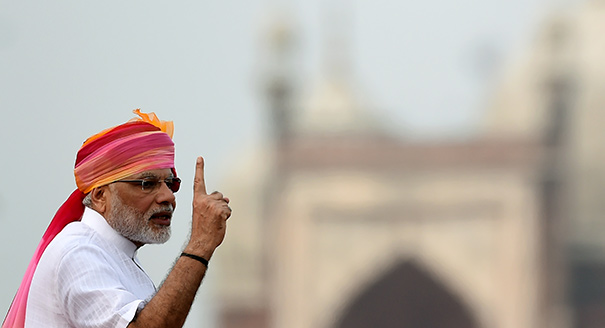
In his speech for India’s Independence Day, Prime Minister Modi criticized Pakistan, while reaffirming his commitment to promoting regional cooperation and developing a joint struggle against terrorism.
Source: Indian Express
Sceptics will dismiss Prime Minister Narendra Modi’s references to Balochistan and Pakistan-occupied Kashmir from the ramparts of Red Fort on Monday as part of the familiar posturing in Delhi when relations with Islamabad hit a rough patch. Many others, however, would like to interpret the PM’s statements as a definitive departure from the past and the beginning of a more muscular approach to Pakistan.
The truth, as always, may lie somewhere in between these two extreme assessments. The PM’s remarks do confirm what we know about his diplomatic strategy. Unlike many of his predecessors, Modi is willing to take risks, raise the stakes and bargain for better outcomes.
His remarks, especially those on Balochistan, suggest that Modi is willing to gamble a bit to end the current stalemate with Pakistan. Implicit in them is the willingness to raise Pakistan’s costs for supporting cross-border terrorism in India by wading into occupied Kashmir and Balochistan.
Until last week, the PM had stayed above the fray despite some very provocative statements on Kashmir from Pakistan. Modi had left himself some diplomatic room to retrieve the situation if possible. But his call last Friday at an all-party meeting to expose Pakistan’s atrocities in occupied Kashmir and Balochistan suggested a change of course. Once the PM chose to put these regions into rhetorical play, it was inevitable that he would expand on the theme in the Independence Day speech at Red Fort.
Since the late 1980s, when Kashmir and terrorism returned to centrestage in India-Pakistan relations, Independence Day speeches have become an important vehicle for Indian PMs to send public signals — positive or negative — across the border. There were occasions when Modi’s predecessors — P.V. Narasimha Rao, Atal Bihari Vajpayee and Manmohan Singh — would insist that the entire state of Jammu and Kashmir belonged to India and that the only thing to negotiate was the question of ending Pakistan’s illegal occupation of a part of the state and support to cross-border terrorism in India. On other occasions, the Indian PMs would signal flexibility and invite Pakistan to work together for peace and prosperity in the subcontinent.
Although Modi’s comments on Gilgit and Balochistan have gotten all the media attention, a careful review of his speech suggests that the PM has not given up on talks with Pakistan. As he criticised Pakistan’s glorification of terrorists, Modi pointed to the outpouring of Indian empathy for the terrorist attack in Peshawar at the end of 2014. He also reaffirmed his commitment to promoting regional cooperation and developing a joint struggle against terrorism.
It is also important to distinguish between the PM’s comments on occupied Kashmir and Balochistan. Pakistan claims the entire state of Jammu and Kashmir as disputed and has created the pretence that the parts of Kashmir under its control are “free”. Its emphasis is on “self-determination” for the people of Jammu and Kashmir. Modi’s comments on reaching out to the people of occupied Kashmir do not imply a shift in India’s position. After all, India claims them as its citizens and Pakistan does not. Engaging the groups in occupied Kashmir has always been an option available for India, but one which Delhi did not choose to exercise.
But Balochistan is a different place and the PM’s remarks are indeed significant for a number of reasons. With the exception of Bangladesh, India has refused to be drawn into Pakistan’s territorial disputes with other countries or its internal troubles. Delhi has not backed claims in Kabul disputing the legitimacy of the Durand Line that separates Afghanistan from Pakistan. India has also avoided embracing the secessionist movements in Sindh and Balochistan.
Many nationalists from these provinces, who hoped India would support their struggles for liberation after the separation of east Pakistan, were deeply disappointed. But here comes a paradox. Although Modi’s references to Balochistan are seen in India as a big change of direction, many in Pakistan have convinced themselves that India has been creating mischief in the restive south western province of the nation.
Over the last decade, Pakistan has sought to put India’s support to “terrorism in Balochistan” on the table with Delhi (Remember the 2009 Sharm el Sheikh summit between Manmohan Singh and Yousaf Raza Gilani that issued a joint statement referring to Balochistan and the heat it generated in India). Islamabad routinely blames India for terror attacks in Balochistan, including the most recent one against a hospital in Quetta that killed nearly a hundred people. It has also accused Delhi of collaborating with Kabul and Tehran in destabilising Balochistan. The latest allegation is that Delhi and Washington are promoting terror in Balochistan to undermine China’s economic projects.
Notwithstanding Pakistani allegations, there is no doubt India could do a lot more in highlighting the human rights violations in Balochistan. It could also join the unfolding Great Game in Balochistan — which hosts the Afghan Taliban fighting the Kabul government, is the site of frequent contestation between Tehran and Islamabad, and draws Sunni dissident groups fighting Iran’s Islamic Republic. Balochistan’s Makran coast is where China’s economic corridor through Pakistan connects with the Arabian Sea. Islamabad has also offered the Gwadar port as a naval base for China.’
All this makes Balochistan an exciting place to be in. But here comes the rub. Geopolitical play in Balochistan does not really help solve India’s problems in Kashmir. The BJP had indeed made a historic advance in Jammu and Kashmir by becoming a part of the ruling coalition and outlining a positive joint programme with the PDP in early 2015.
That Pakistan, the separatists and the militant groups would try their best to undermine the BJP-PDP coalition was never in doubt. Delhi had every reason to counter this by making a big success of the coalition government. Overcoming that failure in Srinagar must remain at the heart of the Modi government’s Kashmir strategy. All else, including Balochistan, is secondary.
Former Nonresident Senior Fellow, Carnegie India
A leading analyst of India’s foreign policy, Mohan is also an expert on South Asian security, great-power relations in Asia, and arms control.
Recent Work

C. Raja Mohan, Darshana M. Baruah


Alexander Gabuev, Paul Haenle, C. Raja Mohan, …
Carnegie does not take institutional positions on public policy issues; the views represented herein are those of the author(s) and do not necessarily reflect the views of Carnegie, its staff, or its trustees.

European NATO countries are wrestling with the possibility of U.S. disengagement from the alliance. With the continent’s security increasingly uncertain, governments must restore the credibility of their collective defense.



Hans-Dieter Lucas, Adam Thomson, Pierre Vimont

The new U.S.–Denmark–Greenland agreement will help Washington exert political, economic, and financial dominance under the guise of security. Yet, it acknowledged Copenhagen’s and Nuuk’s sovereignty on the island.

Marc Pierini

A summer of escalation in the Black Sea has hurt Ukraine economically and is exacerbating world food security. A truce is needed—as is a broader reframing of Europe’s Ukraine strategy.

Thomas de Waal

Are Germany’s economic, industrial, and political struggles becoming a liability for the EU’s ability to rise to the geopolitical moment?

Rym Momtaz, ed.

European Commission President Ursula von der Leyen is about to give her annual address on the state of the EU. Here’s what she won’t—but should—say.
Rym Momtaz