

Article
Paul Stronski
{
  "authors": [
    "Paul Stronski"
  ],
  "type": "legacyinthemedia",
  "centerAffiliationAll": "dc",
  "centers": [
    "Carnegie Endowment for International Peace"
  ],
  "collections": [],
  "englishNewsletterAll": "ctw",
  "nonEnglishNewsletterAll": "",
  "primaryCenter": "Carnegie Endowment for International Peace",
  "programAffiliation": "russia",
  "programs": [
    "Russia and Eurasia"
  ],
  "projects": [],
  "regions": [
    "Central Asia",
    "Uzbekistan"
  ],
  "topics": [
    "Political Reform",
    "Democracy"
  ]
}
Source: Getty
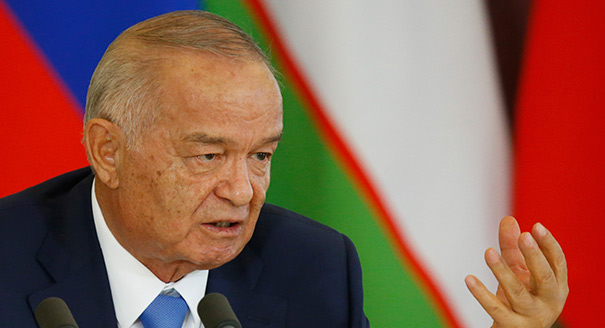
Uzbekistan’s President Islam Karimov has held that position since the country gained independence in 1991. A great deal of uncertainty remains about who his successor might be.
Source: Radio Free Europe/Radio Liberty
Speaking on a panel hosted by Radio Free Europe/Radio Liberty, Carnegie’s Paul Stronski discussed the situation in Uzbekistan following the announcement that the country’s president, Islam Karimov, had been hospitalized. He was joined by Shahida Yakub and Alisher Sidik, both of Radio Free Europe/Radio Liberty. Discussing the possibility that Karimov might not be able to continue on as president, Stronski observed that many countries will be watching the efforts to select a new president closely. He discussed what both Russia and the West will be looking for, both in terms of a candidate for president and the process. “Russia’s going to be watching very closely, hoping that whoever rises to the top is someone who is going to be favorable towards Russia, not too Western,” Stronski said.
This was originally broadcast by Radio Free Europe/Radio Liberty.

Former Senior Fellow, Russia and Eurasia Program
Paul Stronski was a senior fellow in Carnegie’s Russia and Eurasia Program, where his research focuses on the relationship between Russia and neighboring countries in Central Asia and the South Caucasus.
Recent Work
Paul Stronski
Paul Stronski
Carnegie does not take institutional positions on public policy issues; the views represented herein are those of the author(s) and do not necessarily reflect the views of Carnegie, its staff, or its trustees.

A notable degree of participative democracy has firmly arrived in Europe. But to have more far-reaching impact, democratic deliberation needs to move into a radically new phase.

Richard Youngs

The domestic impacts of how long it is taking to end the war in Ukraine have pushed the French electorate to the political extremes and compromised the country’s diplomatic capacity.

Rym Momtaz

Before the next wave of EU enlargement takes place, the union needs to grapple with thorny questions of how power is distributed among its members.


Emil Sondaj Hansen, Ditte Brasso Sørensen

Radical-right parties are expected to do well in upcoming elections in four of the EU's biggest member states. If successful, they could prevent the union from addressing key challenges ahead.

Stefan Lehne

An overwhelming victory by a far-right-wing party in a small state in eastern Germany will have major repercussions for Chancellor Friedrich Merz’s coalition.

Judy Dempsey