

Article
C. Raja Mohan, Darshana M. Baruah
{
  "authors": [
    "C. Raja Mohan"
  ],
  "type": "legacyinthemedia",
  "centerAffiliationAll": "dc",
  "centers": [
    "Carnegie Endowment for International Peace",
    "Carnegie India",
    "Carnegie Russia Eurasia Center"
  ],
  "collections": [],
  "englishNewsletterAll": "ctw",
  "nonEnglishNewsletterAll": "",
  "primaryCenter": "Carnegie India",
  "programAffiliation": "SAP",
  "programs": [
    "South Asia"
  ],
  "projects": [],
  "regions": [
    "South Asia",
    "India",
    "Russia"
  ],
  "topics": [
    "Foreign Policy"
  ]
}
Source: Getty
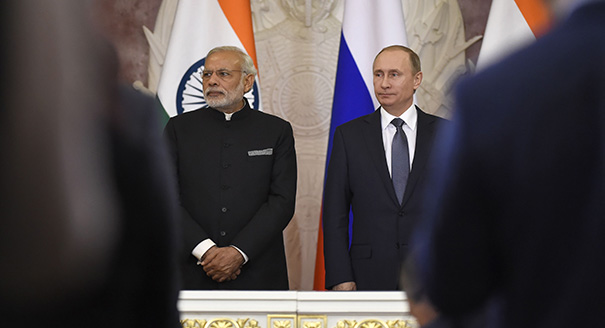
As Russia conducts its first ever military exercise with the Pakistan Army this week, Delhi has to reckon with the prospect that Russia might not necessarily remain India’s “best friend forever.”
Source: Indian Express
“Every school child in India knows Russia is India’s best friend.” That was the essence of Prime Minister Narendra Modi’s remarks when he first met the Russian President Vladimir Putin at the margins of the BRICS summit two years ago in Brazil. Although Modi was on his very first diplomatic assignment outside the Subcontinent, he had got the popular Indian sense of Russia just right.
As Russia conducts its first ever military exercise with the Pakistan Army this week, Delhi has to reckon with the prospect that Russia might not necessarily remain India’s “best friend forever”. Rethinking Russia’s position in India’s strategic calculus will be heart-wrenching for many in Delhi. Moscow’s new warmth towards Pakistan may have, wittingly or unwittingly, begun to nudge India towards a relationship with Russia that is founded in realism rather than inertia.Until now India’s Russian relationship seemed immune to change — internal and external. Governments — centrist, leftist and rightist — have come and gone in Delhi. The Soviet Union, which had such strong influence on the formation of modern India’s worldview during the inter-war period, simply disappeared from the map in 1991. But Delhi and Moscow seemed to carry on after the end of the Cold War. But by letting the sensitive Jammu and Kashmir question into its current play with Pakistan, Moscow might have dealt a big blow to the popular enthusiasm in India for the Russian relationship. At the heart of the Indian perception of Russia as the most reliable international partner was Moscow’s attitude towards the dispute between India and Pakistan over Jammu and Kashmir. The Soviet tilt towards India on the issue in the 1950s amidst the Anglo-American maneuvers in favour of Pakistan helped put a halo around Russian heads in India. During their 1955 visit to India that laid the foundations for an extended partnership between the two countries, the Soviet leaders Khrushchev and Bulganin, travelled to Srinagar. In a public reception there, Khrushchev proclaimed that Moscow was just across the border and if there is any trouble in Kashmir, Delhi should just give a shout. Moscow kept its word and exercised its veto in the UN Security Council to block Anglo-American moves on Kashmir in the 1950s.
Anyone familiar in Moscow with the special role of Kashmir in the evolution of India-Russia relations would have balked at the Pakistani proposal to conduct military exercises in Gilgit-Baltistan, that is part of the Kashmir claimed by India. It is entirely possible that the Russians did not see through the Pakistani ruse to lure them into Kashmir. Others suggest the decision may have simply been a bureaucratic mix-up. The Russian embassy in Delhi stepped in to clarify that the exercises will not take place in Gilgit-Baltistan. But the damage had been done. The timing of the exercise was bad enough. It comes at a moment when India was trying to isolate Pakistan after the Uri attacks, coping with fresh political violence inside Kashmir, and drawing international attention to India’s claims over Gilgit-Baltistan. That Russia was unwilling to postpone these exercises in deference to Indian sensitivities at this critical juncture suggests something fundamental is at work in Moscow’s approach to the Subcontinent.
That Russia has sought a normal relationship with Pakistan since the end of Cold War has not been a secret. So is the fact that Indian diplomacy often prevailed over its old friends in Moscow to limit Russian ties with Pakistan. Moscow’s reluctance to defer to Indian sensitivities this time suggests that a new phase in India-Russia relations is finally with us. Only the sentimentalists in Delhi will be surprised at Russia’s decision to redo its South Asian sums.
That a sovereign has no permanent friends is part of traditional wisdom around the world. Nothing illustrates this more than the evolution of Russia’s ties with China and Pakistan. Few countries in the non-Western world have done more damage to Russian interests. The Chinese alignment with the West from the 1970s and the Pakistani jihad against Moscow in the 1980s were central to the defeat of the Soviet Union in the Cold War. That was then; Moscow now believes it can play the China card in enhancing its leverage with the US. Some in Moscow may also bet that cosying up to Pakistan would help caution India against drawing too close to America. Others in Russia might point to the unintended consequence of pushing India into the arms of the US.
But India has no reason to be drawn into that argument within Moscow. Russia has the sovereign right to choose its friends. Nor should Delhi assume that Russia’s current orientation — warmth to China and hostility to the West — is a permanent one. At a moment of great turbulence in great power relations, Russia is rightly jockeying for position. This demands that Delhi must stop taking Moscow for granted. It must focus instead on reconstituting the partnership with a country that will remain a powerful force in Eurasia, on its own merits.
Former Nonresident Senior Fellow, Carnegie India
A leading analyst of India’s foreign policy, Mohan is also an expert on South Asian security, great-power relations in Asia, and arms control.
Recent Work

C. Raja Mohan, Darshana M. Baruah


Alexander Gabuev, Paul Haenle, C. Raja Mohan, …
Carnegie does not take institutional positions on public policy issues; the views represented herein are those of the author(s) and do not necessarily reflect the views of Carnegie, its staff, or its trustees.

Russia is testing the waters of NATO’s mutual defense clause. What do strikes in Romanian territorial waters mean for the alliance’s posture toward Moscow?

Dimitar Bechev

With its public finances in shambles, the far right polling at 35 percent ahead of the 2027 presidential election, and a growing protest movement, is France’s crisis a threat to the EU’s geopolitical awakening?

Rym Momtaz, ed.

Ahead of a tough winter for Ukraine, Donald Trump’s swing back toward Russia bodes ill. But instead of panicking, Kyiv’s European allies are focusing on action.
Rym Momtaz

Funding Ukraine remains a priority for European leaders. As Russia’s war of aggression heads into another winter, two feasible options to mobilize support for Kyiv should be fast-tracked.


Vladyslav Rashkovan, Gregory P. Wilson

While the EU and European governments are embracing the much-lauded middle-power moment, this entails three difficult conundrums.

Richard Youngs