

Article
C. Raja Mohan, Darshana M. Baruah
{
  "authors": [
    "C. Raja Mohan"
  ],
  "type": "legacyinthemedia",
  "centerAffiliationAll": "dc",
  "centers": [
    "Carnegie Endowment for International Peace",
    "Carnegie India"
  ],
  "collections": [],
  "englishNewsletterAll": "ctw",
  "nonEnglishNewsletterAll": "",
  "primaryCenter": "Carnegie India",
  "programAffiliation": "SAP",
  "programs": [
    "South Asia"
  ],
  "projects": [],
  "regions": [
    "Asia",
    "North America",
    "United States",
    "Southeast Asia"
  ],
  "topics": [
    "Foreign Policy"
  ]
}
Source: Getty
Asian nations must find ways to adapt to the structural changes in the Asian balance of power, the essence of which is the rise of China and the perceived decline of the United States.
Source: Indian Express
It is not often that nations undertake big foreign policy shifts. US President Richard Nixon’s outreach to China in 1971 after a quarter century of American effort to isolate the People’s Republic is one celebrated instance. In 1972, the then president of Egypt, Anwar Sadat, threw out Russian military advisers from his country and soon after became a leading partner for America in the Middle East.
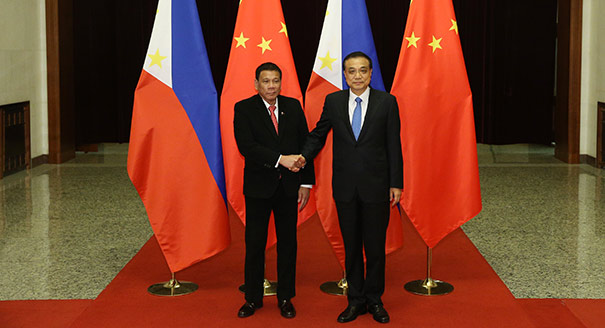
President Rodrigo Duterte of the Philippines has now done something similar. Last week he announced the “separation” of his country from the United States. Speaking during an official visit to China, Duterte pronounced that “it is time to say good bye to America”, Manila’s military ally for nearly seven decades. He said that America had “lost now”. “Both in military, not maybe social, but economics also. America has lost,” he said.
Duterte underlined his personal Chinese racial lineage, recalled historic ties between China and the Philippines and pleaded for a commercial alliance between the two nations. “I have realigned myself in your ideological flow,” he said. Duterte also promised to reach out to Russia. “There are three of us against the world — China, Philippines and Russia. It’s the only way,” Duterte added. That he chose to do it in front of very appreciative interlocutors in Beijing makes Duterte’s pivot to China that much more significant. It is surprising, coming as it does after a period of escalating maritime tensions with Beijing in the South China Sea. Duterte’s attempt to placate Beijing is also shocking since an international tribunal in July ruled entirely in favour of Manila.
Why does Duterte kowtow to a China that is threatening the territorial integrity of the Philippines and abandon its alliance with its most likely protector, the United States? Thereby hangs a tale — of power shifts and their consequences. Many have pointed to the political populism of Duterte, an abusive personal style and a running argument with the United States over his ruthless war against drugs as the proximate cause for the outburst in Beijing. Others insist that Duterte can’t sustain his anti-Americanism given the deep interconnections between the Philippines and the United States. They point to Duterte’s attempt to “clarify” some of his statements in China after his return from Beijing. Some hope that during his visit to Japan this week, the president of the Philippines will make some much needed amends.
All these factors, important as they are, do not mask the larger trend in Asia — the region’s adaptation to the structural changes in the Asian balance of power, the essence of which is the rise of China and the perceived decline of the United States. Strategic communities in Asia and America have long debated the nature of this power shift. But few have been prepared for its expression in such a definitive manner by the Philippines president. In the US, as well as in Asia, there has been persistent underestimation of China’s political will and material capacity to press for a rejigging of the regional order. Beijing, especially under President Xi Jinping, has made no secret of its claim to primacy in Asia and for what it sees as its rightful role in the management of the global order.
Consider, for example, its successful pressure on most Asian countries to not criticise Beijing’s refusal to accept the international verdict in the South China Sea. It has successfully divided the Association of South East Asian Nations, ASEAN — the foremost regional organisation in Asia. China’s boldest move, however, has been its active probing of the cleavages in America’s regional alliances. Growing economic integration with its Asian neighbours, including those quite close to the United States, has given considerable leverage to Beijing. Few in the region are willing to forgo the presumed economic benefits of a partnership with China and question its political assertiveness.
Beijing has also stepped up its effort to revive that old resonating slogan of “Asia for Asians”. While few in Asian chancelleries might be willing to bite, China’s campaign does tap into the enduring anti-American resentments in Asia. The idea of “Asia for Asians” has also helped China to develop alternatives to the traditional US-led regional institutions in Asia. China also reminds its neighbours of an important geographic reality — that Uncle Sam is far away and can’t really protect them against Beijing. America might still be the biggest military power in the world, but China’s growing armed strength has begun to constrain the US’ forward presence in Asia.
Even as China tempts America’s Asian allies with the benefits of neutralism, it is teasing the United States with the prospects for a G-2. Instead of trying to limit Chinese power in the region, Beijing is asking Washington to accept a Sino-centric order in Asia. Those who don’t wish to fold into the Sinosphere will need much strength and determination to survive Beijing’s extraordinary power play. Meanwhile, India could learn a trick or two from China on how to divide your opponents, pacify the periphery, do deals with rival powers, turn adversaries into neutrals, and neutrals into friends and friends into allies.
This article was originally published in the Indian Express.
Former Nonresident Senior Fellow, Carnegie India
A leading analyst of India’s foreign policy, Mohan is also an expert on South Asian security, great-power relations in Asia, and arms control.
Recent Work

C. Raja Mohan, Darshana M. Baruah


Alexander Gabuev, Paul Haenle, C. Raja Mohan, …
Carnegie does not take institutional positions on public policy issues; the views represented herein are those of the author(s) and do not necessarily reflect the views of Carnegie, its staff, or its trustees.

As we close out another season of Strategic Europe, it is worth taking stock of the deep shifts underway.

Rym Momtaz

The hybrid warfare landscape is evolving rapidly, leaving policymakers without clear strategies. To better inform their work in addressing emerging challenges, governments must dig deeper into the underlying dynamics at play.


Raluca Csernatoni, Alicia Wanless
The EU had to compromise to adopt a twenty-first sanctions package against Russia, exposing growing cracks in the union’s resolve. Is this latest, weaker round worth it to keep pressure on Moscow?
Rym Momtaz, ed.

Trump is distracted and Ukraine wants Europe to step up. The continent’s leaders must find their voice and assert it in talks with Russia.

Alissa de Carbonnel

Mounting economic strain and battlefield losses will not necessarily make the Kremlin less dangerous. They could instead push Moscow toward a more aggressive hybrid campaign designed to test NATO’s Eastern flank, exploit allied hesitation, and fracture European resolve.

Maksym Beznosiuk