

Paper
Douglas H. Paal
{
  "authors": [
    "Douglas H. Paal"
  ],
  "type": "legacyinthemedia",
  "centerAffiliationAll": "dc",
  "centers": [
    "Carnegie Endowment for International Peace",
    "Carnegie China"
  ],
  "collections": [
    "China’s Foreign Relations",
    "U.S.-China Relations"
  ],
  "englishNewsletterAll": "asia",
  "nonEnglishNewsletterAll": "",
  "primaryCenter": "Carnegie China",
  "programAffiliation": "AP",
  "programs": [
    "Asia"
  ],
  "projects": [],
  "regions": [
    "North America",
    "United States",
    "East Asia",
    "China"
  ],
  "topics": [
    "Foreign Policy"
  ]
}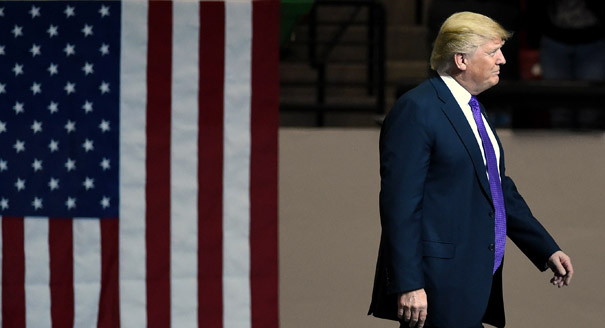
Source: Getty
As the Trump administration takes shape and prepares to take office, advice will pour in on how to manage security, trade, and economic relations with China, including how to deal with Taiwan. Striking the right tone would be a great start.
Source: Diplomat
As the Trump administration takes shape and prepares to take office, advice will pour in on how to manage security, trade, and economic relations with China, including how to deal with Taiwan. Good advice will include maintaining healthy U.S. alliance relationships, adequate forward deployments, and a credible domestic economic reform agenda to stand up to growing Chinese pressure. All this will require coordination and consultation to be implemented effectively.
But more important will be the tone the new Trump team adopts. George W. Bush was initially confrontational, calling China a strategic competitor. That did not survive 9/11. Obama was solicitous of Chinese cooperation. He got an assertive China in his face.
This time it might be better to project American self-confidence. President-elect Trump has already signaled self-assurance by taking the first call from a Taiwan leader in almost forty years. At the positive end of the spectrum, the United States can welcome Chinese cooperation on the tough issues we all face. But the United States will not shrink from competition, if China pushes that approach. The U.S. intends to go about its business advancing and protecting its vital interests in the Asia-Pacific region, whatever path China chooses.
Trump will draw strength by not appearing obsessed with China’s growing power and influence, though indeed they are growing. He will retain leverage by not focusing on this or that economic transaction that smacks of unfairness. Rather, he can maintain that no matter how China’s power grows, it cannot displace that of America. When there are trade irregularities, we will pursue appropriate and effective remedies as we rebuild the American economy. We can live alongside each other without descending into conflict. So far, China says regularly it wants to avoid conflict, so the U.S. stance can be a test, and perhaps an opportunity.
China might be hoping to push the United States out of the Western Pacific, through hybrid measures short of conflict, or economic inducements. But Trump can reassure friends and potential foes alike that it’s not going to happen. U.S. alliances in Asia are strong and will only get stronger under Chinese pressure. A self-confident American leadership can go about its business, including freedom of navigation exercises, without feeling the need to substitute rhetoric for action by shouting about it as the Obama team did, but by actually doing things that reassure stability.
To reinforce the message of self-assurance, the Trump administration can depart from the Obama script of resisting innovation in the Asian and global financial architecture. Washington led a lonely opposition to the Asian Infrastructure Investment Bank proposed by China. The Philippines was being asked by Washington to confront China in the South China Sea, but was not offered assistance to arrest the deterioration of its infrastructure and promote development for its impoverished population. Little wonder President Rodrigo Duterte reached for the $24 billion being dangled by Beijing.
Trump and his secretary of the Treasury would do well to provide American intellectual and institutional leadership to shape the future by summoning a new Bretton Woods conference. Unlike the one Roosevelt called to shape the post-World War II environment, this would embrace not just the Perm-Five, nor just the G-7, but the G-20, and beyond.
By harnessing the fabulous energy and dynamism of the American success story that is modern Asia, the tremendous resources of the world’s growth center can be put to purposes in places like the Philippines. China’s Asian neighbors will welcome an energetic and engaged United States as a traditional counterbalance to China, all the more if the U.S. proceeds with its head high and undeterred by a China that faces an uncertain future.
Moreover, China’s leader is seeking to build a new security architecture for the region. The region is resistant to this kind of structure largely because of the tremendous diversity of the nations with stakes in security. Asia is not Europe. And China’s neighbors are not willing to put aside their suspicions about China’s motives in taking the lead. This is an opportunity for the United States to consult widely and give China’s neighbors a chance to shape the future of security.
There is a lot more to be said on the many specifics, but striking the right tone will be a great start.

Distinguished Fellow, Asia Program
Paal previously served as vice chairman of JPMorgan Chase International and as unofficial U.S. representative to Taiwan as director of the American Institute in Taiwan.
Recent Work
Douglas H. Paal


Douglas H. Paal, Tong Zhao, Chen Qi, …
Carnegie does not take institutional positions on public policy issues; the views represented herein are those of the author(s) and do not necessarily reflect the views of Carnegie, its staff, or its trustees.

Funding Ukraine remains a priority for European leaders. As Russia’s war of aggression heads into another winter, two feasible options to mobilize support for Kyiv should be fast-tracked.


Vladyslav Rashkovan, Gregory P. Wilson

While the EU and European governments are embracing the much-lauded middle-power moment, this entails three difficult conundrums.

Richard Youngs

Europe is facing rising populism internally as well as external pressures from Russia, China, Turkey, and the United States.

Dimitar Bechev

Much has been said of the changes Brussels is trying to make to the EU enlargement process. Here’s why gradual integration might—or might not—be the answer.
Dimitar Bechev

The European Commissioner for Trade is headed to China. But after President Xi’s bridge-building visit to Washington, can a more isolated EU overcome Beijing’s stranglehold on critical raw materials? Who will blink first?

Rym Momtaz, ed.