

Article
C. Raja Mohan, Darshana M. Baruah
{
  "authors": [
    "C. Raja Mohan"
  ],
  "type": "legacyinthemedia",
  "centerAffiliationAll": "dc",
  "centers": [
    "Carnegie Endowment for International Peace",
    "Carnegie India"
  ],
  "collections": [],
  "englishNewsletterAll": "ctw",
  "nonEnglishNewsletterAll": "",
  "primaryCenter": "Carnegie India",
  "programAffiliation": "SAP",
  "programs": [
    "South Asia"
  ],
  "projects": [],
  "regions": [
    "United States",
    "Asia",
    "South Asia",
    "India",
    "North America",
    "East Asia",
    "China"
  ],
  "topics": [
    "Foreign Policy",
    "Religion"
  ]
}
Source: Getty
Tibet is at the very heart of the Sino-Indian disputation over territorial sovereignty and much else over the last six decades.
Source: Indian Express
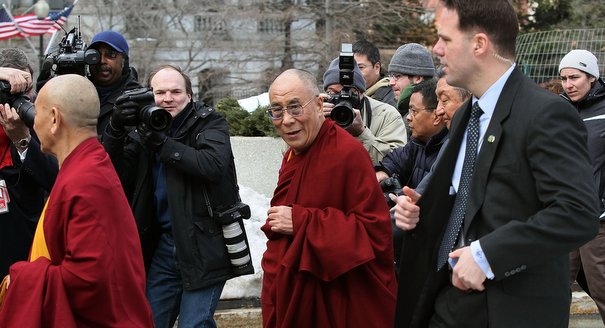
It was no surprise that China strongly objected to the presence of the Dalai Lama at the Rashtrapati Bhavan a few days ago. In a sharp reaction last week, the spokesman of the ministry of foreign affairs in Beijing said “in disregard of China’s solemn representation and strong opposition, the Indian side insisted on arranging for the 14th Dalai Lama’s visit to the Indian Presidential palace”. He added that Beijing is “strongly dissatisfied with and firmly opposed” to all contact between the Dalai Lama and the Indian authorities.
Delhi’s response was equally predictable. “His Holiness the Dalai Lama is a respected and revered spiritual leader. It was a non-political event organised by Nobel laureates dedicated to the welfare of children”, the foreign office said. Delhi says it does not allow any political activity by the Dalai Lama in India. China, however, argues the Dalai Lama is a “political exile” who engages in separatist activities “under the cloak of religion”.
This by no means is a new argument between Delhi and Beijing. But there is a gathering intensity to it that could add to the current turbulence in Sino-Indian relations. If Tibet is at the very heart of the Sino-Indian disputation over territorial sovereignty and much else over the last six decades, the Dalai Lama has personally embodied the dynamic tension between the two Asian giants. Born Tenzin Gyatso, the 14th Dalai Lama took charge of Tibet’s political affairs after China gained control of the region in 1950, when he was barely 15 years old.
As Communist China became independent India’s new neighbour, Tibet, the traditional cultural bridge between India and China, turned into a zone of contestation. When the young Dalai Lama turned to Delhi in 1950 for support against Chinese occupation, Prime Minister Jawaharlal Nehru decided not to challenge China’s control over Tibet. This did not help remove Tibet from India’s China agenda.
India’s Tibetan border with China remains in dispute, despite on-again, off-again negotiations over the decades. Delhi and Beijing also differ over the nature of Tibet’s relationship with China. Delhi would like to see Beijing arrive at a political settlement with the Tibetan people and allow the Dalai Lama’s return to China. Beijing sees Delhi as part of the problem ever since the Dalai Lama took took refuge in India after a failed Tibetan uprising against Beijing in 1959. The breakdown of the Dalai Lama’s relations with Beijing in the late 1950s coincided with the escalation of tensions on the disputed Sino-Indian border and an eventual military conflict in 1962.
The normalisation of Sino-Indian relations since the late 1980s saw Delhi and Beijing limit Tibet’s salience for bilateral relations. But Tibet and the Dalai Lama are back in the frame as Sino-Indian relations entered a difficult period since 2008. As China’s power relative to India began to rise rapidly over the last decade, China’s position on the boundary dispute with India has become harder even as Beijing suspended its informal political dialogue with the representatives of the Dalai Lama.
China also ended its neutrality in Delhi’s territorial dispute with Islamabad on Kashmir and has tightened its strategic embrace of Pakistan. China’s reluctance to support India’s permanent membership of the United Nations Security Council, its active opposition to Delhi’s effort to join the Nuclear Suppliers Group, and Beijing’s strategic push into the Subcontinent and the Indian Ocean have pushed the bilateral ties into an uncertain phase.
Although China’s new economic clout has allowed Beijing to limit international engagement with Tibetan affairs in recent years, it has not been able to render the Dalai Lama irrelevant to the world or undermine his spiritual authority. And it is not just Delhi that has been involved in an argument with Beijing on the Dalai Lama. China’s northern neighbour, Mongolia, in defiance of Beijing’s warning, invited the Dalai Lama to visit and is now facing Chinese economic measures.
At the end of his visit to Mongolia last month, the Dalai Lama announced that the next spiritual leader of Mongolia, the Jebtsundamba Khutuktu, considered the third most important lama after the Dalai Lama and the Panchen Lama, has been born. The move has angered Beijing, which has long challenged the Dalai Lama’s right to anoint Buddhist reincarnations. Meanwhile Dalai Lama’s own succession will be a problem for China and India. Last year, Beijing denounced the Dalai Lama’s suggestion that he might end his spiritual lineage and not reincarnate. China, however, insists that the Dalai Lama must reincarnate, and on Beijing’s terms.
This week’s exchange between Delhi and Beijing over the Dalai Lama could get a lot worse in the coming months as the US president-elect, Donald Trump, questions Washington’s commitment to the “One China” policy on Taiwan. Trump might also seek an early meeting with the Dalai Lama. Given the current negative dynamic in Sino-Indian relations, Delhi and Beijing can’t afford to let their renewed arguments over the Dalai Lama spin out of control. They need a quiet dialogue on Tibet that seeks to limit and manage their differences in the difficult times ahead.
This article was originally published in the Indian Express.
Former Nonresident Senior Fellow, Carnegie India
A leading analyst of India’s foreign policy, Mohan is also an expert on South Asian security, great-power relations in Asia, and arms control.
Recent Work

C. Raja Mohan, Darshana M. Baruah


Alexander Gabuev, Paul Haenle, C. Raja Mohan, …
Carnegie does not take institutional positions on public policy issues; the views represented herein are those of the author(s) and do not necessarily reflect the views of Carnegie, its staff, or its trustees.

The EU can impose sanctions but struggles to enforce them without the United States. With Washington increasingly disinterested in backing European interests, the bloc must now fend for itself.


Nicu Popescu, Tiago Antunes

Russia is testing the waters of NATO’s mutual defense clause. What do strikes in Romanian territorial waters mean for the alliance’s posture toward Moscow?

Dimitar Bechev

With its public finances in shambles, the far right polling at 35 percent ahead of the 2027 presidential election, and a growing protest movement, is France’s crisis a threat to the EU’s geopolitical awakening?

Rym Momtaz, ed.

Ahead of a tough winter for Ukraine, Donald Trump’s swing back toward Russia bodes ill. But instead of panicking, Kyiv’s European allies are focusing on action.
Rym Momtaz

Funding Ukraine remains a priority for European leaders. As Russia’s war of aggression heads into another winter, two feasible options to mobilize support for Kyiv should be fast-tracked.


Vladyslav Rashkovan, Gregory P. Wilson