

Q&A
Dara Massicot, Aaron David Miller, Andrew S. Weiss
{
  "authors": [
    "Andrew S. Weiss"
  ],
  "type": "legacyinthemedia",
  "centerAffiliationAll": "dc",
  "centers": [
    "Carnegie Endowment for International Peace"
  ],
  "collections": [],
  "englishNewsletterAll": "ctw",
  "nonEnglishNewsletterAll": "",
  "primaryCenter": "Carnegie Endowment for International Peace",
  "programAffiliation": "russia",
  "programs": [
    "Russia and Eurasia"
  ],
  "projects": [],
  "regions": [
    "North America",
    "United States",
    "Russia"
  ],
  "topics": [
    "Security",
    "Foreign Policy",
    "Technology"
  ]
}
Source: Getty
Establishing deterrents for a country like Russia to discourage it from conducting offensive cyberoperations against the United States is practically an impossible task.
Source: PBS’s NewsHour
HARI SREENIVASAN: We now turn back to the latest in U.S.-Russia relations.
For insight into Putin’s reaction to the Obama administration’s leveling of sanctions against Russia yesterday, we turn to Andrew Weiss. He was director of Russian, Ukrainian and Eurasian affairs at the White House National Security Council staff. He’s now with the Carnegie Endowment for International Peace.
So, what do you make of Putin’s reactions?
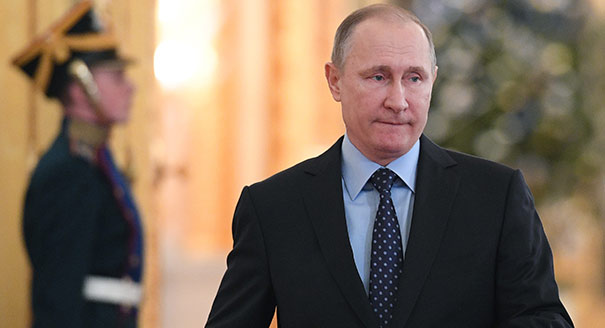
ANDREW WEISS, Carnegie Endowment for International Peace: Vladimir Putin is an opportunist, and he loves being the center of attention.
So here he has got the entire world talking about his incredible magnanimity in not returning the favor by expelling U.S. diplomats or responding to these sanctions. A couple of months ago, when Putin was talking about the hacking scandal, he basically said, a few years ago, no one talked about Russia. Now that’s all people want to talk about. They say bad things, but it’s good for us. It’s all very pleasant.
HARI SREENIVASAN: And do any of the sanctions create deterrents enough for Russia to stop doing what they have been doing?
ANDREW WEISS: Establishing deterrents for a country like Russia to deter it from conducting offensive cyber-operations against the United States is practically an impossible task.
What you can do is, you can expose, you can name and shame, you can hit a few key individuals or key institutions, like the Obama administration did yesterday, that might sort of expose what Russia is doing, provide public education, especially on the eve of important European elections.
That’s what governments are doing around the world, is they’re trying to say, we know what the Russians are up to. We can explain it to our publics. And hopefully it will not have the effect it had in the United States.
HARI SREENIVASAN: What is the invitations of the diplomats’ children to the Kremlin holiday party? What is that trying to fix?
ANDREW WEISS: I think it’s cheap theatrics at this point. It’s basically a stunt.
We have had a pattern of harassment of U.S. personnel in Moscow that goes back several years. People’s apartments are broken into. Diplomats are followed. Children are bothered.
This has been I think an extreme period, a very unusual period of Cold War-style pressure against our people stationed in Moscow.
HARI SREENIVASAN: So, really, even in this moment, he sees the long game.
ANDREW WEISS: Putin looks ahead and I think sees continued opportunities.
He has a new U.S. administration taking office obviously on January 20. President-elect Trump has been saying all sorts of flattering things, including as recent as this afternoon, about how brilliant Putin is, what an effective leader he is.
He has seen all sorts of Western leaders basically disappear from the scene, most obviously Barack Obama, who has been a nemesis for him. So if he looks ahead, he sees Russia’s got the upper hand in Syria, he’s transformed the battle on the ground inside Syria.
He sees a weak Ukraine. He sees Western Europe divided, a weakening E.U. He has got, I think, a sense of wind at his back and more confidence that the more audacity, the more surprise, the more the West is going to back off.
And a lot of the kind of aggressive Russian tactics we have seen are aimed at exactly that, be intimidating, be unpredictable, and your enemies will back off.
HARI SREENIVASAN: There was some dissension among the ranks.
Early in this morning, you started getting alerts on your phone that said Foreign Minister Lavrov wanted to go ahead and retaliate by kicking out U.S. diplomats, and then within minutes, Vladimir Putin has said, no, not going to do that.
ANDREW WEISS: I think the Russians have really got — you have got to hand it to them.
They have become masters at the art of surprise. Just, I guess, about 14 months ago, you had President Putin was coming to the U.N. General Assembly. He was going to be basically isolated, not get any meetings. They announced their dramatic military intervention in Syria.
And then Russia was as at the center of attention and there was a showdown between Obama and Putin in New York. This is part of that same script. It’s part of the playbook where if you force surprises on people, you invade Crimea, you start a covert war in Ukraine, suddenly the world has to respond to the facts that you’re creating.
HARI SREENIVASAN: What are the prospects for the relationship with the United States?
ANDREW WEISS: Well, we don’t know.
President-elect Trump has talked about how he’s going to reset the reset, he’s going to team up with Russia to “knock the hell out of ISIL.” Those are what explains that are sort of the core interests that might unite the United States and Russia.
I’m personally rather skeptical that he’s going to be able to have those kinds of quick wins. There have been many efforts over the past year or so between the Obama administration and the Russian government to find some ways to cooperate on the ground in Syria. We have serious definitional challenges, where there are groups that the United States has supported on the ground in Syria that the Russians want to basically paint with one big brush and say, oh, they’re all terrorists.
So, I think it’s going to be very hard, given the corrosive mistrust between the two governments. There’s basically no trust left between the national security establishment, the career people who will be serving under a President-elect Trump and their Russian counterparts. It is going to be very hard to build that trust out of the barren landscape that they’re inheriting.
HARI SREENIVASAN: What does that win in Syria or ISIL, what is the cost of that? Is it Crimea? Is it Ukraine?
ANDREW WEISS: We don’t know.
And so far the price that Russians have been talking about in their communications with the United States are exorbitant. They’re saying the United States should recognize the annexation of Crimea. They’re saying the United States should pay a penalty for the imposition of economic sanctions after the shoot-down of a civilian airliner over Eastern Ukraine in July 2014.
These are outlandish demands. And I think it would be unusual to expect that the Trump administration is somehow going to grant those wishes.
HARI SREENIVASAN: Are there concerns that the Trump administration doesn’t see the multiple dimensions of Vladimir Putin?
ANDREW WEISS: Well, I think we just don’t know.
We know that this is a president-elect who has very little foreign policy experience. He’s tapped a neophyte to be his secretary of state, Rex Tillerson. These are people who have records in the business community. They have got I think a lot of credentials in that area.
But for the issues that have been at the heart of U.S.-Russian relations over the past two-and-a-half decades and which have created so mention tension and so much built-up resentment and mistrust, it’s not something that they have really had to deal with.
HARI SREENIVASAN: You called Rex Tillerson a neophyte. He’s a neophyte to government, but not necessarily to foreign affairs. Technically, he might be the person with the most connections to Russia in the Trump administration.
ANDREW WEISS: There’s no doubt that Rex Tillerson’s access and accomplishments in Russia are dramatic.
He’s come from a period of working in Russia at the highest levels going back to the late 1990s. He knows Putin personally. He knows Putin’s top advisers personally.
That’s all obviously a real asset. The question is, does he know a lot about the IMF treaty, does he know a lot about the harassment of U.S. diplomatic personnel, does he follow Syria closely?
My sense is those are issues that he has not had to delve into in great detail.
HARI SREENIVASAN: Andrew Weiss from the Carnegie Endowment for International Peace, thanks for joining us.
ANDREW WEISS: Thank you.
James Family Chair, Vice President for Studies
Andrew S. Weiss is the James Family Chair and vice president for studies at the Carnegie Endowment for International Peace, where he oversees research on Russia, Ukraine, and Eurasia. His graphic novel biography of Vladimir Putin, Accidental Czar: the Life and Lies of Vladimir Putin, was published by First Second/Macmillan in 2022.
Recent Work

Dara Massicot, Aaron David Miller, Andrew S. Weiss

Frances Z. Brown, Nate Reynolds, Priyal Singh, …
Carnegie does not take institutional positions on public policy issues; the views represented herein are those of the author(s) and do not necessarily reflect the views of Carnegie, its staff, or its trustees.

With its public finances in shambles, the far right polling at 35 percent ahead of the 2027 presidential election, and a growing protest movement, is France’s crisis a threat to the EU’s geopolitical awakening?

Rym Momtaz, ed.

Ahead of a tough winter for Ukraine, Donald Trump’s swing back toward Russia bodes ill. But instead of panicking, Kyiv’s European allies are focusing on action.
Rym Momtaz

Funding Ukraine remains a priority for European leaders. As Russia’s war of aggression heads into another winter, two feasible options to mobilize support for Kyiv should be fast-tracked.


Vladyslav Rashkovan, Gregory P. Wilson

While the EU and European governments are embracing the much-lauded middle-power moment, this entails three difficult conundrums.

Richard Youngs

Europe is facing rising populism internally as well as external pressures from Russia, China, Turkey, and the United States.

Dimitar Bechev