Source: EU Observer
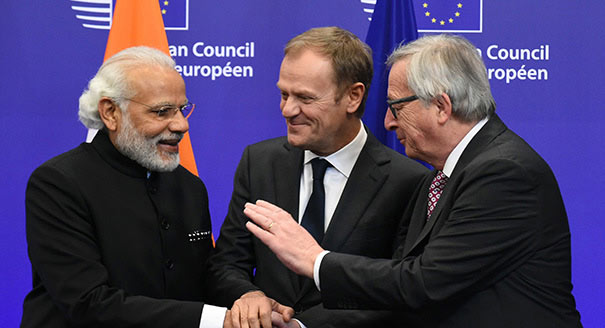
Despite common interests, shared objectives and similar initiatives, biased perceptions have persistently hindered dialogue and cooperation between India and the European Union in Afghanistan.
In New Delhi’s perspective, Brussels’ Common Foreign and Security Policy remains on paper and the EU’s efforts in Afghanistan are thus determined by the geostrategic interests of the United States and NATO.
Europeans, in turn, tend to dismiss every Indian initiative in Afghanistan as a ploy against Pakistan that risks transforming the country into a proxy battleground.
As President Donald Trump threatens to scale back American engagement globally, the EU and India will have to take on a more prominent role and cooperate to keep the United States involved and at the same time, rope in other stakeholders committed to supporting a democratic regime in Kabul.
In a joint research project between Carnegie India and the Global Public Policy Institute (Berlin), we found significant areas of EU-India convergence that could facilitate cooperation in Afghanistan.
Work with Afghanistan's neighbors
First, the EU and India should not shy away from a frank dialogue on how best to balance incentives and disincentives to ensure that Pakistan plays a constructive role.
Besides guaranteeing transit rights to ISAF, billions of US dollars and Euros in assistance have failed to force Islamabad to seal the Durand Line.
As Pakistan’s largest trade partner and a major source of development assistance, Brussels must use its economic leverage to compel Pakistani civilian and military authorities to cease all support for terrorist organisations, isolate the Taliban, and normalise relations with Kabul.
If the EU is serious about promoting regional cooperation in South Asia, it must also pressure Islamabad to stop impeding trade and transit between Afghanistan, India and the rest of South Asia.
Second, Brussels and Delhi will have to learn how to talk to each other about talking to the Taliban.
India has determinedly opposed any type of outreach to the insurgents but, below the radar, it has secretly built communication channels with several Pashtun factions to keep all options open.
The EU, on the other hand, played an active role through the Quadrilateral Coordination Group to promote a reconciliation process with the “good” Taliban, and been more optimistic about the chances for a negotiated settlement.
If Brussels and New Delhi develop a high-level and frank political dialogue on the potential and dangers of engaging the Afghan Taliban, it is likely that they will find a lot more common ground than expected.
Third, Brussels and New Delhi will have to step up their commitments to ensure that the Afghan state’s capacity is further strengthened.
The EU and India should pool efforts, for example through joint training for Afghan officials. By rotating through European and Indian institutions, Afghan civil service, military, police and intelligence officials would benefit from a comparative experience.
Brussels and New Delhi should also consider joining hands in their democracy assistance projects, supporting Afghanistan’s nascent parliamentary, electoral and civil society institutions, with special emphasis on the rule of law, minority rights, and media freedom.
Fourth, following the Iran deal and a timid rapprochement between Brussels and Moscow, there is now scope for greater EU-India convergence on the regional environment.
Iran, China, Russia
In order to avoid Afghanistan from turning into a turf for geopolitical rivalries, Brussels and Delhi must create conditions for greater dialogue and coordinated behaviour between the powers committed to supporting a stable, prosperous and democratic Afghanistan, including Russia, China, and Iran.
By hosting the Brussels Conference on Afghanistan and the Heart of Asia ministerial conference, late last year, the EU and India indicated their commitment to this multilateral approach.
Fifth, the EU and India have a shared interest in strengthening the Afghan economy by diversifying its external linkages.
While Kabul has expressed a desire to join the China-Pakistan Economic Corridor, its excessive reliance on Pakistani trade routes will render it even more susceptible to pressure from Islamabad.
Iran plays a key role in Afghan connectivity plans towards the West, via Turkey and Russia, and towards the South, to the Indian Ocean.
The success of alternative Eurasian connectivity plans to China’s One Belt One Road, for example the International North-South Transport Corridor, will hinge on the EU’s willingness to lift restrictions on Teheran and, on the other hand, on India’s capacity to invest in infrastructure like Iran’s Chabahar port as a hub to Afghanistan.
For EU-India coordination and cooperation to succeed on all these fronts, Brussels and Delhi must invest in a high-level bilateral dialogue on Afghanistan’s internal dynamics and its regional context, and also consider setting up a trilateral EU-India-Afghanistan consultative mechanism.
As the United States abandons the driving seat and ceases to micromanage Kabul, the EU and India will have to step up and take on a leading role in support of a stable, united, democratic and prosperous Afghanistan.
This article was originally published in the EU Observer.