

Article
C. Raja Mohan, Darshana M. Baruah
{
  "authors": [
    "C. Raja Mohan"
  ],
  "type": "legacyinthemedia",
  "centerAffiliationAll": "",
  "centers": [
    "Carnegie Endowment for International Peace",
    "Carnegie India"
  ],
  "collections": [],
  "englishNewsletterAll": "",
  "nonEnglishNewsletterAll": "",
  "primaryCenter": "Carnegie India",
  "programAffiliation": "",
  "programs": [],
  "projects": [],
  "regions": [
    "United States",
    "Asia",
    "South Asia",
    "India",
    "North America",
    "East Asia",
    "China"
  ],
  "topics": [
    "Foreign Policy"
  ]
}
Source: Getty
India must find a way to maximize gains and avoid any pitfalls that might emerge as a result of collusion or confrontation between the China and the United States.
Source: CGTN
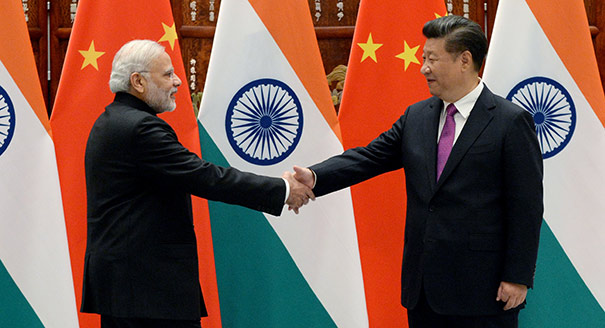
Speaking on CGTN, Carnegie India’s C. Raja Mohan emphasized the importance of achieving a cooperative relationship between India and China, as India rises on the global stage. Mohan spoke about the uncertainties accompanying the new Trump administration and the U.S. leader’s willingness to discard past administrations’ positions on key issues. He argued that India’s strategy, drawing from its desire to maintain good relationships with both the United States and China, is to maximize gains and avoid any pitfalls that might emerge as a result of collusion or confrontation between the two great powers. Despite concerns emerging as a result of Trump’s mantra of ‘Buy American, Hire American,’ Mohan pointed out that the success of the administration does depend on international cooperation.
On the flip side, managing the Sino-Indian relationship is complicated by the former’s ties with Pakistan, Mohan said. With territorial sovereignty being a sensitive issue for India, the ‘Belt and Road Initiative’ passing through the disputed territory of Pakistan-occupied-Kashmir makes it difficult for India to extend its support for the project, despite India agreeing with its core objective of developing infrastructure and connectivity. Mohan added that whether these projects are purely civilian, or have strategic and security implications, further complicates the situation. He said that what is needed are greater consultations and dialogue, to help India understand Chinese intentions. From a broader strategic perspective, he argued that the Pacific Ocean is large enough for India, China, and the United States to co-exist, but cautioned against the possible coming disruptions of power relations as a result of the fourth industrial revolution.
Former Nonresident Senior Fellow, Carnegie India
A leading analyst of India’s foreign policy, Mohan is also an expert on South Asian security, great-power relations in Asia, and arms control.
Recent Work

C. Raja Mohan, Darshana M. Baruah


Alexander Gabuev, Paul Haenle, C. Raja Mohan, …
Carnegie does not take institutional positions on public policy issues; the views represented herein are those of the author(s) and do not necessarily reflect the views of Carnegie, its staff, or its trustees.

The European Commissioner for Trade is headed to China. But after President Xi’s bridge-building visit to Washington, can a more isolated EU overcome Beijing’s stranglehold on critical raw materials? Who will blink first?

Rym Momtaz, ed.

European NATO countries are wrestling with the possibility of U.S. disengagement from the alliance. With the continent’s security increasingly uncertain, governments must restore the credibility of their collective defense.



Hans-Dieter Lucas, Adam Thomson, Pierre Vimont

The new U.S.–Denmark–Greenland agreement will help Washington exert political, economic, and financial dominance under the guise of security. Yet, it acknowledged Copenhagen’s and Nuuk’s sovereignty on the island.

Marc Pierini

A summer of escalation in the Black Sea has hurt Ukraine economically and is exacerbating world food security. A truce is needed—as is a broader reframing of Europe’s Ukraine strategy.

Thomas de Waal

Are Germany’s economic, industrial, and political struggles becoming a liability for the EU’s ability to rise to the geopolitical moment?
Rym Momtaz, ed.