

Paper
Constantino Xavier
{
  "authors": [
    "Constantino Xavier"
  ],
  "type": "other",
  "centerAffiliationAll": "dc",
  "centers": [
    "Carnegie Endowment for International Peace",
    "Carnegie India"
  ],
  "collections": [],
  "englishNewsletterAll": "ctw",
  "nonEnglishNewsletterAll": "",
  "primaryCenter": "Carnegie India",
  "programAffiliation": "SAP",
  "programs": [
    "South Asia"
  ],
  "projects": [],
  "regions": [
    "South Asia",
    "India"
  ],
  "topics": [
    "Foreign Policy",
    "Security"
  ]
}
Source: Getty
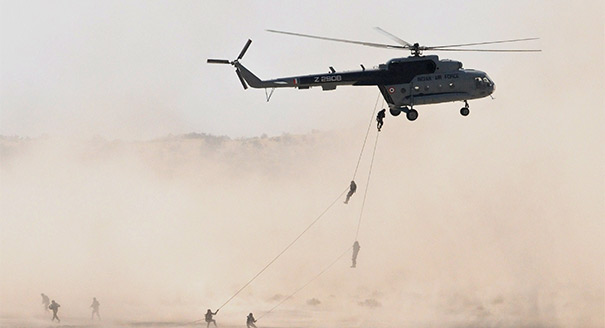
To ensure the safety of Indians abroad, the Indian armed forces will have to develop specific doctrines, procedures and capabilities to deploy expeditionary forces in coordination with civilian authorities.
Source: Force
Over the last few decades, the Indian government conducted dozens of emergency operations to protect and evacuate its distressed citizens abroad. When the lives and assets of overseas Indians are threatened due to war, natural calamities or discriminatory policies, New Delhi is expected to act swiftly and decisively.
As the Indian Diaspora grows in size, dispersion and complexity, and areas of major concentration like the Gulf region witness large-scale destabilisation, the government will have to expand its capacity and expertise to execute such missions. Most importantly, these missions cannot remain an almost exclusively civilian prerogative. While the ministry of external affairs (MEA) will continue to play a lead role, the Indian military must be roped in as a key stakeholder.
To ensure the safety of Indians abroad, the Indian armed forces will have to develop specific doctrines, procedures and capabilities to deploy expeditionary forces in coordination with civilian authorities. Especially in hostile and conflict environments, the Indian military will have to be prepared to use lethal power, including Special Forces, to protect and extricate emigrants....
Former Fellow, Carnegie India
Constantino Xavier was a fellow at Carnegie India, based in New Delhi. His research focus is on India’s foreign policy, with emphasis on relations with its neighboring countries and South Asian regional security.
Recent Work
Constantino Xavier
Constantino Xavier
Carnegie does not take institutional positions on public policy issues; the views represented herein are those of the author(s) and do not necessarily reflect the views of Carnegie, its staff, or its trustees.

Are Germany’s economic, industrial, and political struggles becoming a liability for the EU’s ability to rise to the geopolitical moment?

Rym Momtaz, ed.

European Commission President Ursula von der Leyen is about to give her annual address on the state of the EU. Here’s what she won’t—but should—say.
Rym Momtaz

The aftermath of the Ceuta crisis shows Europe has drawn the wrong lessons. Rather than doubling down on failed migration policies, the EU needs to address the underlying roots of such episodes.

Richard Youngs

Canadian Prime Minister Mark Carney has twice inspired praise for standing up to U.S. President Donald Trump: at the 2026 World Economic Forum in Davos and on Canada-U.S. trade negotiations. Is Carney showing a third way better than the EU has in dealing with the Trump administration?
Rym Momtaz, ed.

The EU’s responses to two recent incidents expose the gulf between European perceptions and capabilities. Unless the union can bridge that gap, it will never become a real geostrategic power.
Rym Momtaz